

Conversion Rate Optimisation (or CRO) is the ongoing process of turning more of your website visitors into customers. It’s not about finding more traffic; it’s about getting more value from the people already visiting your site by systematically improving their experience.
Understanding Conversion Rate Optimisation
Think of your website as a physical shop. You’ve invested time and money in marketing to get people through the door (that’s your website traffic), but far too many are browsing for a minute and then leaving without buying a thing. CRO is the art and science of rearranging your shop’s layout, clarifying your signage, and making the checkout process smoother to help more of those browsers become buyers.
It’s a data-driven approach that moves beyond guesswork. By digging into how users actually move through your site what they click on, where they get stuck, and what makes them leave you can spot clear opportunities to make things better.
What Is a Conversion?
A ‘conversion’ isn’t always a sale. It’s simply any valuable action you want a user to take on your website, and what that action is depends entirely on your business goals.
Key examples include:
- E-commerce Sale: The most obvious one, where a visitor completes a purchase and becomes a paying customer.
- Lead Generation: A user fills out a contact form, turning their visit into a tangible lead for your sales team.
- Newsletter Signup: A visitor subscribes to your email list, giving you a direct line for future marketing.
- File Download: Someone downloads a valuable resource like a white paper or a case study, signalling strong interest.
Essentially, any measurable step that moves a potential customer closer to doing business with you can be defined as a conversion.
CRO is a structured and systematic approach to improving the performance of your website. It is about understanding what motivates, stops, and persuades your users, so you can give them the best user experience possible.
This systematic process is all about forming a hypothesis, testing it, and learning from the results. For example, you might hypothesise that changing your “Buy Now” button from blue to a more urgent-looking green will encourage more clicks.
Through A/B testing, you can show the blue button to one group of visitors and the green one to another, then measure which version performs better. This continuous cycle of testing, learning, and refining is the real engine behind effective CRO.
Why CRO Is Your Business Growth Engine

It’s easy to think of conversion rate optimisation (CRO) as just a tool for boosting sales. But that’s selling it short. A dedicated CRO programme is the engine room of sustainable business growth, driving efficiency and profitability right across your entire operation.
The most immediate impact you’ll see is on your return on investment (ROI). Every pound you put into marketing from Google Ads to social campaigns goes further when your website is fine-tuned to convert. By improving your conversion rate, you’re effectively lowering your cost per acquisition and making every single marketing channel more profitable.
Maximising Your Existing Assets
Instead of constantly pouring money into finding more traffic, CRO flips the script. It’s all about getting more value from the visitors you already have. That shift in mindset is a game-changer for long-term success. You’re not just spending more to grow; you’re growing smarter by making your existing assets work harder for you.
CRO is the art of turning insights into action. The data you gather doesn’t just improve your website; it provides a direct line to understanding your customer’s needs, frustrations, and motivations.
This entire process builds a stronger, more resilient business. For instance, a better user experience a direct result of good CRO builds brand trust. When a customer has a seamless journey from landing page to checkout, they’re far more likely to come back. Better yet, they’ll become loyal advocates who recommend you to others.
Fuelling Smarter Business Decisions
The gold you dig up during CRO testing has benefits that reach far beyond your website. When you understand why one headline beats another, or why customers bail on a specific form, you’re unlocking insights that can shape your entire business strategy.
These learnings can directly influence:
- Product Development: Discovering which features your users actually value can guide future product updates and spark new ideas.
- Marketing Messaging: Testing different value propositions reveals what truly clicks with your audience, sharpening your ad copy and campaign themes.
- Customer Service: Pinpointing friction points on your site helps you get ahead of common customer frustrations before they even happen.
Ultimately, committing to conversion rate optimisation gives you a serious competitive edge. It ensures your business is constantly evolving based on real customer behaviour, not just guesswork.
The Step-by-Step CRO Action Plan
Successful conversion rate optimisation isn’t about guesswork or randomly tweaking your website. It’s a disciplined, repeatable process. When you follow a structured action plan, every adjustment is backed by evidence, not just a gut feeling, leading to much more reliable and impactful improvements. This framework is all about moving from confusion to clarity.
At its heart, any solid CRO plan follows a simple but powerful five-step loop: gather your data, form a hypothesis, prioritise what to test, run the experiment, and then analyse the results to start the cycle all over again.
Step 1: Gather and Analyse Data
Before you can even think about fixing a problem, you have to understand it inside and out. The first job is to collect both quantitative (the ‘what’) and qualitative (the ‘why’) data. This dual-pronged approach gives you the complete picture of how people are actually behaving on your site.
- Quantitative Data: This is the hard data, the numbers you pull from tools like Google Analytics. You’re looking for the red flags pages with lots of traffic but surprisingly high exit rates, or specific points in your sales funnel where a huge chunk of users just disappear.
- Qualitative Data: This is where you get the human insight. Tools like heatmaps show you exactly where users are clicking (or not clicking), while session recordings let you watch real user journeys, stumbles and all. Surveys and customer feedback give you direct commentary on what’s working and what’s causing frustration.
This infographic shows a simplified measurement funnel, helping you visualise how visitors move towards becoming customers.
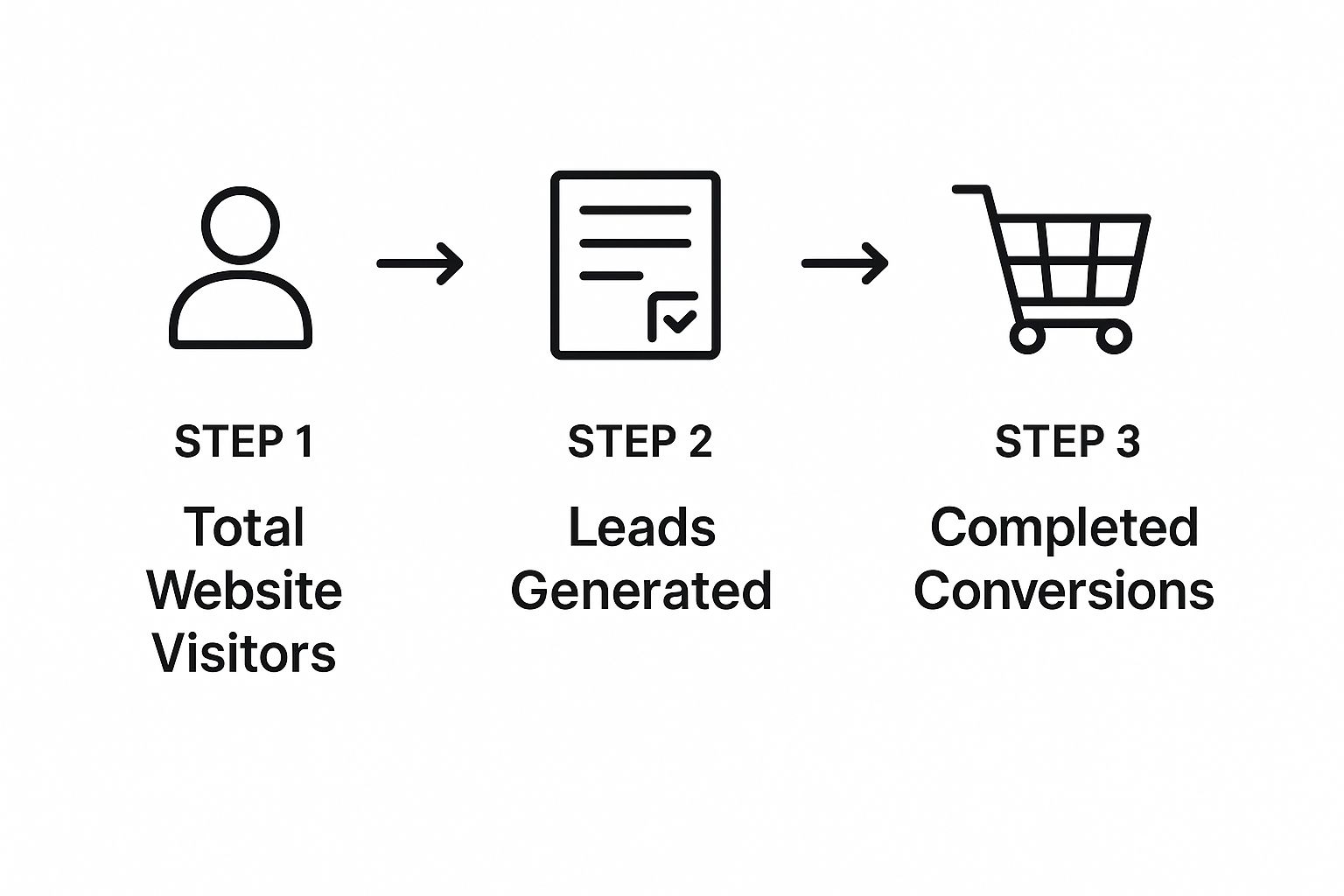
By tracking these stages, you can pinpoint exactly where the biggest drop-offs are happening. That tells you precisely where to focus your optimisation efforts first.
Step 2: Form a Strong Hypothesis
With solid data in hand, you can finally move away from “I think we should change this…” to “I believe changing X will result in Y because of Z.” A strong hypothesis is a testable statement that clearly lays out the proposed change, the expected outcome, and the reasoning behind it.
For example, a weak hypothesis sounds like this: “Making the button bigger will get more clicks.”
A strong, data-driven hypothesis is much more specific: “By changing the CTA button colour on our checkout page from grey to bright orange, we will increase completed sales by 15% because user feedback indicated the current button is not visible enough.” See the difference?
Step 3: Prioritise Your Tests
You’ll likely end up with dozens of great ideas. But trying to test everything at once is a surefire recipe for chaos and muddled results. Prioritisation is absolutely key. A simple and incredibly effective model for this is the PIE framework, which scores each test idea based on three criteria:
- Potential: How much improvement can this change realistically deliver?
- Importance: How valuable is the traffic to this specific page? (A checkout page, for example, is far more important than a blog post).
- Ease: How simple will this be to implement, both technically and logistically?
The PIE framework forces you to focus your limited resources on the tests that promise the biggest return for the least effort, ensuring you get meaningful results faster. For more practical ideas, check out these helpful https://gfctech.co.uk/conversion-rate-optimization-tips/.
Step 4: Run the Experiment
This is where you bring your hypothesis to life. The most common method by far is A/B testing. Here, you create two versions of a page a control ‘A’ and a variation ‘B’ and show them to different segments of your audience to see which one performs better against your goal.
For more complex changes that involve multiple elements on a single page, you might use multivariate testing. The crucial part is to let the test run long enough to achieve statistical significance. This ensures your results are reliable and not just a random fluke.
Step 5: Analyse and Learn
Once the test is complete, it’s time to dig into the results. Did your variation win, lose, or make no difference at all? More importantly, why? A crucial part of any CRO action plan is implementing strategies to recover abandoned carts, which can turn what looks like a lost conversion into a successful sale.
A winning test confirms your hypothesis, and you can confidently roll out the change. But a losing test is just as valuable it provides a vital learning opportunity, telling you what not to do and saving you from making a permanent, damaging change. Every result, win or lose, fuels the next, smarter round of optimisation.
How to Measure What Truly Matters in CRO

Without the right data, conversion rate optimisation is just a guessing game. To make any meaningful improvements, you need to track the metrics that reveal the true health of your business. It’s all about moving beyond that surface-level conversion rate and digging into the numbers that tell a much more complete story.
While the primary conversion rate is a vital starting point, a truly effective CRO strategy looks at a wider set of Key Performance Indicators (KPIs). These metrics provide crucial context, helping you understand not just if people are converting, but how valuable those conversions are to your bottom line.
Effective CRO isn’t just about getting more clicks; it’s about getting the right clicks from the right people, leading to sustainable growth. Measuring a variety of KPIs ensures your optimisations are driving genuine business value, not just vanity metrics.
Key Metrics Beyond Conversion Rate
To get a complete picture of your performance, you need to build a dashboard of essential metrics. Each one offers a unique window into your customer’s journey and your business’s profitability.
- Average Order Value (AOV): This tells you the average amount customers spend per transaction. Increasing your AOV is a powerful way to boost revenue without needing more traffic. It’s about getting more value from the customers you already have.
- Customer Lifetime Value (CLV): This metric forecasts the total revenue you can expect from a single customer account over their entire relationship with you. Optimising for CLV encourages loyalty and repeat business, which is far more cost-effective than constantly acquiring new customers.
- Bounce Rate: This is the percentage of visitors who land on a page and leave without taking any action. A high bounce rate often signals a disconnect between your marketing message and the landing page experience. It’s a clear red flag that something isn’t resonating.
Understanding how these numbers work together is fundamental. You can learn more about connecting your efforts to financial outcomes in our guide on how to measure marketing ROI.
The primary metrics in CRO each tell a part of the story. Here’s a quick breakdown of the essentials and why they are so vital for understanding your performance.
Essential CRO Metrics and Their Importance
| Metric | What It Measures | Why It’s Important |
|---|---|---|
| Conversion Rate | The percentage of visitors who complete a desired action (e.g., purchase, sign-up). | The most direct indicator of how well your page persuades visitors to act. |
| Bounce Rate | The percentage of visitors who leave after viewing only one page. | High rates can signal poor landing page relevance, bad design, or slow load times. |
| Average Order Value (AOV) | The average amount spent each time a customer places an order. | Shows the value of each conversion; increasing AOV directly boosts revenue. |
| Customer Lifetime Value (CLV) | The total revenue a business can expect from a single customer account. | Highlights the long-term value of your customers and informs retention strategies. |
| Cost Per Conversion | The total cost of generating traffic divided by the total number of conversions. | Measures the efficiency of your marketing spend and helps calculate your return on investment. |
| Exit Rate | The percentage of visitors who leave your site from a specific page. | Pinpoints weak links in your conversion funnel where users are dropping off. |
By keeping an eye on these numbers, you move from simply guessing what works to making informed, data-driven decisions that genuinely improve your bottom line.
Building Your Essential CRO Toolbox
To gather this data, you need the right tools. A powerful tech stack doesn’t have to be complicated; it just needs to cover three core areas of insight to give you the full picture.
- Analytics Platforms: Tools like Google Analytics are the foundation. They track where your traffic comes from, which pages are most popular, and where users drop off, giving you the quantitative “what.”
- User Behaviour Tools: Platforms like Hotjar provide the qualitative “why.” With features like heatmaps and session recordings, you can watch how real users interact with your site, seeing exactly where they click, where they scroll, and where they get stuck.
- A/B Testing Platforms: Tools like Google Optimize allow you to run controlled experiments. By testing variations of a page against each other, you can make data-backed decisions on which changes actually improve performance, removing all the guesswork.
Tailoring Your Strategy for Different Visitors
Let’s be honest: not all website visitors are the same. Someone clicking a targeted Google Ad for “emergency plumber in Surrey” has a completely different mindset to a person casually scrolling through their Instagram feed. Smart conversion rate optimisation is all about spotting these differences and tailoring the user journey to match where they came from and what device they’re on.
Imagine that person frantically searching for a plumber. They click your ad, expecting a direct solution. But instead of a page that screams “We can fix your leak NOW,” they land on your generic homepage. It’s a jarring disconnect, and you’ve almost certainly lost that customer. The secret is creating a seamless journey by aligning your landing page experience with the traffic source.
Aligning Experience with Intent
The path from that first click to a conversion should feel like a single, continuous conversation. This means the promise you make in your ad or social media post needs to be instantly fulfilled on the landing page. If your ad copy shouts about a “50% off summer sale,” that exact phrase should be front and centre on the page they land on.
This principle, known as “message match,” builds immediate trust and reassures visitors they’re in the right place. To get it right, you need to think about where your visitors are coming from:
- Paid Traffic: Make sure the headlines, images, and calls-to-action on your landing pages directly mirror the ad copy the user clicked. No surprises.
- Social Media Traffic: Visitors from platforms like Instagram or Facebook are often less focused. You need to grab their attention fast with visually striking content and a clear, compelling value proposition.
- Organic Search Traffic: These visitors arrived by typing a question or a problem into a search engine. Your page content should directly answer that query, showing them you have the solution they were looking for.
By personalising the journey, you slash friction and guide each type of visitor more effectively towards converting. You can dive deeper into this by checking out our guide on how to create landing pages that really deliver.
The Mobile-First Imperative
These days, optimising for mobile isn’t just a good idea; it’s essential. People on their phones are often on the go, easily distracted, and have zero patience for a clunky website. A desktop site that just shrinks to fit a smaller screen will actively kill your conversions.
A truly mobile-friendly experience considers the user’s context. Forms need to be stripped back for thumb-typing, with fewer fields and bigger buttons. And page speed is absolutely critical; slow-loading pages are the number one reason mobile users give up and leave.
A mobile user’s attention is a precious and fleeting resource. Every extra second they have to wait, and every difficult button they have to tap, is another opportunity for them to give up and go elsewhere.
Traffic source data from the UK market shows just how vital these targeted strategies are. Direct traffic converts at the highest average rate of 3.3%, followed closely by paid search at 3.2%. In stark contrast, social media traffic converts at a mere 1.5%. This tells us that people arriving from different channels have vastly different levels of buying intent. A smart move is to tailor your approach to prioritise those high-intent channels first. You can read more about these UK conversion rate statistics and what they mean for businesses.
Frequently Asked Questions About CRO
1. What is a good conversion rate?
There’s no magic number. A “good” rate varies massively depending on your industry, traffic source, and what you’re trying to achieve. A typical e-commerce site might aim for 2-3%, but the real goal is always continuous improvement against your own baseline.
2. How do CRO and SEO work together?
They’re two sides of the same coin. SEO gets people to your door, and CRO convinces them to come inside and take action. Good CRO improves user experience signals like time on page and bounce rate, which in turn can give your SEO rankings a healthy boost.
3. Can I do CRO on a small budget?
Absolutely. You can start with free tools like Google Analytics to find your weakest pages. You can also gather priceless feedback by sending out a customer survey or simply talking to your clients. This qualitative data is often more powerful than complex analytics.
4. How long until I see results from CRO?
While some quick wins can pop up in a few weeks, the real impact comes from a long-term commitment. CRO isn’t a one-off project; it’s about building a culture of continuous testing and improvement. Lasting success comes from iterative gains over time.
5. What is the most common CRO mistake?
One of the biggest blunders is testing without a clear, data-informed hypothesis. Making changes based on a gut feeling or copying a competitor instead of solid user research often leads to wasted time and results that don’t tell you anything useful.
Ready to turn more of your website visitors into valuable customers? The team at GFC Tech specialises in creating data-driven CRO strategies that deliver real results for small businesses in Surrey and beyond. Find out how we can help you grow your business.
Adam is a Founder of GFC Tech, a company dealing in SEO and website design and development services. Adam has been an SEO expert for the past 8 years and has been working with different companies in this field. He is an SEO consultant and a marketing strategist and works closely with his clients to ensure that his marketing plans and strategies provide them with the marketing advantages they need to grow their business. Adam’s main role is an SEO consultant, but he is also involved in all technical aspects. Adam also develops WordPress websites, designs them professionally and performs SEO for them so they can rank on the first page of google.


