

At its heart, measuring marketing ROI is about calculating the net profit from your campaigns and dividing it by your total marketing costs. The simple formula, (Sales Growth – Marketing Cost) / Marketing Cost, boils down complex data into a single, powerful performance figure. It tells you exactly how much revenue you’re getting back for every pound you spend.
Why Accurate ROI Measurement Matters More Than Ever

For UK businesses, proving the value of marketing is a constant pressure. It goes far beyond a simple formula; it’s about justifying budgets, winning over stakeholders, and making smart decisions in a crowded market. Without a clear view of your return on investment (ROI), you’re effectively marketing in the dark.
Understanding your ROI transforms vague metrics into a compelling story about your marketing’s real-world impact. It equips you to answer the tough questions:
- Which channels are actually driving the most revenue?
- Where should we put next quarter’s budget for the biggest impact?
- Are our campaigns truly contributing to the bottom line?
This framework turns your complex data into a clear narrative of success, showing precisely which efforts are fuelling growth and which are draining resources.
Setting Realistic Benchmarks
Knowing what to aim for is crucial. A widely accepted benchmark in digital marketing is an ROI of around 5:1, meaning for every £1 spent, companies aim to generate £5 in revenue. However, this varies massively by channel. For instance, email marketing in the UK has reported an extraordinary average ROI of 36:1.
It’s worth noting that organisations that regularly track their ROI are 1.6 times more likely to see their marketing budgets increase. This highlights a simple truth: when you can prove value, you get more investment.
Typical Marketing Channel ROI Benchmarks in the UK
To help set realistic expectations, here’s a quick overview of the average Return on Investment for some popular marketing channels in the UK.
| Marketing Channel | Average ROI (Return per £1 Spent) |
|---|---|
| Email Marketing | £36 |
| SEO | £22 |
| Content Marketing | £15 |
| PPC (Google Ads) | £2 |
| Social Media Marketing | £3 |
Source: Data compiled from various industry reports (DMA, HubSpot, etc.). Figures are averages and can vary significantly.
These benchmarks show that not all channels are created equal when it comes to direct returns. A balanced strategy often relies on a mix of high-ROI channels like email and SEO, supported by others that build brand awareness.
Understanding the broader scope of how to measure marketing effectiveness can give you a more complete picture of your campaigns’ impact. This knowledge is especially vital when you need to generate leads online and prove the worth of every click and conversion.
Ultimately, measuring marketing ROI is the bridge between your activities and tangible business results. It’s the definitive way to prove your marketing isn’t just a cost centre—it’s a powerful engine for growth.
Building the Foundation for Flawless ROI Tracking

Before you can even think about calculating your return on investment, you need to get the groundwork right. This starts with ditching vague goals like ‘boost brand awareness’ and setting crystal-clear, measurable objectives tied directly to your business’s bottom line.
To build this solid foundation for ROI tracking, it’s vital to get to grips with the key digital marketing performance metrics that actually move the needle. It means defining what success looks like in concrete terms. For example, instead of just aiming for more website traffic, a S.M.A.R.T. goal would be to “increase qualified leads from organic search by 15% in Q3.” That kind of specificity makes measurement straightforward.
Accounting for Every Single Cost
I’ve seen it time and again: a common mistake that completely skews ROI calculations is overlooking hidden expenses. Your total investment is always more than just what you spend on ads. To get a true picture, you must meticulously track every cost that goes into a campaign.
This includes things like:
- Direct Ad Spend: The cash you pay directly to platforms like Google or Meta.
- Software and Tools: The monthly subscriptions for your email marketing platform, analytics software, or social media scheduling tools.
- Agency or Freelancer Fees: Any retainers or project fees paid to external partners who help you out.
- Team Hours: The cost of your internal team’s time spent planning, creating, and managing the campaign.
Capturing all these costs is non-negotiable. A simple spreadsheet can work perfectly for logging these expenses, ensuring that your final ROI figure is built on clean, trustworthy data.
This comprehensive approach is crucial for any marketing you do. Strategists often advise allocating roughly 50-60% of your budget to brand awareness activities, with the rest focused on direct performance marketing. Understanding the full cost of both is essential, as brand-building has long-term value that is crucial for sustained growth.
For those just starting out, getting these fundamentals right is the most important step. Our guide on digital marketing for beginners offers more foundational tips to get you started on the right path. Without this careful prep work, any ROI calculation you make will be flawed from the very beginning.
Connecting Your Data Across Every Channel
With your goals defined and costs logged, it’s time to connect the dots between your marketing activities and actual sales. This phase is all about attribution the art and science of correctly linking a conversion, like a sale or lead, back to the specific marketing touchpoint that drove it.
Getting this right is what separates guesswork from a genuinely data-driven strategy. It’s the difference between knowing you made a sale and knowing exactly which Facebook ad or email campaign delivered it.
A great place to start is by mastering UTM parameters. These are simple tags you add to your URLs that tell tools like Google Analytics precisely where your traffic is coming from. Think of it like a digital breadcrumb trail. You can create unique links for a specific social media post, a newsletter, and a guest blog, letting you see which channels bring in your most valuable customers.
This infographic breaks down the core workflow for bringing all your data together to calculate ROI.
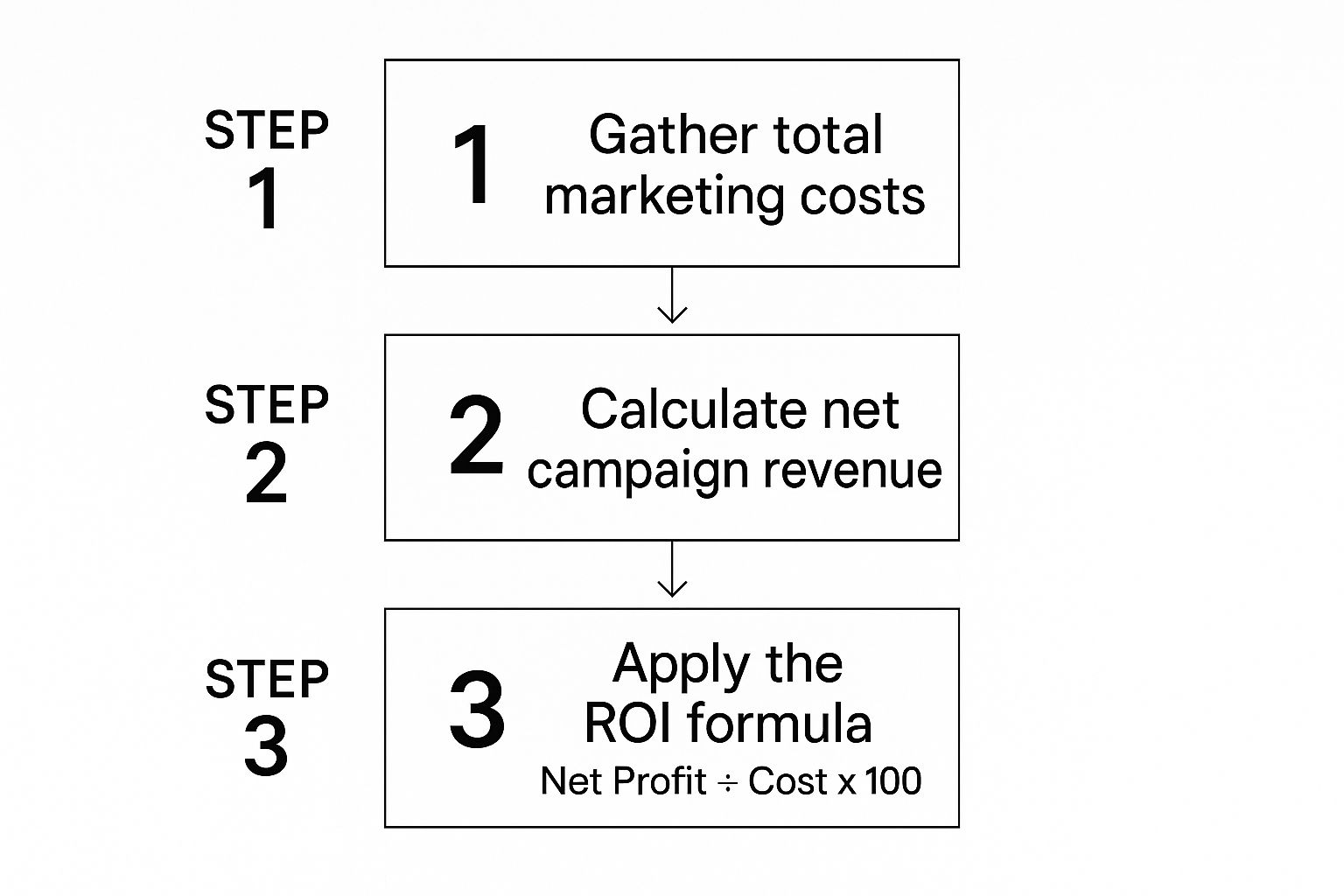
As you can see, gathering your total costs and revenue flows directly into that final, all-important ROI calculation.
Choosing the Right Attribution Model
Not all attribution models tell the same story, and your choice can drastically change how you perceive your ROI. For instance, giving all the credit to the final click before a sale might make your bottom-of-funnel ads look heroic, while completely ignoring the blog post that first introduced the customer to your brand.
Integrating your CRM with Google Analytics 4 is a powerful move here. It helps you track a customer from their first click all the way to their final purchase and beyond, giving you a glimpse into their true Customer Lifetime Value (CLV).
Here are the most common models you’ll encounter:
- First-Touch: This model gives 100% of the credit to the very first interaction a customer had with your brand. It’s useful for understanding which channels are best at generating initial awareness.
- Last-Touch: The polar opposite. This gives all credit to the final touchpoint before a conversion. It’s simple, but it can overvalue channels that close sales while ignoring those that build initial interest.
- Multi-Touch: These models distribute credit across multiple touchpoints in the customer journey. A linear model gives equal credit to each step, while a data-driven model (available in GA4) uses machine learning to assign credit based on actual contribution.
For most small businesses, starting with a last-touch model is practical and easy to implement. However, as you grow, moving to a multi-touch model will provide a far more accurate and holistic view of how all your marketing efforts work together to drive revenue.
From Calculation to Actionable Insight
With your data connected and ready to go, it’s time to bring it all together. Thankfully, the basic formula for marketing ROI is refreshingly simple: (Sales Growth – Marketing Cost) / Marketing Cost. This calculation turns your inputs into a clear, no-nonsense performance figure.
Let’s imagine a UK e-commerce brand spends £2,000 on a social media campaign. That campaign then generates £8,000 in sales that can be directly attributed to it.
The calculation would look like this: (£8,000 – £2,000) / £2,000 = 3. This translates to a 3:1 ROI, or a 300% return. In plain English, for every £1 spent, the brand made £3 in revenue.
Understanding the Story Behind the Number
However, that number itself is just the starting point. The real value comes from interpreting it. So, is a 3:1 return a clear win? It depends entirely on what the campaign was designed to achieve.
For a direct-response ad aiming for immediate sales, 3:1 might be a bit low. But for a top-of-funnel brand awareness push, it could be a fantastic result that pays dividends down the line.
A single ROI figure doesn’t tell the whole story. You must view it through the lens of your campaign objectives, profit margins, and industry benchmarks to truly understand its strategic meaning.
Knowing how to measure marketing ROI is one thing; acting on that insight is what separates good marketers from great ones. A low or negative ROI isn’t a failure it’s a signal to investigate and optimise. A high ROI is a green light to double down on what’s working. This cycle of calculation, interpretation, and action is the very core of effective marketing.
Solving the Social Media ROI Puzzle

Measuring social media ROI can feel like trying to catch smoke. You post, you engage, you get likes and new followers… but how do you assign a pound value to any of it? The key is to stop chasing vanity metrics and start connecting your social media activity to tangible business outcomes.
It’s about tracking direct sales from social commerce features on platforms like Instagram and Facebook. But it also means assigning value to the softer metrics by linking them to long-term brand equity. For instance, a consistently high engagement rate on your content often correlates with stronger brand recall and, ultimately, future sales.
To truly solve this puzzle, you need to understand and track the right social media performance metrics. This is what helps you finally see which actions are genuinely impacting your bottom line.
Turning Influence into Income
In the UK, the influence of social media on purchasing decisions is massive. Take influencer marketing it’s a powerhouse, with around 49% of UK consumers making monthly purchases based on influencer recommendations. At the same time, short-form video continues to deliver knockout results, with 71% of UK video marketers saying it delivers the highest ROI of any content format.
A successful social media strategy doesn’t just build a following; it builds a customer base. The challenge is to prove it with clear, credible data drawn from both native platform analytics and third-party tools.
This approach requires a shift in mindset. You need to see your social channels not just as platforms for engagement, but as integral parts of your sales funnel. By connecting your social media efforts with your overall SEO strategy, you create a powerful combination for growth. You can explore more on this in our guide to social media and SEO for maximizing online presence. This integrated view is how you finally put the pieces together and solve the social media ROI puzzle.
Frequently Asked Questions About Measuring Marketing ROI
Even with the best framework in place, some practical questions always arise when digging into marketing ROI. Here are answers to five common queries we hear from UK businesses.
1. What is a good marketing ROI in the UK?
A common benchmark is a 5:1 ratio (£5 revenue for every £1 spent), but this isn’t a universal rule. A ‘good’ ROI depends heavily on your industry, profit margins, and specific campaign goals. A high-margin business might be thrilled with 3:1, while a low-margin one might need 10:1 to be profitable.
2. How do I measure ROI for SEO and content marketing?
These long-term strategies require a different lens. You can’t just look at last month’s spend. Instead, you need to track growth in organic traffic to key “money” pages and leads generated from organic search over several quarters. It’s about correlating leading indicators (like rankings and traffic) with revenue over time.
3. Why is Customer Lifetime Value (CLV) important for ROI?
CLV reveals the total revenue a customer is likely to generate over their entire relationship with your brand. A campaign might have a low initial ROI but attract highly loyal customers. Factoring in CLV can show that the campaign’s true value is much higher than it first appeared.
4. Which attribution model should I use?
There’s no single ‘best’ model for everyone. For a balanced view, most businesses benefit from a ‘Multi-Touch’ model (like the Linear or Data-Driven models in Google Analytics 4) that gives credit to multiple touchpoints along the customer journey.
5. What should I do if my ROI is negative?
Don’t panic! A negative ROI is a signal to investigate, not a reason to scrap everything. First, audit your data to ensure its accuracy. Then, dissect the campaign. Is the audience targeting off? Is the creative weak or the messaging unclear? Use it as a valuable chance to diagnose, test, and optimise.
At GFC Tech, we specialise in creating data-driven marketing strategies that deliver measurable results for small businesses across Surrey. If you want to stop guessing and start seeing a clear return on your investment, let’s talk. Get in touch Now
Adam is a Founder of GFC Tech, a company dealing in SEO and website design and development services. Adam has been an SEO expert for the past 8 years and has been working with different companies in this field. He is an SEO consultant and a marketing strategist and works closely with his clients to ensure that his marketing plans and strategies provide them with the marketing advantages they need to grow their business. Adam’s main role is an SEO consultant, but he is also involved in all technical aspects. Adam also develops WordPress websites, designs them professionally and performs SEO for them so they can rank on the first page of google.


