

At its core, keyword research is simply the process of discovering the exact words and phrases your potential customers are typing into search engines to find you. It’s the essential practice that turns SEO from guesswork into a predictable strategy for growth.
What Is Keyword Research
Imagine trying to navigate a new city without a map. You might wander around for hours, hoping you’ll eventually stumble across that landmark you’re looking for. That’s pretty much what digital marketing feels like without a solid grasp of keyword research.
It’s the art and science of identifying the search terms real people enter into search engines like Google when they’re looking for something. By uncovering these terms, you can build your website and create your content around the precise language your audience uses. This isn’t just about getting more traffic; it’s about attracting the right traffic people who are actively searching for the solutions, products, or information you offer.
The Foundation of Your Digital Strategy
When you get down to it, keyword research helps you answer a few fundamental questions about your audience:
- What are they searching for? This helps you understand their real-world needs and pain points.
- How many people are searching for it? This gives you a sense of the potential audience size.
- What kind of information do they want? This ensures your content format be it a blog post, video, or product page matches their expectations.
Keyword research bridges the gap between how you describe your business and how your customers actually look for it. Getting this right is the first real step towards building meaningful, long-term online visibility.
Why It Still Matters for UK Businesses
There’s a common misconception that keyword research has become obsolete with the rise of smarter search algorithms. In reality, it’s more important than ever. For UK businesses in 2025, especially startups and SMEs, keyword research remains the bedrock of any successful SEO strategy.
Modern search engines prioritise context, user intent, and relevance. By digging into the terms your audience uses, you can tailor your content to meet those exact needs, capturing highly targeted traffic. You can learn more about the enduring relevance of SEO strategy from this detailed analysis. This guide will walk you through exactly how to do that, helping you connect with your customers by finally speaking their language.
Understanding Core Keyword Concepts

To get keyword research right, you first need to get your head around its fundamental building blocks. Think of these core concepts less as jargon and more as your compass, guiding you toward the search terms that will bring the right audience knocking. Get these right, and you’ll make smarter SEO decisions from day one.
First up is search volume. This is simply the average number of times a specific keyword gets searched each month. It’s a direct measure of demand. A high-volume keyword has a huge potential audience, while a low-volume one points to a smaller, often more specialised, group.
Next, we have keyword difficulty. This is a score, usually from 0-100, that estimates how tough it will be to rank on the first page of Google for that term. In short, it’s a measure of competition. A low score is great news for a new or small website, suggesting you have a fighting chance. A high score means you’re up against the big, established players.
Decoding The Why Behind The Search
Perhaps the most important concept of all is search intent the why behind a person’s search. Grasping this helps you create content that actually solves their problem instead of just ranking for a term.
We can break down search intent into four main types. Here is a simple breakdown of what each one means for you and your content.
Keyword Types and User Intent
| Keyword Type | Description | UK Example | Primary User Intent |
|---|---|---|---|
| Informational | The user is looking for an answer or wants to learn something. | “how to brew pour-over coffee” | To Find Information |
| Navigational | The user wants to find a specific website or physical location. | “GFC Tech blog” | To Go Somewhere |
| Commercial | The user is comparing products or services before buying. | “best espresso machines under £500” | To Investigate |
| Transactional | The user is ready to make a purchase right now. | “buy single-origin coffee beans online UK” | To Buy Something |
Matching your content to the user’s intent is non-negotiable for success. If someone is ready to buy, a long, rambling blog post will just get in their way. Likewise, if they’re looking for information, a hard sales page will send them packing.
Head Terms vs Long-Tail Keywords
Finally, it’s crucial to understand the difference between broad “head terms” and highly specific “long-tail keywords”.
A head term is short and general, like ‘coffee’. It gets a massive amount of searches, but the competition is fierce, and the user’s intent is anyone’s guess. Are they looking for a café? Beans? The history of coffee? Who knows.
In contrast, a long-tail keyword is a longer, more detailed phrase, like ‘organic fairtrade coffee beans for French press’. These phrases have lower search volume, but the intent is crystal clear. Someone typing that into Google knows exactly what they want, making them a red-hot prospect.
By focusing on long-tail keywords, small businesses can sidestep the fiercest competition and connect directly with people who are much closer to making a purchase. It’s about choosing precision over sheer volume.
For an even deeper dive into these concepts, check out our complete guide to https://gfctech.co.uk/keyword-research-in-seo/.
And this isn’t just about Google. These ideas extend to social media, too. Keywords can be specific topics or even popular tags, like finding the right Instagram hashtags to get your content seen by the right audience.
A Step By Step Keyword Research Process
Knowing the theory is one thing, but turning it into a repeatable system is what drives real results. An effective keyword research process isn’t a one-off task; it’s a structured framework that helps you consistently uncover opportunities. This step-by-step approach breaks a seemingly huge job into clear, manageable stages.
It starts with your core business topics and progressively drills down into the specific phrases your ideal customers are using every day. By following a logical flow, you can build a powerful keyword strategy from scratch, ensuring every piece of content you create has a purpose.
Start With Broad Seed Keywords
Every great keyword strategy starts with brainstorming. Your first step is to identify your seed keywords. These are the broad, foundational topics that define your business or niche. Forget about search volume or difficulty for a moment; just think about the core services or products you offer.
For a Surrey-based web design agency like ours, seed keywords might include:
- “web design Surrey”
- “local SEO services”
- “WordPress maintenance”
- “small business website”
These terms act as the launchpad for uncovering hundreds of more specific variations. To really get the ideas flowing, you’ll want to master brainstorming and mind mapping techniques.
Expand Your List With Keyword Tools
Once you have a handful of seed keywords, it’s time to expand your list. This is where keyword research tools become invaluable. By plugging your seed terms into a tool, you can generate a vast list of related long-tail keywords, questions, and other relevant phrases that you might never have thought of on your own.
This simple action transforms your initial list of five or ten ideas into a database of hundreds, or even thousands, of potential opportunities. Right now, it’s all about gathering as much raw data as possible before you start refining it.
The infographic below shows the fundamental flow: identify your core terms, expand on them, and then evaluate the results.
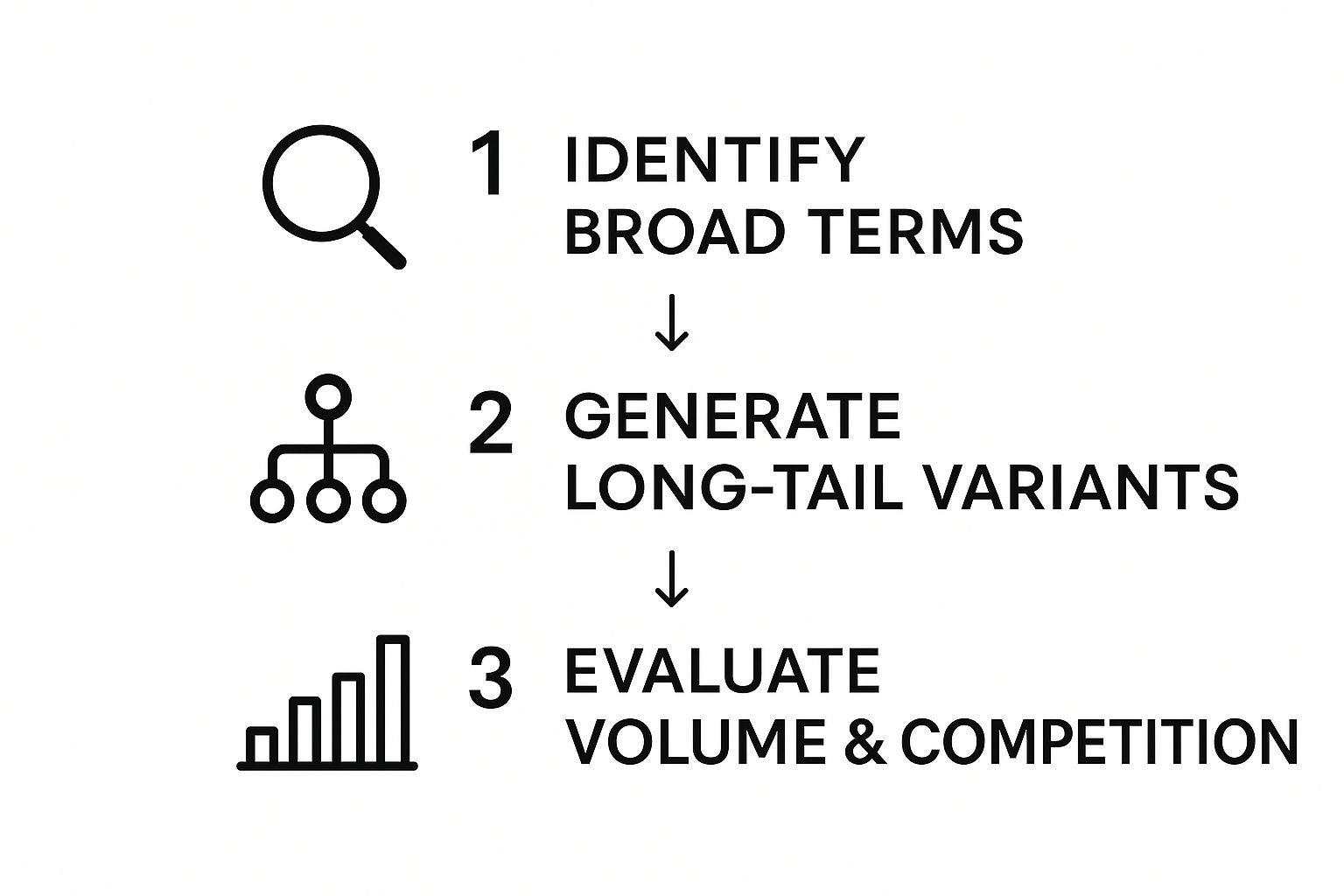
As you can see, good keyword research is really a filtering process, moving from broad ideas to specific, actionable targets.
Analyse And Prioritise Your Keywords
With a huge list of potential keywords, the next step is analysis. Not all keywords are created equal, and your goal is to find the “sweet spot” terms with a healthy balance of search volume, manageable competition, and strong relevance to your business.
Filter your list using these key metrics:
- Search Volume: How many people are searching for this term each month?
- Keyword Difficulty: How hard will it be to rank on the first page?
- Relevance: Does this keyword line up with a product or service you offer?
- Search Intent: What is the user really looking for? (e.g., information, a product to buy).
The goal isn’t just to find popular keywords; it’s to find the right keywords for your business. A keyword with 100 monthly searches from people ready to buy is often far more valuable than a keyword with 10,000 searches from casual browsers.
This prioritisation ensures you focus your efforts where they will have the biggest impact on your goals, whether that’s generating leads, making sales, or building brand awareness. A systematic approach like this turns a daunting list into a clear action plan.
Putting Your Keyword Research Into Action

A well-researched list of keywords is much more than just a spreadsheet of data; it’s the strategic blueprint for your entire digital presence. The real value kicks in when you translate those findings into tangible actions that attract your ideal customers. This is the point where all that hard work starts to deliver measurable results.
The most direct application is sharpening up your on-page SEO. By weaving your target keywords naturally into your website’s pages think page titles, headings, meta descriptions, and body text you send clear signals to search engines about what your content is about.
And that really matters. After all, around 42% of UK consumers turn to search engines when looking for products or services. Crucially, 39% of purchasers say a relevant search directly influenced their buying decision. You can explore these trends and more in these UK buyer behaviour statistics on artios.io.
From Keywords To Content
Your research is the perfect foundation for a powerful content calendar. Instead of guessing what to write about, you now have a list of the exact questions your audience wants answered and the problems they need solved. This lets you create blog posts, guides, and articles that directly meet their needs.
Let’s take a plumber in Bristol as a practical example. Their keyword research might uncover two very different but equally valuable terms:
- ‘Emergency plumber Bristol’: This is a high-intent, transactional keyword. It’s perfect for a service page because the user needs help now and is ready to hire someone.
- ‘How to fix a leaky tap’: This is a classic informational keyword. It’s an excellent topic for a blog post, helping the plumber build trust and demonstrate their expertise to potential future customers.
This approach ensures every piece of content you create has a clear purpose. You’re not just creating content for the sake of it; you’re strategically answering your audience’s queries at every stage of their journey. For a deeper look into this process, check out our guide on how to write SEO content that ranks.
Fuelling Your Paid Campaigns
Keyword research isn’t just for organic search; it’s also essential for Pay-Per-Click (PPC) advertising, like Google Ads. By targeting specific, high-intent keywords, you can make sure your ads are shown to people who are actively looking to make a purchase.
This allows you to structure effective campaigns that maximise your return on investment. You can allocate more budget to the keywords that drive conversions and less to those that are purely informational, making every pound of your ad spend far more efficient.
Choosing The Right Keyword Research Tools
Picking the right tool for your keyword research can feel a bit like a locksmith choosing a key; the right one opens the door to valuable insights without any fuss. What works best for you will come down to your budget, your business goals, and how much experience you already have with SEO.
The good news? You don’t need a huge budget to get started. There are plenty of powerful free options that provide an excellent foundation for any small business. Google’s own offerings, like Google Keyword Planner and Google Trends, are perfect for initial discovery. They give you solid search volume estimates and show you how popular topics are over time.
As your needs grow, you can dip your toes into “freemium” tools. Platforms like Ubersuggest give you a free taste of their more advanced features, with the option to upgrade when you’re ready for deeper data and longer keyword lists. This makes them a great middle-ground for businesses that want to take their SEO more seriously but aren’t quite ready to commit to a big monthly expense.
Premium Industry Standard Platforms
For businesses ready to invest in a complete SEO toolkit, premium platforms like Semrush and Ahrefs are the industry standard. These are the all-in-one powerhouses, offering a treasure trove of data from precise keyword difficulty scores to deep competitor analysis and backlink tracking.
While they come with a subscription fee, the investment often pays for itself many times over for businesses that rely on organic search for leads and sales. These tools are particularly brilliant for uncovering valuable long-tail keywords those highly specific phrases that often signal a user is very close to making a purchase. You can explore a complete long-tail keyword strategy in our detailed guide.
The sheer richness of data from premium tools from search volume to competition levels helps UK marketers allocate their resources wisely, fine-tune their SEO strategies, and ultimately improve their organic search performance.
This data-driven approach is essential. For example, long-tail keywords, which are searches with four or more words, have become increasingly important because of their specificity and the strong user intent behind them. Tools like Semrush are widely used in the UK to capture these vital insights, allowing businesses to connect with customers at just the right moment.
As you explore more modern solutions, you’ll find that integrating artificial intelligence can seriously boost efficiency, a topic covered well in this resource on AI keyword research for books to boost sales.
Which Tool Is Right For You?
To help you decide, here’s a simple comparison of what to expect:
| Tool Type | Best For | UK Price Example | Key Feature |
|---|---|---|---|
| Free | Start-ups, bloggers, and initial research. | £0 | Basic volume & trend data. |
| Freemium | Small businesses scaling their SEO efforts. | ~£20-£40/mo | More keyword ideas & basic competitor insights. |
| Premium | Agencies and established businesses. | £100+/mo | Full competitor analysis & technical SEO audits. |
Ultimately, the right tool depends entirely on where you are on your business journey. Start with the free options to build your confidence and understanding. As your needs expand, you can graduate to the more powerful platforms that will grow right alongside you.
Frequently Asked Questions About Keyword Research

As you start putting keyword research into practice, a few questions almost always come up. It’s completely normal. Getting clear, practical answers to these common queries is the key to building confidence and turning theory into an SEO strategy that actually drives business growth.
This section tackles five of the most frequently asked questions we hear. We’ll cut through the jargon and give you direct answers to help you sidestep common hurdles and make smarter decisions from the get-go.
1. How often should I do keyword research?
Think of keyword research less as a one-off task and more as an ongoing process. You should perform a deep-dive analysis when launching a new website or service. After that, it’s best to revisit and refresh your keywords at least quarterly. Markets change, new competitors emerge, and search trends evolve, so regular check-ins keep your SEO strategy relevant and effective.
2. Can I do keyword research for free?
Yes, absolutely! While premium tools offer advanced data, you can build a strong foundation using free resources. A great starting toolkit includes:
- Google Keyword Planner for search volume estimates.
- Google Trends to understand topic popularity and seasonality.
- AnswerThePublic to discover question-based keywords your audience is using.
Combining these provides more than enough insight to begin without any cost.
3. What is the difference between SEO and PPC keywords?
While the keywords themselves might be the same, the strategy is different. For SEO, you target keywords to create high-quality content that earns organic (free) traffic over the long term. For PPC (Pay-Per-Click), you bid on keywords to place ads for immediate visibility. PPC campaigns typically focus on high-intent, commercial keywords that are likely to drive immediate conversions and a direct return on ad spend.
4. What is a good keyword difficulty score?
A “good” score is relative to your website’s authority. Keyword Difficulty (KD), a metric from tools like Ahrefs or Semrush, estimates how hard it is to rank on page one.
- For a new website, targeting keywords with a KD under 20 is a smart strategy.
- An established website with strong authority can realistically target keywords in the 40-60 range.
The goal is to find a balance between search volume and your genuine ability to compete.
5. Should I only target keywords with high search volume?
No, and this is a common mistake. High-volume keywords are usually very broad and extremely competitive. The real value for many businesses lies in long-tail keywords. These are longer, more specific phrases (e.g., “eco-friendly running shoes for women UK”). While they have lower search volume, the user’s intent is much clearer and they often convert at a much higher rate.
At GFC Tech, we transform complex keyword data into a clear roadmap for your business growth. If you need a trusted partner to build an SEO strategy that gets results, get in touch with us today.
Adam is a Founder of GFC Tech, a company dealing in SEO and website design and development services. Adam has been an SEO expert for the past 8 years and has been working with different companies in this field. He is an SEO consultant and a marketing strategist and works closely with his clients to ensure that his marketing plans and strategies provide them with the marketing advantages they need to grow their business. Adam’s main role is an SEO consultant, but he is also involved in all technical aspects. Adam also develops WordPress websites, designs them professionally and performs SEO for them so they can rank on the first page of google.


