

Local SEO services are all about making sure your business shows up when people nearby are searching for what you do. It’s the art and science of connecting your real-world shop, café, or service with the customers right on your doorstep who are pulling out their phones to find you. This isn’t just about getting seen online; it’s about turning those searches into actual footfall and sales.
Why Local SEO Is Your Biggest Opportunity
Picture this: your ideal customer is just around the corner, phone in hand, searching for exactly what you offer. That’s not a hopeful guess; it’s happening constantly all over the UK. This is where local SEO shines, acting as a digital signpost that points high-intent customers those ready to buy right now directly to your door.
Think of the internet like a massive, sprawling high street. Without a solid local SEO strategy, your business is like a hidden gem tucked away down a quiet alley nobody knows about. Good local SEO, on the other hand, puts you right on the main drag, with bright lights and a welcoming storefront that’s impossible to miss.
Winning the Neighbourhood Battle
For small businesses, trying to out-muscle national chains with massive marketing budgets can feel like a lost cause. But local SEO completely levels the playing field. When someone searches for “cafés near me” or “plumber in Surrey,” Google’s priority isn’t to show the biggest brand; it’s to show the most relevant, nearby result. This gives you a home-turf advantage.
This hyper-local focus is a huge opportunity. A well-optimised local presence lets you intercept customers at the very moment they need you. And the numbers don’t lie: a staggering 75% of “near me” searches result in someone visiting a physical store within 24 hours. That’s an immediate, tangible impact. To dig deeper into how this drives real growth, you can explore the benefits of local SEO for small UK businesses.
The Core Pillars of Local Success
To really make the most of this, you need to understand the fundamental building blocks of local search visibility. It’s not just one thing, but a few key components working together.
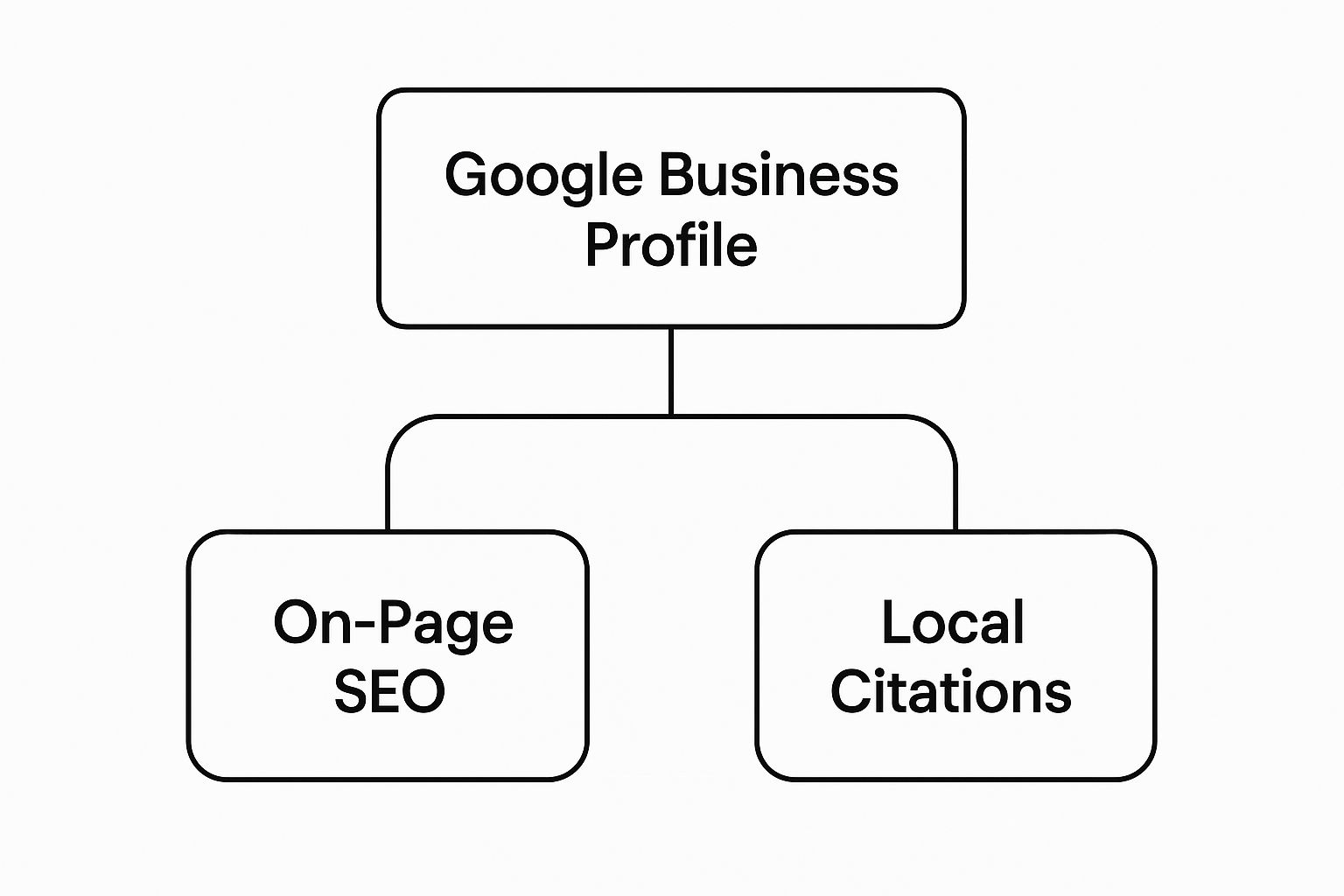
This table breaks down the essential components that work together to boost your visibility and attract local customers.
| Component | Primary Goal | Key Benefit for Small Businesses |
|---|---|---|
| Google Business Profile | To dominate the map pack and provide key information at a glance. | Increases direct calls, direction requests, and builds immediate trust. |
| Local Citations | To build consistent and authoritative mentions across the web. | Reinforces to Google that your business is legitimate and located where you say it is. |
| On-Page SEO | To optimise your website content for local search terms. | Helps you rank for “service in location” queries and attracts qualified traffic. |
| Local Link Building | To earn links from other local businesses and organisations. | Signals to search engines that you are a trusted, active part of the community. |
By mastering these pillars, your business doesn’t just show up; it stands out as the best and most trustworthy choice in the area. These efforts are most powerful when integrated into a comprehensive digital marketing content strategy that speaks directly to your local audience, turning searchers into loyal customers.
Your Digital Storefront on Google Business Profile
If local SEO were a high street, your Google Business Profile (GBP) would be your main shop window. It’s often the very first interaction a potential customer has with your brand, appearing right at the top of Google Maps and local search results. Getting this right isn’t just an option; it’s the cornerstone of any effective local SEO service for small businesses.
Think of your GBP as far more than a simple online listing. It’s a dynamic hub where customers can find your opening hours, get directions, call you with a single tap, and see what others think of your service. For many people searching on the go, it provides everything they need without them ever having to click through to your website.
This powerful tool has become a fundamental pillar of local SEO for UK small businesses. It acts as a digital storefront that often shows up even before a company’s own website. Making sure your business name, address, and phone number (NAP) are perfectly consistent everywhere online is vital; even tiny discrepancies can confuse Google and erode customer trust. UK businesses that actively manage their GBP using real photos, choosing precise categories, posting updates, and responding to every review build higher trust and earn better visibility.
Nailing the Fundamentals of Your Profile
The foundation of a strong GBP is accuracy and completeness. Imagine you’re filling out the essential details that a customer standing right outside your physical shop would need to know.
- Perfect Your NAP (Name, Address, Phone Number): This is the holy trinity of local SEO. Your details must be 100% identical across your GBP, your website, and any other online directory. A “Ltd” here and a “Limited” there can be enough to create confusion for search engines.
- Choose the Right Categories: Be specific. Instead of just “Restaurant,” choose “Italian Restaurant” or “Vegan Restaurant.” You can select one primary category and several secondary ones to accurately describe every part of your business.
- Add Real, High-Quality Photos: Show, don’t just tell. Upload clear photos of your premises (inside and out), your team at work, and your products. Authentic images build trust far more effectively than generic stock photos ever could.
A complete and accurate Google Business Profile is one of the most powerful, low-cost marketing tools a small business can possess. It directly influences your visibility in the local map pack, where the majority of high-intent customers make their decisions.
Engaging Customers and Building Trust
Creating your profile is just the beginning. The real value comes from ongoing management, which signals to Google that your business is active, relevant, and engaged with its community.
You need to actively use features like Google Posts to share offers, news, and events. It’s also a great idea to build out a helpful Q&A section by pre-emptively answering common questions, showing you really understand what your customers need. For a more detailed guide, you can check out our article on how to optimise your Google Business Profile for maximum impact.
Your Google Business Profile FAQs
1. How do I get more positive reviews on my GBP?
The best way is to ask happy customers directly. You can create a direct link to your review page and include it in email signatures, on receipts, or via a simple follow-up message after a purchase or service.
2. What are Google Posts and why should I use them?
Think of Google Posts as mini-adverts or social media updates that appear directly on your GBP. They are perfect for promoting special offers, new products, or company news and are a strong signal to Google that your business is active.
3. Does it matter if I use a mobile number instead of a landline?
For local SEO, a local landline number can be a stronger signal of a fixed, physical presence in an area. However, consistency is what matters most. Use the number that customers can reliably reach you on and make sure it’s the same everywhere online.
4. What should I do about a negative review?
Always respond professionally and promptly. Acknowledge the customer’s issue, apologise if necessary, and offer to resolve the problem offline. How you handle criticism is a powerful public display of your customer service quality.
5. How often should I update my photos?
Aim to add new photos every few months to keep your profile looking fresh and current. This is especially important if your business is seasonal or you regularly introduce new products or services.
Building Digital Trust with Local Citations
Once your Google Business Profile is polished and ready, the next job is to build trust across the wider web. This is where local citations come in. Think of them as digital breadcrumbs you scatter online, with each one confirming your business exists and leading search engines back to your door.
Every time your business gets mentioned online with its core details Name, Address, and Phone number (NAP) it acts like a vote of confidence. These mentions tell Google that your business is legitimate, active, and located exactly where you say it is. A strong, consistent trail of these citations is a cornerstone of any effective local SEO services for small businesses.
Why Consistency Is Your Superpower
Imagine telling one friend a new restaurant is on “High Street,” while another hears it’s on “High St.” That tiny difference is enough to cause confusion. Search engines feel the same way when they find conflicting details about your business online.
The absolute golden rule of citations is NAP consistency. Your Name, Address, and Phone number must be identical everywhere you list them. Even small variations can weaken your authority and make it harder for Google to trust your information, which will directly impact your local search rankings. For a deeper look, our guide on what SEO citations are and why they matter breaks it down even further.
A clean, consistent citation profile sends a powerful signal of trust and authority to search engines. It removes all doubt about your business’s identity and location, giving you a distinct advantage over local competitors with messy digital footprints.
Where to Build Your Citations
Not all citations are created equal. Your focus should be on building a profile across a mix of high-authority, relevant platforms. The goal here is quality over sheer quantity.
1. Foundational UK Directories:
These are the big, trusted names that Google already pays close attention to. Getting a listing on these sites is a non-negotiable first step.
- Yell: The modern version of the Yellow Pages is a powerhouse for UK local business data.
- Thomson Local: Another long-standing and trusted UK directory.
- 192.com: A key directory for verifying people and business information in the UK.
- The Independent: Major news outlets often have their own business directories that carry significant weight.
2. Niche and Industry-Specific Sites:
These are directories or websites focused on your specific trade or industry. A listing here is highly relevant and tells Google you are a specialist.
- A Reigate-based restaurant should be listed on TripAdvisor or Zomato.
- A tradesperson in Guildford should aim for a profile on Checkatrade or TrustATrader.
- A wedding photographer should be listed on sites like Hitched or Bridebook.
Building these digital breadcrumbs methodically is what helps you climb the local search rankings. It’s a patient process that proves your legitimacy one listing at a time, ultimately helping you outrank the local competition.
Your Questions on Local Citations Answered
Here are answers to some of the most common questions we get about building and managing local citations.
1. What if I find incorrect information about my business online?
You’ll need to claim the listing on that specific site and correct the information manually. This can be a bit of a grind, but it’s absolutely essential for maintaining NAP consistency.
2. How many citations do I need?
Focus on getting listed on the top 20-30 foundational and key niche directories first. After that, quality becomes far more important than quantity.
3. Do I have to pay for listings?
Many major directories offer free basic listings. While they might try to upsell you on paid features, the free listing is usually all you need to secure the core citation value.
4. What’s the difference between a structured and unstructured citation?
A structured citation is a formal listing in a directory. An unstructured citation is a more casual online mention of your business, for example, in a local news article or a blog post about an event you sponsored.
5. How long does it take for new citations to affect my ranking?
It can take several weeks or even a few months for search engines to find, index, and give weight to your new citations. Patience and consistency are key here.
Optimising Your Website for Local Customers
Your Google Business Profile and local citations are powerful signposts, but they all need to point somewhere. That ‘somewhere’ is your website, the final destination where searchers become customers. Think of it this way: if your GBP and citations are the directions, your website is the front door. If the door is locked or the address is wrong, all that great signposting goes to waste.
This is where on-page SEO comes in. It’s the art of fine-tuning your website’s content and structure to speak directly to both search engines and local customers. It’s how you prove your relevance for searches like “emergency plumber in Manchester” or “best artisan bakery in Bristol.” Nailing this is a cornerstone of any effective local SEO services for small businesses, ensuring your digital storefront is every bit as welcoming as your physical one.
Creating Location-Specific Pages
If you serve a particular city or town, creating dedicated pages for that location is one of the smartest moves you can make. A generic “Services” page is fine, but a page titled “Bespoke Garden Design in Surrey” is vastly more powerful. It leaves no doubt in Google’s or a potential customer’s mind about what you do and where you do it.
These pages need to be more than just a name-drop; they should be steeped in local flavour. Add testimonials from local clients, mention recognisable neighbourhood landmarks, or show off projects you’ve completed in the area. This isn’t just good for SEO; it builds instant trust and shows you’re a real part of the community.
Key On-Page Elements for Local Success
Beyond dedicated pages, a few other on-page tweaks are critical for signalling your local relevance. Getting these right reinforces the information in your GBP and citations, creating a consistent and trustworthy presence that both Google and customers appreciate.
- Embed an Interactive Google Map: Placing an interactive map on your contact page or in your site’s footer is a crystal-clear visual signal of your location. It helps customers find you and proves to search engines that your address is the real deal.
- Display Your NAP Prominently: Your Name, Address, and Phone Number (NAP) should be clearly visible, ideally in the footer of every single page. This ensures it’s instantly accessible and, crucially, that it perfectly matches the NAP on your GBP and other local listings.
- Use Local Keywords Naturally: Weave location-based keywords into your page titles, headings, and body copy. A big part of on-page SEO is figuring out what your local customers are actually searching for. You can find some effective keyword research tips to uncover the best terms for your business.
By echoing your local signals consistently across your website, you create a seamless user experience and a powerful, unified message for search engines. This alignment is what transforms website visitors into paying customers.
To help you get started, here’s a simple checklist to run through. Use it to audit your own site and spot quick wins that can boost your local performance.
On-Page Local SEO Checklist
| Element | Action Item | Why It Matters for Local SEO |
|---|---|---|
| Page Titles & Headers | Include your target service and city/town in page titles and H1 tags (e.g., “Boiler Repair in Ewell”). | Tells search engines and users the exact topic and location relevance of the page immediately. |
| NAP Consistency | Display your Name, Address, and Phone number in the website footer and on the contact page. Ensure it matches your GBP exactly. | Inconsistent NAP information confuses search engines and erodes trust, hurting your local rankings. |
| Embedded Google Map | Embed an interactive Google Map on your contact page or footer, linked to your GBP listing. | Provides a strong, visual location signal to Google and makes it easy for customers to get directions. |
| Localised Content | Create unique content for each location page, mentioning local landmarks, case studies, or community involvement. | Shows genuine connection to the area, builds trust with local visitors, and avoids duplicate content issues. |
| Local Schema Markup | Implement ‘LocalBusiness’ schema to clearly define your NAP, hours, and services in a machine-readable format. | Helps Google understand your business details correctly, which can lead to enhanced search results (rich snippets). |
| Image Optimisation | Name image files with local keywords (e.g., cafe-in-guildford.jpg) and add location-specific alt text. |
Adds another layer of local signals for search engines to crawl and reinforces your geographic relevance. |
| Mobile-Friendliness | Ensure your website is fully responsive and easy to navigate on a smartphone. | The majority of “near me” searches happen on mobile. A poor mobile experience will cost you customers. |
Running through this checklist is a great first step. Each small fix adds up, creating a much stronger signal to Google about where you are and what you do.
The Power of Local Content
Your website shouldn’t be a static brochure. A blog that’s updated regularly is an incredible tool for local SEO. By writing about topics that matter to your community, you can demonstrate your local expertise and involvement.
Think about publishing content like:
- Community Event Sponsorships: Writing a post about a local fair or charity event you’re involved with.
- Local Client Case Studies: Showcasing a successful project you completed for a well-known local business.
- Guides to Your Area: A café could write about “The Best Dog-Friendly Walks in Guildford,” subtly positioning themselves as a local authority.
This type of content doesn’t just attract local search traffic. It builds a connection that bigger, faceless competitors simply can’t replicate.
Local On-Page SEO FAQs
1. Should I create a separate page for every town I serve?
If you have a physical office or a significant customer base in multiple towns, then absolutely. For each location, create a unique page with truly localised content to maximise your visibility in that specific area.
2. What is schema markup and do I need it for local SEO?
Schema markup is a snippet of code you add to your website to help search engines understand your content better. Using ‘LocalBusiness’ schema is a game-changer; it explicitly defines your NAP, opening hours, and other key details for Google, which can seriously improve how you show up in search results.
3. How important is mobile-friendliness for local on-page SEO?
It is absolutely critical. The vast majority of “near me” searches happen on mobile devices. If your site is a pain to navigate on a phone, you will lose customers. It’s that simple.
4. Where is the best place to put my NAP on my website?
The footer is the industry standard and most effective spot, as it appears on every page. You should also have it clearly displayed on your ‘Contact Us’ page, right alongside your embedded map.
5. How can I localise my website’s images?
When you upload images, give them descriptive filenames (e.g., “gfc-tech-office-in-ewell.jpg”) and write alt text that includes your location and service (e.g., “GFC Tech’s web design team in Ewell, Surrey”). This adds yet another layer of local signals for search engines to find.
How Local SEO Outsmarts Bigger Competitors
It’s a common worry for any small business owner: how can my local shop possibly stand a chance against national chains with their colossal marketing budgets? The answer, thankfully, isn’t about outspending them. It’s about outsmarting them with local SEO.
When it comes to local searches, Google plays by a different set of rules. It prioritises relevance and proximity over sheer brand size, creating a massive opportunity for smaller players to win in their own back yard. This is where all the groundwork we’ve discussed Google Business Profile optimisation, clean citations, and targeted on-page SEO really comes together. These tactics don’t just work in isolation; they create a powerful, sustainable advantage that bigger, more generic competitors often completely overlook.
Local SEO is the great equaliser. It allows a small, agile business to outmanoeuvre a corporate giant by proving it is the most relevant and trusted choice for customers in the immediate area.
A Story of Local Success
Let’s imagine a small, independent bookshop in a competitive UK city like York. It’s surrounded by national chain bookstores with huge brand recognition and deep pockets. By using local SEO services for small businesses, the owner builds a strategy focused on what makes their shop special.
- They meticulously optimise their Google Business Profile, highlighting unique selling points like “rare and second-hand books” and using Posts to announce local author signings.
- They ensure their Name, Address, and Phone Number (NAP) are perfectly consistent across trusted UK directories like Yell and niche literary websites.
- Their website features blog posts like “A History of York’s Literary Scene” and “The Best Reading Nooks in Local York Cafés.”
Before long, when someone searches for “independent bookshop York” or “rare book specialist near me,” the small shop appears right at the top of the results. The national chain, with its generic corporate website, is nowhere to be seen for these specific queries. This targeted approach drives real foot traffic from passionate local readers, levelling the playing field one search at a time.
The Merit-Based Advantage
SEO, and local SEO in particular, is an absolute game-changer for small businesses in dense UK markets. Unlike paid advertising, which often feels like a simple case of whoever has the deepest pockets wins, SEO rewards relevance, authority, and user experience. It lets small enterprises rank based on merit.
With over 53% of all website traffic coming from organic search, a smart investment in keyword-rich content and local strategies lets small UK businesses capture searcher intent tied to specific locations, often outpacing their larger competitors. You can find out more about why London small businesses need SEO to thrive.
Frequently Asked Questions
1. How can I find local keywords my big competitors are ignoring?
Think hyper-local. Use terms that combine your service with specific neighbourhoods, postcodes, or local landmarks (e.g., “emergency plumber near Kingston Bridge”). Big brands rarely have the local knowledge or incentive to drill down to this level.
2. Can local SEO really beat a huge advertising budget?
For local intent searches, yes. A big budget can buy the top ad spots, but local SEO services for small businesses help you earn organic visibility, which many users trust far more than paid ads. You’re winning on relevance, not just ad spend.
3. Do local links from other small businesses actually help?
Absolutely. A link from a neighbouring café, a local community blog, or a nearby supplier is a powerful signal to Google that you are a genuine, trusted part of the local community. These are gold.
4. How does my business’s physical location affect my ranking?
Proximity is one of the biggest ranking factors in local search. Your physical address is crucial for “near me” searches, giving you a natural advantage over competitors located further away, regardless of their size.
5. Is it better to be a specialist or a generalist to compete locally?
Specialising can be a massive advantage. If a large chain is a general hardware store, optimising your smaller shop as “the best place for bespoke joinery supplies in Reigate” helps you own a valuable niche and attract the most qualified customers.
Your Questions on Local SEO Answered
Getting your head around digital marketing can feel like a mammoth task, but local SEO is one of the most powerful moves you can make for your business. Here, we tackle the most common and practical questions we hear from small business owners looking to get more customers through the door.
1. What’s the difference between local SEO and regular SEO?
Think of it as focus. Regular (or national) SEO aims to make a website visible to anyone in a country, regardless of their location (e.g., “buy running shoes online”). Local SEO is laser-focused on attracting customers in a specific geographic area. It relies heavily on signals like your Google Business Profile, local directory listings, and your physical address to appear in “near me” or “in [city]” searches.
2. How long does it take to see results from local SEO?
Local SEO is a marathon, not a sprint. While quick wins like optimising your Google Business Profile can show results in a few weeks (e.g., more calls), ranking for competitive local keywords typically takes 3-6 months of consistent effort. This includes building citations, getting reviews, and creating local content. The key is consistent, long-term investment.
3. Do I need a physical shopfront to do local SEO?
Not necessarily. Service-area businesses (SABs), like plumbers, electricians, or consultants who travel to their customers, are perfect candidates for local SEO. You can set up your Google Business Profile to show a service area instead of a physical address. The goal is the same: to show up when local customers search for your services.
4. How important are customer reviews for my local ranking?
They are critically important. Reviews are a powerful ranking factor because they provide social proof. A steady stream of recent, positive reviews signals to Google that your business is active, trusted, and provides a quality service. Responding to all reviews good and bad is also crucial as it shows you are engaged with your customers.
5. Can I do local SEO myself or should I hire an agency?
You can absolutely get started yourself. Claiming and fully optimising your Google Business Profile is the most important first step any business owner can take. However, for competitive markets, hiring an agency that provides local SEO services for small businesses can be a smart move. They have the time, tools, and expertise for more complex tasks like technical on-page SEO, citation building, and local link-building campaigns to get you results faster.
At GFC Tech, we live and breathe the unique challenges facing small businesses in Surrey and the South East. Our team specialises in ethical, effective local SEO strategies that drive real, measurable results. If you’re ready to turn local searches into loyal customers, explore our digital marketing services and let’s build your local presence together.
Adam is a Founder of GFC Tech, a company dealing in SEO and website design and development services. Adam has been an SEO expert for the past 8 years and has been working with different companies in this field. He is an SEO consultant and a marketing strategist and works closely with his clients to ensure that his marketing plans and strategies provide them with the marketing advantages they need to grow their business. Adam’s main role is an SEO consultant, but he is also involved in all technical aspects. Adam also develops WordPress websites, designs them professionally and performs SEO for them so they can rank on the first page of google.


