

At its heart, writing for SEO is all about planning, creating, and fine-tuning content so that it ranks well in search engines like Google. It’s a careful mix of deep keyword research, getting inside the head of your user to understand their intent, and then crafting genuinely valuable articles that answer their questions completely. This is the shift from just publishing content to creating assets that pull in steady, organic traffic.
Building a Winning Content Blueprint
Long before a single word is written, the most successful pieces of content are already set up to win. The groundwork you lay understanding who you’re writing for, seeing what the competition is doing, and structuring your ideas is what separates a top-ranking article from one that vanishes on page ten of Google. This strategic planning is the absolute core of learning how to write effective SEO content.
This prep work ensures every article has a clear purpose and is built to solve a specific user’s problem. It’s about being intentional, not just prolific.
The visual below breaks down the core content creation workflow into three simple, essential stages.
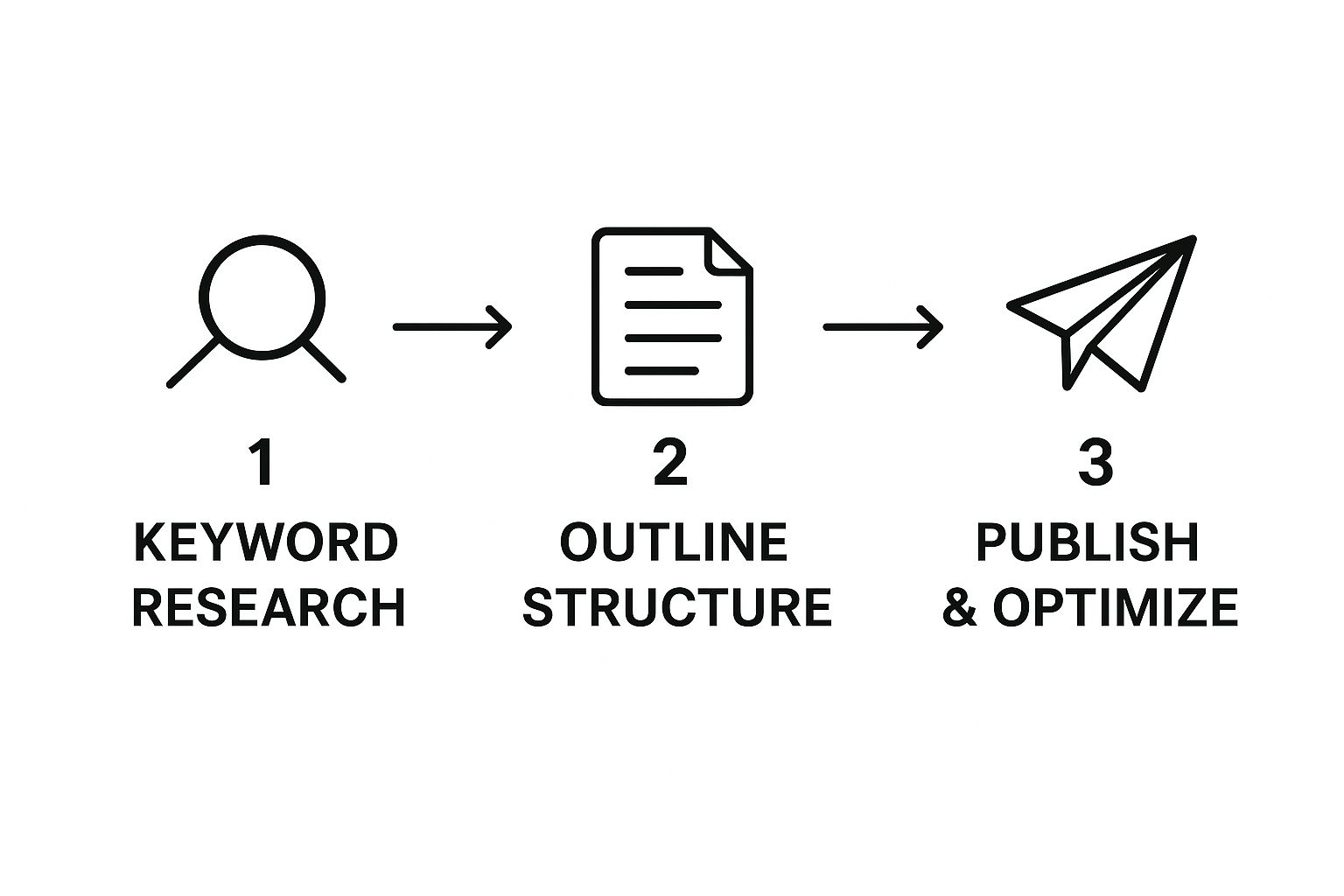
This flow shows that great content isn’t a one-off task. It’s a cycle that kicks off with data-driven research and finishes with ongoing optimisation long after you hit publish.
Get to Grips with Your Audience and Their Intent
The first step isn’t about keywords; it’s about people. Who are you trying to reach? What problem are they trying to solve right now? This is what we call search intent, and it’s the ‘why’ behind every single Google search.
Is someone just looking for information, are they comparing products, or are they ready to pull out their wallet? Nailing this answer dictates the entire angle of your content.
- Informational Intent: The user wants to learn something. Your content needs to be educational, like a detailed “how-to” guide or a clear explanation of a complex topic.
- Commercial Intent: The user is doing their homework before a purchase. This is where reviews, comparison articles, and “best of” lists really shine.
- Transactional Intent: The user is ready to buy. Here, you need product pages or service pages with an unmissable call-to-action.
- Navigational Intent: The user is simply trying to find a specific website (e.g., searching for the “GFC Tech blog”).
Matching your content to the right intent isn’t just a good idea; it’s non-negotiable if you want to rank.
Carry Out a Practical Competitive Analysis
Once you know what your audience wants, your next job is to see who’s already giving it to them. A competitive analysis isn’t about copying what others have done. It’s about spotting their weaknesses and identifying the gaps in their content.
Go ahead, search for your main keyword and open the top 3-5 results. Now, ask yourself:
- What questions are they answering really well?
- What crucial details have they completely missed?
- How have they structured their content? Could I make mine easier to scan or more engaging?
- Are there unanswered questions lingering in their comments section? Goldmine.
This process is how you find opportunities to create something more thorough, more up-to-date, or just plain more helpful than what’s currently ranking. Your goal should be to create the definitive resource on the topic.
This strategic mindset has become absolutely vital. Recent SEO trends in the UK show a huge shift where search engines are rewarding content that aligns with user intent and engagement over old-school keyword stuffing. They want to see genuine expertise, authority, and trustworthiness the pillars of Google’s E-E-A-T guidelines. You can get ahead of the curve by learning more about these evolving content writing standards for 2025.
To make this planning stage stick, use the checklist below before you start writing your next article. It’s a simple way to ensure you’ve covered all the strategic bases.
Essential Pre-Writing Strategy Checklist
| Strategic Check | Action Item | Impact on Ranking |
|---|---|---|
| Audience Intent | Define the primary search intent (Informational, Commercial, etc.). | High. Mismatched intent leads to high bounce rates and poor rankings. |
| Competitive Gap | Identify what the top 3-5 results are missing or doing poorly. | High. Allows you to create a superior, more comprehensive resource. |
| Unique Angle | Determine your unique value proposition (e.g., more data, better examples). | Medium. Helps you stand out and attract clicks from the SERPs. |
| Topic Clustering | Decide if this piece is a “pillar” or a “cluster” and how it will link. | High. Builds topical authority and boosts the rank of related pages. |
This checklist forces you to think strategically from the outset, moving you from just writing content to engineering content that is designed to rank from day one.
Group Related Topics into Clusters
Finally, it’s time to think bigger than a single article. A topic cluster is a powerful SEO strategy where you create a main “pillar” page on a broad topic. This pillar then links out to several “cluster” pages that dive deeper into related, more specific subtopics.
For example, you could have a pillar page on “Small Business SEO.” This page would then link out to cluster articles like “Local Keyword Research,” “Google Business Profile Optimisation,” and “Link Building for Tradesmen.” This structure signals to search engines that you’re an authority on the entire subject, which can boost the ranking potential of all the articles in the cluster. It’s a brilliant way to organise your content and build topical authority over time.
Finding Keywords That Drive Real Traffic
Great SEO writing starts with finding the right keywords, but this isn’t about chasing the highest search volumes. It’s about uncovering the exact phrases your ideal customers are typing into Google the terms that lead to genuine enquiries and sales. This is where the strategic groundwork pays off.
Think of keywords as the language your audience uses. If you don’t speak their language, they’ll never find you. That means you have to dig deeper than the obvious, one-word terms.
Uncovering Long-Tail Keywords
Broad keywords like “SEO services” might look tempting, but they’re incredibly competitive. For most small businesses, the real gold is in long-tail keywords. These are longer, more specific phrases usually three or more words that signal a searcher is much closer to making a decision.
For example, someone searching for “plumber” is probably just browsing. But a person searching for “emergency plumber for leaking boiler in Guildford” has a specific, urgent problem they need solving now. That’s a high-intent search, and ranking for it can bring in highly qualified leads. In fact, research consistently shows that long-tail keywords have higher conversion rates because they match a user’s specific intent so closely.
- Brainstorm Core Topics: First, list your main services or products. Put yourself in your customer’s shoes what problems are you actually solving for them?
- Use Free Tools: Start typing your core topics into Google and see what its autocomplete suggests. Then, look at the “People also ask” section on the results page. These are direct clues from Google about what real users want to know.
- Analyse Competitors: Take a look at what your local competitors are ranking for. Can you spot any long-tail opportunities they’ve overlooked?
This screenshot of a Search Engine Results Page (SERP) shows all the different places your content could appear if you get your keywords right from the main results to the “People also ask” boxes.

Every single one of these features is an opportunity. Targeting the right long-tail and question-based keywords gets you in the game. For a much deeper dive into this, check out our complete guide to keyword research in SEO.
Weaving Keywords into Your Content Naturally
Once you’ve got your target keywords, the next job is to work them into your content without it sounding clunky or forced. Your mantra should be: write for humans first, search engines second. Keyword stuffing is an old-school tactic that will only get you penalised and drive readers away.
Your primary keyword needs to appear in a few key places to give search engines strong signals about your page’s topic:
- Title Tag: This is the headline people click on in the search results. It’s a massive ranking signal.
- Meta Description: While it’s not a direct ranking factor, a well-written meta description with your keyword makes people want to click. A higher click-through rate (CTR) can definitely give your rankings a boost. Studies show the top result on Google gets a CTR of nearly 40%.
- H1 Heading: Your main on-page title should include your primary keyword. Simple as that.
- First 100 Words: Drop your keyword somewhere in your opening paragraph, but make it feel natural.
- Subheadings (H2, H3): Sprinkle your primary keyword or close variations into some of your subheadings.
The golden rule is natural integration. If a sentence sounds awkward or you’ve shoehorned a keyword in, rewrite it. Your content has to flow like a real conversation to keep people reading.
Embracing Semantic SEO
Modern search engines like Google are incredibly sophisticated. They don’t just scan for exact-match keywords anymore; they understand the context and the relationships between different words. This is what we call semantic SEO.
So, instead of repeating “how to write seo content” over and over, you should cover related topics and include relevant terms, such as:
- Keyword research tools
- On-page optimisation
- User intent
- Meta descriptions
- Content structure
- Readability
- Backlinks
By covering these related subtopics, you’re creating a far more comprehensive and authoritative piece of content. This tells Google that you’re an expert on the subject, which helps you rank for a whole host of related queries, not just the one keyword you started with. It’s about painting the complete picture for both your reader and the search engine.
Frequently Asked Questions About Keyword Research
1. What is keyword difficulty?
Keyword difficulty (KD) is a score that SEO tools use to guess how hard it will be to rank on the first page of Google for a keyword. A higher score means more competition, so you’ll need stronger content and more authority to stand a chance.
2. How many keywords should I target in one article?
Stick to one primary keyword per article. You can support this by targeting 2-3 secondary keywords that are very closely related. If you try to target too many different keywords, you’ll dilute your focus and likely won’t rank for any of them.
3. What’s the difference between a focus keyword and a long-tail keyword?
A focus keyword (or primary keyword) is simply the main term you want a page to rank for. A long-tail keyword is often used as a focus keyword, but it’s defined by its length (usually 3+ words) and its high level of specificity.
4. Should I use keywords in my image file names and alt text?
Yes, absolutely. Using descriptive file names (like seo-content-writing-tips.jpg) and writing clear alt text that includes your keyword helps search engines understand what your images are about. This improves accessibility and makes your page even more relevant.
5. How often should I conduct keyword research?
You should do keyword research every time you plan to write a new piece of content. It’s also a good idea to review and refresh your keyword strategy for your most important existing content at least once or twice a year to keep up with changing search trends.
Structuring Content for Engagement and SEO
Even the most brilliant article will flop if it’s just a wall of text. Structure is everything not just for keeping readers hooked, but for signalling quality to search engines. Think about it: poorly organised content leads to high bounce rates, which is a massive red flag to Google that your page isn’t solving the searcher’s problem.
How you present your information is a critical part of learning how to write SEO content. A scannable, visually appealing layout makes your article more inviting and much easier to digest, especially on mobile, where most people are browsing these days.

Embrace the Inverted Pyramid Model
Journalists have been using the inverted pyramid for decades for one simple reason: it works. The model is straightforward: put the most crucial information the main takeaway or the direct answer to your reader’s question right at the very top of your article.
This approach immediately grabs their attention by giving them exactly what they came for. Once you’ve delivered that core value upfront, you can then expand on the topic with supporting details, examples, and deeper context. You’ve already won their trust.
Use Formatting to Create a Scannable Experience
Let’s be honest, nobody wants to read long, dense paragraphs online. To keep your readers engaged, you have to break up your text with strategic formatting. This isn’t just about making things look pretty; it’s about readability, a massive factor in user experience.
Here’s how to improve the flow and visual appeal of your content:
- Keep Paragraphs Short: Stick to a maximum of 1-3 sentences per paragraph. This creates essential white space and makes your content feel less intimidating on the screen.
- Use Bullet Points: When you’re listing items, benefits, or steps, use bullet points. They are incredibly easy to scan and help people quickly absorb key information without getting bogged down.
- Break It Up with Subheadings: Use descriptive H3 and H4 headings to segment your article into logical sections. This acts as a handy roadmap, allowing readers to jump to the parts that matter most to them.
Remember, the goal is to create content that can be understood at a glance. If someone can skim your article and still grasp the main points, you’ve nailed the structure for both them and for search engines.
This structure respects your reader’s time and improves dwell time on your page a positive signal for SEO.
Link Strategically to Build Authority
Your linking strategy is another powerful structural tool. Both internal and external links play distinct but equally important roles in how search engines and users see your content’s quality and authority.
An internal link simply connects one page on your website to another. A smart internal linking strategy helps in several ways:
- It guides users through your site, encouraging them to explore more of your content and stick around longer.
- It passes authority (or “link equity”) between your pages, which can help give other articles a rankings boost.
- It helps search engines understand the relationships between your content, reinforcing your expertise on a subject.
For example, in an article about SEO content, it makes perfect sense to link to your other posts on “keyword research” or “on-page optimisation.”
On the other hand, external links point from your website to another domain. Linking out to credible, high-authority sources shows you’ve done your homework and adds credibility to your own content. Don’t be afraid to send users to other helpful resources; it shows you’re focused on providing real value, which both users and Google love to see.
Frequently Asked Questions About Content Structure
1. How do I know if my content is scannable enough?
A great method is the “squint test.” Seriously, step back from your screen and squint your eyes. If you can still make out a clear structure headings, lists, short paragraphs, and images your content is likely well-formatted and easy to scan.
2. Does using too much formatting hurt SEO?
Not at all, as long as it’s used logically to improve the reader’s experience. Overusing bold text or cramming dozens of H3s into a short article might look a bit spammy, but using formatting to create a clear hierarchy is a huge plus.
3. What is the ideal paragraph length for SEO?
There’s no single magic number, but aiming for 1-3 sentences is a solid best practice for web content. This is especially important for mobile users, where even a three-sentence paragraph can look like a huge block of text on a small screen.
4. How many internal links should I include in an article?
Focus on quality and relevance, not just quantity. A good rule of thumb is to include 2-5 relevant internal links for every 1,000 words. Each link should add genuine value for the reader.
5. Should links open in a new tab?
It’s generally considered a best practice for external links to open in a new tab (target="_blank") so you don’t send visitors away from your site. Internal links, however, should typically open in the same tab to provide a smooth, seamless journey through your website.
Writing Content People Actually Want to Read
Once you’ve nailed the keywords and the structure, you get to the heart of the matter: the writing itself. This is where you stop chasing algorithms and start building real trust with a human audience. It’s the craft that turns a click into a reader, a reader into a follower, and a follower into a customer.
Getting this right is what separates a technically sound article from a genuinely valuable one that drives business. Let’s break down how to do it.
Find a Consistent and Authentic Brand Voice
Before you even think about the first sentence, you need to decide how you’re going to sound. Your brand voice is your company’s personality, and it has to be consistent everywhere. Are you the friendly, approachable expert? The witty, no-nonsense authority? Or the professional, data-driven advisor?
There’s no single correct answer, but whatever you choose, it must be authentic to you and resonate with your audience. A consistent voice builds familiarity and trust, making your content instantly recognisable.
Craft Introductions That Actually Hook People
You’ve got seconds. That’s it. Your introduction is your one shot to convince someone your article is worth their time, so don’t waste it with fluff. A great intro needs to do three things, fast:
- Acknowledge Their Problem: Show them you get it. You understand their pain point right from the off.
- Promise a Solution: State clearly what they’ll learn or how you’re going to help them solve that exact problem.
- Create Curiosity: Hint at a unique insight, a surprising stat, or a common mistake you’re about to reveal.
Think of your intro as the trailer for your article. It needs to be punchy, promise real value, and leave the reader feeling like they absolutely have to stick around to see what’s next.
Once you’ve got a solid draft, a great next step is to dive into our detailed guide on how to write blog posts that keep people glued to the page.
Embrace the Power of Long-Form Content
Sure, short and snappy posts have their place. But the data doesn’t lie: search engines consistently favour longer, more in-depth content. Why? Because comprehensive articles are simply better at answering a user’s entire query, and that’s Google’s number one priority.
In the UK, the trend is clear. A recent analysis found that the average published article is now 1,427 words long a jump of over 70% from a decade ago. This isn’t about adding filler; it’s about covering a topic with the depth it deserves. Your goal should be to create the single best resource on that subject, leaving no stone unturned.
Use Stories and Examples to Make Your Ideas Stick
Facts and data are crucial, but stories are what make them memorable. People connect with narratives. Instead of just stating a point, illustrate it with a real-world scenario or a relatable analogy.
For example, don’t just say “long-tail keywords convert well.” Tell a quick story about a local plumber in Guildford who was getting nowhere competing for “plumber” but saw a 300% spike in qualified leads after targeting “emergency boiler repair Guildford.” That makes the concept real and its value obvious.
Write Conclusions That Inspire Action
A weak ending can undo all your hard work. Don’t let your article just fizzle out. End with a clear, powerful call-to-action (CTA). Your conclusion should briefly recap the key takeaways and then tell the reader exactly what to do next.
This could be:
- Asking them to leave a comment with their own thoughts.
- Encouraging them to download a related guide or checklist.
- Prompting them to get in touch for a consultation.
A strong conclusion turns a passive reader into an active participant, guiding them deeper into your world and one step closer to becoming a customer.
Frequently Asked Questions About Writing Engaging Content
1. How do I find my brand voice?
Start by jotting down three adjectives that describe your business (e.g., “professional,” “friendly,” “innovative”). Then, write a quick paragraph about what you do, trying to embody those traits. It’s a simple exercise that helps you land on a voice that feels natural.
2. What’s the difference between tone and voice?
Think of it this way: your voice is your brand’s consistent personality. Your tone is the emotional inflection you apply to that voice depending on the situation. For example, your voice might always be “helpful,” but your tone could be “urgent” in a security alert or “celebratory” in a success story.
3. How can I make technical topics more interesting?
Use analogies. Compare a complex IT concept to something simple and familiar. Explaining a server firewall by comparing it to a nightclub’s bouncer, for instance, makes a difficult subject much more accessible and engaging for a non-technical audience.
4. Is it okay to use personal stories in business content?
Absolutely! Personal anecdotes and case studies build credibility and make your content far more relatable. Sharing a real story about how you solved a client’s problem is infinitely more powerful than just listing your services.
5. How long should an introduction be?
Aim for 3-5 short sentences. Your goal is to be concise and impactful. Get straight to the point, hook the reader, and then get on with the main body of your content. No waffle.
Getting Your Content Seen After You Publish
Hitting ‘publish’ isn’t the finish line; it’s the starting pistol. So many businesses put all their energy into creating content, only to let it sit there gathering digital dust. The truth is, your work isn’t over when the article goes live. This is where the real race begins the critical phase of promotion and distribution.
This post-publication push is what ensures all your hard work on research and writing actually pays off. It starts with one final, meticulous check to make sure everything looks professional and works perfectly.

Strategic Content Distribution
Just posting your article and hoping for the best is a recipe for disappointment. You need a proactive plan to get your content in front of the right eyeballs, starting with the channels you already own and control.
- Social Media Promotion: Share your new article across every relevant platform. Don’t just dump a link; craft compelling captions that highlight a key benefit for the reader and ask engaging questions to spark a conversation.
- Email Newsletters: Your email list is one of your most powerful assets. Send a dedicated email to your subscribers, explaining what the new article is about and, most importantly, why it’s a must-read for them.
- Community Forums: Find out where your target audience hangs out online. This could be local Facebook groups, industry forums, or LinkedIn communities. Share your content genuinely as a solution to a problem being discussed, not as spam.
Earning Those All-Important Backlinks
Backlinks links from other websites to yours are a huge ranking signal for search engines. But earning them is a real challenge. UK content marketing statistics reveal a tough reality: a staggering 94% of blog posts receive zero backlinks, and only 2.2% manage to get links from more than one site.
This data highlights a crucial point: if you want to rank, you can’t just publish. You have to actively promote your work and build relationships to earn the links that signal authority to Google.
A simple yet effective outreach technique is to find non-competing blogs that write about similar topics. Send them a friendly, personalised email mentioning your new article and explaining how it could be a valuable resource for their readers. For more actionable strategies, explore our guide full of SEO tips to boost your website’s visibility.
To ensure your content’s long-term success, it’s also essential to conduct regular evaluations of your site’s health. Using a comprehensive WordPress website audit checklist can help you identify areas for improvement in performance, security, and SEO. This ongoing maintenance ensures your published content continues to perform well over time.
Frequently Asked Questions About Content Promotion
1. How long should I wait before promoting a new article?
Start promoting it immediately! The sooner you can drive initial traffic and engagement signals to your new post, the better.
2. Is it okay to pay for promotion on social media?
Yes, a small, targeted ad spend on platforms like Facebook or LinkedIn can be a very effective way to kickstart visibility and reach a wider, more relevant audience than you could organically.
3. What is the most important part of an outreach email?
Personalisation. Show that you’ve actually read their content and have a genuine reason for reaching out. A generic, copy-pasted email will almost always be ignored.
4. How many backlinks do I need to rank?
There’s no magic number. It depends entirely on the keyword’s competitiveness. Focus on acquiring high-quality, relevant links from authoritative sites rather than chasing a specific quantity.
5. How can I repurpose my content for promotion?
Turn key points from your article into an infographic, a short video clip for social media, or a series of tweets. This gives you multiple assets to share, extending the life and reach of your original piece.
Common Questions About Writing SEO Content
As you start writing more content for search engines, a few common questions always seem to pop up. It’s a field with plenty of nuance, and sometimes you just need a straight answer to cut through the noise and get on with your work.
Here, we tackle the most frequent queries we hear, giving you straightforward advice to help you troubleshoot common issues and move forward with confidence.
1. How Often Should I Publish New SEO Content?
This is the classic question, but the answer isn’t a magic number. Forget frequency for a moment; consistency is what really matters. It’s far better to publish one brilliant, in-depth article a month than to churn out four mediocre ones that sink without a trace.
If you’re running a brand-new website and trying to build authority from scratch, aiming for one high-quality, well-researched article per week is a solid target. This steady output signals to search engines that your site is active and a reliable source of fresh information.
For more established sites, the game changes. The focus shifts from sheer volume to strategic quality. At this stage, you’ll often get the best results from a balanced approach: creating some new content while also dedicating time to updating and improving your existing posts.
2. What Is the Ideal Length for an SEO Article?
There’s no single word count that guarantees a top ranking. The perfect length is simply whatever it takes to answer the user’s query comprehensively and to cover the topic in more depth and with more value than the articles already ranking at the top.
That said, the data consistently shows a strong link between longer content and higher rankings, especially for competitive keywords. Studies often find that the average length of a top-ranking article is well over 2,000 words.
Don’t pad out your writing just to hit a number. Instead, focus on creating the most valuable, thorough, and genuinely helpful resource on the subject. If that takes you to 2,500 words, brilliant. The word count should always be a by-product of quality, not the goal itself.
3. Can I Use AI Tools to Write My SEO Content?
AI tools can be incredibly powerful assistants. They are fantastic for brainstorming ideas, generating outlines, suggesting different keyword angles, and helping you smash through the dreaded writer’s block.
However, relying on AI to write entire articles from start to finish is a risky game. It often produces generic, soulless content that lacks a distinct brand voice, personal insight, and the real expertise that builds trust. Search engines are also getting much smarter at spotting content that offers little original value.
The best approach? Use AI as a collaborator. Let it handle some of the heavy lifting with initial research and structure, but always have a human writer add their unique perspective, edit for quality, and meticulously fact-check every single claim.
4. How Long Does It Take for SEO Content to Start Ranking?
Patience is a must in SEO. How long it takes for a new article to rank can vary wildly depending on a few key factors:
- Your Website’s Authority: An established site with a strong backlink profile will see new content rank much faster than a brand-new domain.
- Keyword Competitiveness: Targeting a hugely competitive keyword is a long game, whereas a low-competition, long-tail phrase can rank much sooner.
- Content Quality: Genuinely exceptional content can sometimes defy the odds and rank surprisingly quickly.
As a general rule, expect it to take anywhere from a few weeks to 6-12 months for a new article to climb the rankings and reach its full potential. Just focus on consistent, high-quality work and promotion, and the results will follow.
5. Is It Better to Update Old Content or Write New Posts?
Honestly, the most effective content strategy involves a healthy mix of both. Creating new content is essential for targeting new keywords, reaching different audience segments, and building your overall topical authority.
But updating existing content often called a ‘content refresh’ is one of the most powerful and underrated SEO tactics out there. It helps you protect your existing rankings from competitors, improve underperforming articles, and add fresh, relevant information to keep your content current. Refreshing a post can deliver a significant ranking boost with far less effort than creating a brand-new article from scratch.
Frequently Asked Questions
1. What is the most important part of writing SEO content?
While every element matters, the most crucial part is aligning your content with user intent. If you fail to understand why a user is searching for a particular keyword, you cannot create content that satisfies their needs. A perfectly optimized article that misses the user’s intent will struggle to rank because it will have high bounce rates and low engagement, signalling to Google that it isn’t a helpful result.
2. How is writing for SEO different from regular copywriting?
Traditional copywriting often focuses on persuasion, brand voice, and driving a specific action (like a sale). SEO content writing shares those goals but adds a technical layer. It requires keyword research, strategic placement of keywords, content structuring with headings (H1, H2, H3), and building internal/external links to satisfy both human readers and search engine algorithms. It’s a blend of creative writing and technical optimisation.
3. What is E-E-A-T and why does it matter for SEO content?
E-E-A-T stands for Experience, Expertise, Authoritativeness, and Trustworthiness. It’s a set of guidelines Google uses to evaluate the quality of a webpage. To write content that aligns with E-E-A-T, you should: demonstrate firsthand experience (e.g., case studies), showcase your expertise with accurate information, build authority with backlinks and a strong online presence, and foster trust with a professional website and clear author information. It’s especially critical for topics related to finance and health.
4. Can good SEO content rank without any backlinks?
It’s possible, but very difficult, especially for competitive keywords. High-quality content is the foundation, and for low-competition, long-tail keywords, it might be enough to rank on its own. However, for most topics, backlinks from other reputable websites are a powerful signal to Google that your content is authoritative and trustworthy. A solid SEO strategy involves both creating excellent content and actively promoting it to earn backlinks.
5. What are the best free tools to start with for SEO content writing?
For a beginner, you can get a lot done with free tools. Use Google Keyword Planner (needs a Google Ads account, but you don’t have to spend money) for initial keyword ideas. Use Google Trends to check keyword popularity over time. Use Google’s own search results the “People also ask” section, “Related searches,” and autocomplete suggestions to find long-tail keywords and understand user intent. For checking your writing, tools like Grammarly‘s free version can help with readability.
Crafting high-quality SEO content is the foundation of any successful digital strategy. If you’re a small business in Surrey looking for a partner to help you turn your website into a powerful lead-generation engine, GFC Tech is here to help.
Learn more about our bespoke SEO and content services and let’s start a conversation about growing your business.
Adam is a Founder of GFC Tech, a company dealing in SEO and website design and development services. Adam has been an SEO expert for the past 8 years and has been working with different companies in this field. He is an SEO consultant and a marketing strategist and works closely with his clients to ensure that his marketing plans and strategies provide them with the marketing advantages they need to grow their business. Adam’s main role is an SEO consultant, but he is also involved in all technical aspects. Adam also develops WordPress websites, designs them professionally and performs SEO for them so they can rank on the first page of google.


