
If you’re just dipping your toes into digital marketing, the sheer number of channels and buzzwords can feel like a lot to take in. But let’s strip it back. At its heart, digital marketing is simply about promoting your business where people are already spending their time: online.
Think of it as moving beyond a physical shopfront to build a digital one that’s open 24/7. It’s your way of using the internet through search engines, social media, email, and your website to find new customers, keep them engaged, and ultimately, grow your business.
- Your Starting Point in Digital Marketing
- Understanding the Core Digital Marketing Channels
- Getting Started with Social Media Marketing
- How to Build Your First Digital Marketing Strategy
- Essential and Free Tools for Marketing Beginners
- How to Measure Your Marketing Success
- Common Digital Marketing Questions Answered
Your Starting Point in Digital Marketing
The core idea is simple: connect with the right people, in the right place, at the right time. Since most of us are glued to our screens, that’s exactly where modern marketing needs to happen.
What makes it different from old-school advertising like billboards or magazine ads? It’s a two-way street. Digital marketing gives you a direct line to your audience, allowing you to build real relationships, gather feedback, and see exactly what’s working. Every click, ‘like’, and website visit tells a story, giving you data to sharpen your strategy.
Why It Matters for Your Business
Let’s be honest, the main goal for most businesses is growth, and digital marketing is one of the most powerful tools you have to achieve it. For UK businesses, this couldn’t be clearer. Driving sales is the number one objective, with 54% of companies naming it their top priority.
But it’s not just about the immediate sale. Building brand awareness and boosting customer engagement are just as crucial, with 42% of businesses focusing on each. These goals show how digital tools help you guide someone from just hearing about you to becoming a loyal customer. If you want to dive deeper, you can explore more about these UK business priorities to see what’s driving the market.
To help put these goals into context, here’s a quick look at what UK businesses are focusing on with their digital marketing efforts.
Top Priorities for Businesses Using Digital Marketing
| Marketing Goal | Percentage of UK Businesses Prioritising It |
|---|---|
| Increasing sales revenue | 54% |
| Increasing brand awareness | 42% |
| Increasing customer engagement | 42% |
| Generating more leads | 38% |
| Improving customer experience | 33% |
As you can see, the focus is squarely on activities that produce measurable results, from brand visibility right through to the bottom line. This is the real power of a well-executed digital strategy.
Digital marketing isn’t just one thing; it’s a team of different strategies playing together. SEO brings people to your website, great content gives them a reason to stick around, and social media keeps the conversation alive. Each part makes the others stronger.
Once you grasp these fundamentals, you’re ready to start building an online presence that doesn’t just exist but actually delivers results.
Understanding the Core Digital Marketing Channels
Digital marketing isn’t a single activity but a collection of different channels, each with its own job to do. Think of it like a toolkit. You wouldn’t use a hammer to saw a piece of wood, and in the same way, you’ll pick and choose different marketing channels to hit specific business goals. Getting to grips with these core channels is your first real step towards building a marketing strategy that actually works.
This visual gives a great overview of how a foundational channel like SEO helps you connect with customers who are actively looking for solutions.
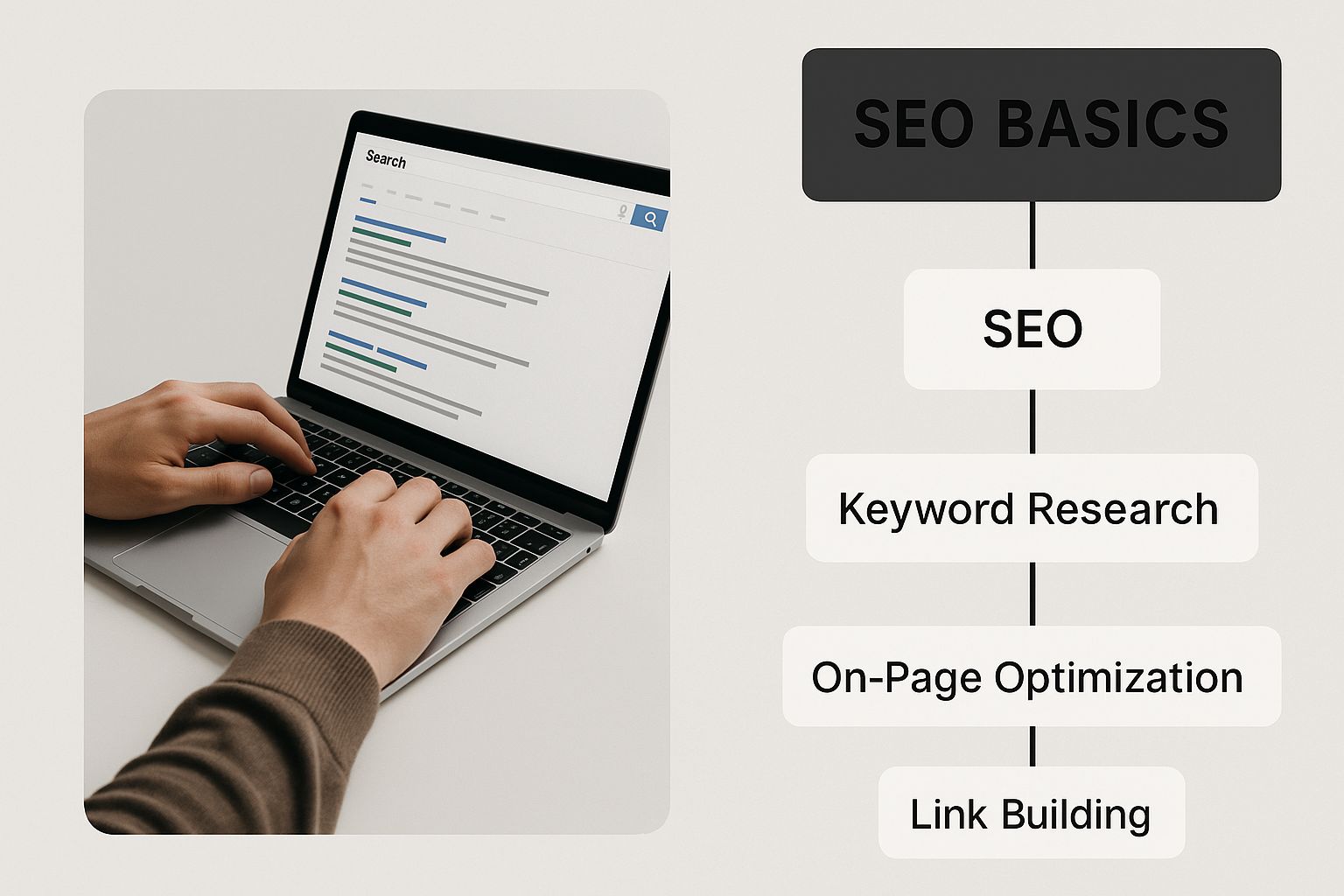
As the image shows, mastering the basics of SEO is about making your business pop up the moment people start searching for what you offer. It creates a powerful and direct path for potential customers to find their way to your door.
Search Engine Optimisation (SEO)
Imagine your local high street. The shops with the best locations, right in the middle of the action, get the most footfall. Search Engine Optimisation (SEO) is the art of securing that prime real estate on a digital high street like Google. When potential customers search for terms related to your business, SEO helps your website appear as high up as possible in the search results.
The goal here is to boost your website’s visibility for relevant searches. It’s a long-term game that involves fine-tuning your website’s content and technical guts to be more appealing to search engines. The prize? A steady stream of “organic” or free traffic from people who are already interested in what you do.
Content Marketing
If SEO is about getting people to your digital shopfront, content marketing is what you fill that shop with to make them want to stay, browse, and trust you. It’s the craft of creating and sharing valuable, relevant, and consistent content to attract and keep a specific audience. This could be anything from blog posts and videos to detailed guides and infographics.
Instead of a hard sell, you’re providing genuinely useful information that solves your audience’s problems. This builds your authority and builds trust, making them far more likely to choose you when they’re finally ready to buy. To make your content truly connect, mastering the words you use is vital; a great starting point is this Copywriting For Beginners: A Practical Guide.
Social Media Marketing
Social Media Marketing is all about building a community on platforms like Facebook, Instagram, LinkedIn, or TikTok. It’s less about direct selling and much more about having conversations and making real connections. Every platform has a different vibe and audience, so success means picking the right one for your business and showing up consistently.
This channel is fantastic for building brand awareness, creating loyalty, and sparking engagement. It gives your business a human voice and a direct line to your customers in the places they hang out in their free time.
Paid Advertising (Pay-Per-Click)
While SEO earns you free traffic over time, Paid Advertising, often called Pay-Per-Click (PPC), lets you buy it. With PPC, you place ads on platforms like Google or Facebook and pay a small fee every time someone clicks on your ad. It’s a way to jump the queue.
This channel offers instant visibility and is incredibly targeted. You can dial in exactly who sees your ads based on their demographics, interests, and online habits, making it a powerful tool for generating leads and sales in a hurry. Our in-depth guide explains more about how digital marketing works by combining all these efforts.
Email Marketing
Email Marketing remains one of the most direct and effective ways to connect with your leads, nurture those relationships, and turn them into paying customers. It involves sending targeted messages to a list of subscribers who have explicitly agreed to hear from you.
Unlike social media, where mysterious algorithms decide who sees your posts, email gives you a direct, uninterrupted line to your audience’s inbox. This makes it perfect for building long-term relationships, sharing updates, and promoting special offers.
Getting Started with Social Media Marketing
Social media is so much more than just posting a few updates and hoping for the best. For anyone just dipping their toes into digital marketing, it’s about finding where your ideal customers hang out online and building a real community around your brand. It’s your chance to have proper conversations and show the human side of your business.
The trick is to stop just broadcasting messages and start creating connections. Each platform, from Facebook and Instagram to LinkedIn and TikTok, has its own crowd and content style. Your first job is to figure out which one makes the most sense for you.
Choosing the Right Platform
Don’t fall into the trap of thinking you need to be everywhere at once. It’s a classic beginner mistake that spreads your energy far too thin. Instead, focus on the one or two platforms where your target audience is genuinely active.
Think of social media platforms like different parties. LinkedIn is a formal networking conference, Instagram is a trendy art gallery, Facebook is a local community fair, and TikTok is a loud, high-energy talent show. You wouldn’t wear the same outfit or talk the same way at each one, would you?
The platform you choose really dictates the kind of content you should be making. Striking photos and short videos are king on Instagram, while in-depth articles and company news feel right at home on LinkedIn. Pinpointing where your customers spend their time is the most crucial first step you’ll take on your social media journey.
To help you get a clearer picture, here’s a quick guide to help you choose where to focus your efforts.
How to Choose the Right Social Media Platform
This table breaks down the main players to help you decide which is the best fit for your business based on who you want to reach and what you want to achieve.
| Platform | Primary Audience | Best For (Content Type) | Key Business Goal |
|---|---|---|---|
| Wide demographic, great for local communities | Community building, news, video, customer service | Brand Awareness, Lead Generation | |
| Younger audience (under 35), visually driven | High-quality photos, Reels, Stories, influencer work | Product Discovery, Brand Personality | |
| Professionals, B2B decision-makers | Industry articles, company news, professional networking | B2B Lead Generation, Building Authority | |
| TikTok | Gen Z and younger millennials | Short, fun, trend-based videos | Viral Reach, Brand Awareness |
Once you’ve zeroed in on the right platform, you’ve won half the battle. Now, you can focus on creating content that speaks directly to that audience in a way they’ll appreciate.
The Power of Social Media Advertising
Beyond building a community organically, social media platforms have incredibly powerful advertising tools. This lets you reach a very specific audience, even if you’re working with a small budget. Forget the scattergun approach of traditional ads; here, you can target users based on their interests, location, age, and online habits.
This precision makes it a fantastic channel for any business just starting out. The UK social media advertising market is set to pull in around £9.95 billion in revenue by 2025, which shows just how vital it has become. For example, Facebook is still a giant with 38.3 million UK users, giving businesses a direct line to a massive audience. You can discover more insights about UK social media usage to get a sense of the scale.
Even spending just £5–£10 a day on a well-targeted ad can drive traffic to your website, generate leads, or boost sales. It’s a fast way to get results while your organic presence builds up over time. It’s also worth remembering that your social media activity can give your other marketing a helpful nudge. If you’re wondering how, have a look at our guide on how social media and SEO can work together to maximise your online presence.
How to Build Your First Digital Marketing Strategy
Jumping into digital marketing without a plan is like setting off on a road trip with no map. You might stumble upon some interesting places, but you’re unlikely to reach your destination efficiently. A strategy is your roadmap; it turns guesswork into a clear, actionable plan that gives every marketing activity a purpose.
Creating your first digital marketing strategy doesn’t need to feel like a monumental task. When you break it down into simple, manageable steps, you can build a solid foundation for growth. This is all about making deliberate choices about who you want to reach, what you want to achieve, and how you’ll get there.
Step 1: Define Your Target Audience
Before you write a single blog post or design an ad, you have to know who you’re talking to. This is the most critical step of all. You need to go beyond basic demographics and really dig into what makes your ideal customer tick.
Think about their daily challenges, their goals, and what problems they’re trying to solve. Where do they look for information? What social media platforms do they scroll through? Creating a simple buyer persona a semi-fictional character representing your ideal customer can make this whole process much easier.
Give this persona a name, a job, and some personal attributes. This simple exercise will help you create marketing messages that resonate on a much deeper level because you’ll be speaking directly to a person, not a faceless crowd.
Step 2: Set SMART Goals
Once you know who you’re talking to, you need to decide what you want to achieve. Vague goals like “get more followers” or “increase sales” just aren’t helpful. To be effective, your goals need to be SMART.
This framework ensures your objectives are clear and trackable:
- Specific: Be precise. Instead of “more website traffic,” aim for “increase organic traffic from Google by 20%.”
- Measurable: You have to be able to track your progress. Use metrics like website visitors, conversion rates, or lead numbers.
- Achievable: Set goals that are realistic for a beginner. Doubling your sales in the first month is probably out of reach, but a 10% increase might be perfectly doable.
- Relevant: Make sure your goals align with your overall business objectives. Does increasing social media engagement directly support your goal of generating more leads?
- Time-bound: Give yourself a deadline. For example, “Achieve 50 new email subscribers within the next 90 days.”
This approach turns your ambitions into a concrete action plan and provides clear benchmarks for measuring your success.
Step 3: Choose Your Marketing Channels
With your audience and goals defined, it’s time to choose where to focus your efforts. As a beginner, the biggest mistake you can make is trying to be everywhere at once. It’s a surefire recipe for burnout.
Instead, pick one or two channels that make the most sense for your business and your audience.
- If your audience is made up of professionals, LinkedIn might be your best bet.
- If you sell visually appealing products, Instagram or Pinterest would be a natural fit.
- For a local service business, focusing on Local SEO and your Google Business Profile is a must.
By concentrating your resources on a couple of well-chosen platforms, you give yourself a much better chance of gaining traction. You can always expand to other channels later once you’ve mastered the first few.
To effectively build your first digital marketing strategy, understanding the comprehensive marketing strategy development process is key.
Step 4: Plan Your Initial Content
Finally, you need to decide what you are going to say. Your content is the bridge that connects you to your audience. Based on your chosen channels, brainstorm some initial content ideas that are genuinely helpful or entertaining for your target customer.
If you chose SEO and blogging, your first three posts could address common questions your customers ask. If you picked Instagram, you could plan a week’s worth of posts, including a customer story, a behind-the-scenes look at your business, and a helpful tip. Don’t overcomplicate it. A simple content calendar sketched out in a notebook is all you need to get started and stay consistent.
Essential and Free Tools for Marketing Beginners
You don’t need a huge budget to start making a real impact with your marketing. In fact, some of the most powerful tools out there are completely free, giving you a professional-grade toolkit without the hefty price tag.
Knowing which ones to pick from the start helps you hit the ground running. The goal is to find tools that simplify core tasks like design, social media, email, and analytics, allowing you to create polished content and actually measure what’s working.
Tools for Creating Great Visuals
First impressions count, and online, that often comes down to your visuals. The good news is you don’t need to be a graphic designer to create stunning images for your social media posts, blog articles, or email newsletters.
- Canva: This is the go-to design tool for non-designers. It uses a simple drag-and-drop interface and offers thousands of templates for everything from Instagram posts to business cards. Its free version is incredibly generous and is more than enough to get you creating polished, professional graphics that feel true to your brand.
Tools for Managing Your Social Media
Staying consistent on social media is crucial, but it can quickly eat up your day. Social media schedulers let you plan and automate your posts in advance, freeing you up to focus on other parts of your business.
- Buffer: This is a clean, straightforward platform for scheduling your content. With its free plan, you can connect up to three social channels and schedule ten posts in advance for each one. It’s perfect for a beginner who wants to get a week’s worth of content lined up without feeling overwhelmed.
Tools for Building an Email List
Email marketing gives you a direct line to your audience, away from the noise of social media algorithms. To get started, you need a service that helps you collect email addresses and send out campaigns without any fuss.
- Mailchimp: A popular choice for a reason, Mailchimp’s free plan lets you have up to 500 subscribers and send 1,000 emails a month. It provides simple templates and basic reporting, giving you everything you need to start building and nurturing your email list from scratch.
Tools for Understanding Your Performance
So, are your efforts actually working? Analytics tools are non-negotiable for tracking website visitors and understanding what they do once they arrive.
Google Analytics: This is the industry-standard tool for website analytics, and it’s completely free. It tells you how many people are visiting your site, where they’re coming from, and which pages they love the most. This data is invaluable for making smart decisions about your marketing.
Here’s a glimpse of what the Google Analytics dashboard looks like, showing key user metrics.
This snapshot gives you a clear view of your website’s performance, helping you spot trends and understand audience engagement at a glance. For a deeper dive into tools that can help with your search performance specifically, check out our guide on the best free SEO tools.
How to Measure Your Marketing Success
Launching your digital marketing campaigns is an exciting first step, but how do you actually know if your efforts are paying off? Measuring your success isn’t about getting lost in complex spreadsheets or confusing jargon. It’s about tracking a few key numbers that tell you what’s working and what isn’t. This data is your guide, helping you make smarter decisions and continuously improve.
The first step is to get familiar with Key Performance Indicators, or KPIs. These are simply the specific, measurable values that show how effectively you are achieving your main business objectives. Instead of drowning in a sea of data, you’ll focus on just the metrics that truly matter for a beginner.
Identifying Your Core Metrics
For every digital marketing channel you use, there are a handful of simple metrics that reveal its performance. You don’t need to track everything under the sun, just the numbers that are most closely tied to your goals.
Here are the essential ones to start with:
- Website Traffic: This is the total number of visitors coming to your site. Using a free tool like Google Analytics, you can see where they’re coming from (e.g., Google search, social media), which tells you which of your channels are driving the most interest.
- Engagement Rate: A crucial metric for social media, this shows how many people are interacting with your posts (likes, comments, shares) relative to your total followers. It’s a great indicator of whether your content is actually connecting with your audience.
- Email Open Rate: For your email campaigns, this simple percentage shows how many subscribers opened your email. It’s a direct measure of how effective your subject lines are at grabbing attention in a crowded inbox.
The most important part of measurement is learning from the data. If a particular blog post drives a lot of traffic, write more on that topic. If your email open rates are low, experiment with different subject lines. Data empowers you to stop guessing and start making informed improvements.
To truly understand your progress, you must identify and track crucial marketing performance metrics beyond simple vanity numbers. Most platforms have built-in analytics dashboards like those on Facebook, Instagram, and your email service provider that make finding these numbers straightforward. By regularly checking these KPIs, you can pivot your strategy, double down on what works, and fix what doesn’t, ensuring your marketing becomes more effective over time.
Common Digital Marketing Questions Answered
Dipping your toes into digital marketing can feel like learning a new language, so it’s completely natural to have a few questions swirling around. We get it. To help clear the fog, here are some straightforward answers to the queries we hear most often from beginners.
We’ll tackle the big ones: how much to spend, which channels actually work, how long it takes to see results, whether you really need a website, and if you can realistically do this all yourself. Think of this as the final, no-nonsense nudge you need to get going with confidence.
1. How Much Should I Spend on Digital Marketing as a Beginner?
There’s no magic number here, and you certainly don’t need a massive budget to make an impact. The smartest way forward is to start small and stay focused. Pick just one or two channels where you know your ideal customers hang out, and set aside a modest amount to test the waters.
Many small businesses get off to a flying start using only free, organic methods like local SEO and creating genuinely useful blog content. If you do want to experiment with paid ads, you could begin with a small social media budget of just £5 to £10 per day.
The most important principle is to track your return on investment (ROI). Pay close attention to which activities are bringing in real results, like phone calls or contact form submissions. Once you know what’s working, you can confidently put more money behind it.
This data-first approach takes the guesswork out of the equation. It means every pound you spend is working hard for your business, allowing you to scale your marketing efforts responsibly as you grow.
2. Which Digital Marketing Channel Is Best for a Small Business?
The “best” channel depends entirely on your business and, more importantly, where your customers are. What works wonders for one company might be a total dud for another. It all comes down to matching the platform to your audience’s habits.
For instance, a business with a strong visual element, like a local bakery or a bespoke furniture maker, will probably find its groove on Instagram. On the flip side, a B2B consultant offering professional services will find a far more receptive crowd on LinkedIn.
For most small businesses, this is a powerful and effective starting combo:
- Local SEO: This is all about optimising your online presence to pop up in local search results, especially on Google Maps. It’s a non-negotiable for any business with a physical location or a defined service area.
- One Relevant Social Media Platform: Don’t spread yourself thin. Choose the single platform where your target audience spends most of their time and concentrate on building a real community there.
3. How Long Does It Take to See Results from Digital Marketing?
Patience is a virtue in this game. The time it takes to see results varies wildly depending on the channel you choose, so it’s vital to set realistic expectations right from the start.
Paid advertising, like Google Ads or Facebook Ads, can deliver results almost immediately. Once your campaign is approved and live, you can start seeing traffic, leads, and sales within hours. Of course, that speed comes with a direct cost.
On the other hand, organic channels like Search Engine Optimisation (SEO) and content marketing are long-term investments. These strategies are all about building trust and authority over time. You’re typically looking at anywhere from 3 to 6 months sometimes longer to see significant, lasting results from these efforts. The payoff, however, is a sustainable stream of free traffic that keeps on giving.
4. Do I Need a Website to Do Digital Marketing?
While having a website is highly recommended for long-term growth, it’s not an absolute must-have to get your foot in the door. You can definitely kick off your marketing journey without one.
Many new businesses start out successfully using just:
- Social Media Profiles: A well-optimised Facebook page or Instagram profile can serve as a great mini-website.
- Google Business Profile: This is a free and incredibly powerful tool for local businesses to get seen in Google Search and on Maps.
- Email Marketing: You can start building an email list and speaking directly to your customers without needing a full website.
But, think of a website as your online headquarters. It’s the one piece of digital real estate that you completely own and control, free from the whims of social media algorithms. It gives you the final say over your brand, your message, and your customer data.
5. Can I Learn Digital Marketing on My Own?
Absolutely. The internet is bursting with high-quality, free, and affordable resources to help you learn the ropes. From in-depth blog posts and YouTube tutorials to practical guides just like this one, all the information you need is out there.
The best way to learn, though, is by doing. Take the basics we’ve covered here, apply them to your own business or a personal project, and watch the results closely. Don’t be afraid to experiment. Test different headlines, try out various types of content, and see what truly connects with your audience. Every campaign, whether it’s a roaring success or a learning opportunity, will teach you something incredibly valuable.
Frequently Asked Questions
- What is the simplest definition of digital marketing?
It’s any marketing that uses the internet or an electronic device. Think search results, social media posts, email campaigns, and your website content it all counts. - Why is digital marketing important for a small business?
It levels the playing field. A small business can compete with huge corporations without a massive budget because digital channels offer targeted, measurable, and cost-effective ways to reach a specific audience, whether they’re local or global. - Do I need to be a technical expert to start?
Not at all. While some technical skill helps, many tools today are built for beginners. The most important things are understanding your audience and creating content that genuinely helps them. - Is digital marketing just about selling things online?
No, it’s so much more. It’s about building a brand people recognise and trust, creating a community around your business, providing excellent customer service, and establishing yourself as an authority in your field. - What is the most crucial first step for a beginner?
Figure out who you’re talking to. Before picking a channel or writing a single word, you have to know your target audience inside and out. Everything else flows from there.
Feeling ready to turn these insights into action but could use a guiding hand? The team at GFC Tech specialises in helping small businesses in Surrey and beyond build a powerful online presence with ethical SEO, bespoke web design, and data-driven strategies. Find out how we can help you grow at https://gfctech.co.uk.
Adam is a Founder of GFC Tech, a company dealing in SEO and website design and development services. Adam has been an SEO expert for the past 8 years and has been working with different companies in this field. He is an SEO consultant and a marketing strategist and works closely with his clients to ensure that his marketing plans and strategies provide them with the marketing advantages they need to grow their business. Adam’s main role is an SEO consultant, but he is also involved in all technical aspects. Adam also develops WordPress websites, designs them professionally and performs SEO for them so they can rank on the first page of google.


