

Getting your website’s SEO right isn’t about finding a magic bullet. It’s about making targeted improvements to your site’s technical health, the quality of your content, and its authority online. This isn’t just theory; it’s a practical roadmap for UK business owners who want to see real results.
Your Starting Point for Better SEO
Before you can figure out how to improve your website’s SEO, you need to understand where you are right now. Long-term success comes from a blended strategy, and that always starts with a clear-eyed diagnosis of your site’s current health. Think of it like planning a road trip: you wouldn’t set off without knowing your starting point, your destination, and the best route to get there.
The first step is realising that consistent effort in a few key areas will deliver far more impact than chasing every shiny new trend. Focus on the fundamentals that have stood the test of time, and you’ll build a solid foundation for growth.
The Four Pillars of Effective Website SEO
To give your efforts some structure, it helps to break SEO down into four core pillars. Getting each one right contributes to a robust strategy that actually works.
I’ve put together a simple table to show how these pillars fit together. Think of it as your blueprint for building a strong online presence.
The Four Pillars of Effective Website SEO
| SEO Pillar | Core Focus | Key Activities |
|---|---|---|
| Technical SEO | Making sure your website is easy for search engines to crawl and understand. | Improving site speed, mobile-friendliness, and site architecture. |
| On-Page SEO | Optimising individual web pages to rank higher and attract more relevant traffic. | Keyword research, title tag optimisation, and content creation. |
| Content Strategy | Creating and sharing valuable, relevant content to attract your ideal audience. | Writing blog posts, creating guides, and developing topic clusters. |
| Off-Page SEO | Building your website’s authority and credibility through signals from other sites. | Earning backlinks, managing online reviews, and digital PR. |
As you start working on these areas, you’ll find that having the right tools can make a huge difference. It’s worth exploring different service providers and software to see what can give you an edge.
The most crucial takeaway is this: SEO is not a one-time fix. It’s an ongoing process of improvement, measurement, and adaptation. The small, consistent actions you take today will compound into significant ranking improvements over time. By focusing on these core pillars, you build a resilient foundation for sustainable growth.
Strengthening Your Technical and On-Page SEO
Think of your website’s technical and on-page SEO as the foundations of a house. Without a solid, well-built base, anything you build on top no matter how impressive is at risk of collapse. It’s exactly the same with SEO. Even the most brilliant content will struggle to get noticed if search engines can’t easily find, understand, and navigate your site.
To really move the needle, you need to look at what’s happening behind the scenes. This means diving into the mechanics of your site and sharpening the on-page signals you’re sending to Google.
Prioritise Website Speed and Mobile Experience
In our always-on world, patience is a rare commodity. A slow-loading website is more than just an annoyance for visitors; it’s a major red flag for search engines. Every single second counts. If your pages drag, users will simply hit the “back” button and head to a competitor. That bounce sends a clear negative signal to Google, suggesting your site offers a poor user experience.
Just as important is how your site feels on a mobile phone. With 92.3% of UK users accessing the internet via mobile, a flawless mobile experience is non-negotiable. If your site isn’t responsive meaning it fails to adapt neatly to different screen sizes you’re not just alienating the vast majority of your audience, you’re actively hurting your search rankings.
Master Your On-Page Elements
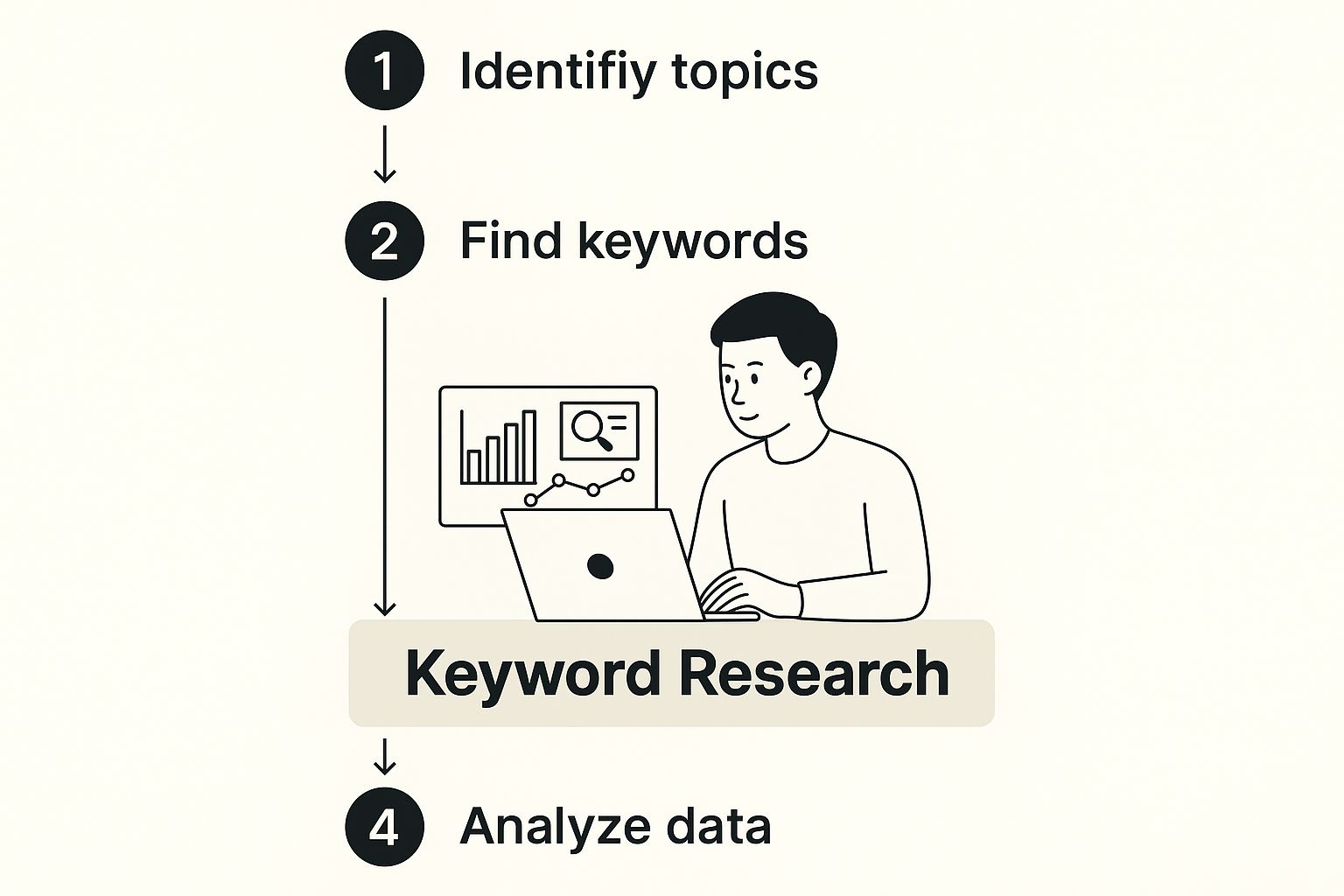
Once your technical foundations are solid, you can shift your focus to optimising individual pages. This is where you make it crystal clear to both people and search engines what your content is all about.
Here are the key on-page elements to get right:
- Title Tags: These are the blue, clickable headlines that appear in search results. They must be compelling and include your primary keyword, ideally near the start.
- Meta Descriptions: This is the short snippet of text below the title. While not a direct ranking factor, a well-written meta description acts as a free advert for your page, tempting users to click.
- Header Tags (H1, H2, H3): These give your content structure and create a logical hierarchy. Your main title should always be an H1, with subheadings as H2s and further points as H3s. This helps search engines quickly grasp the main topics and sub-topics of your page.
A compelling title tag and meta description can dramatically increase your click-through rate (CTR) from search results. A higher CTR tells Google your page is highly relevant for that search, which can positively influence your rankings over time.
Build a Logical Site Structure with Internal Linking
How your pages link to each other is crucial. A logical site structure, held together by a smart internal linking strategy, accomplishes two vital goals. First, it helps users and search engines navigate your site without getting lost. Second, it distributes “link equity” or authority throughout your site.
When you link from a high-authority page (like your homepage) to a newer, less powerful page (like a recent blog post), you pass some of that authority along, giving the new page a small but helpful boost.
For example, a UK-based e-commerce site selling handmade leather bags might structure its site like this:
- The Homepage links to a central “Shop” page.
- The “Shop” page links out to categories like “Tote Bags,” “Backpacks,” and “Satchels.”
- Each category page then links down to individual product pages.
- A relevant blog post, like “How to Care for Your Leather Bag,” would link back up to the relevant product and category pages.
This creates a clear, logical path for both users and search crawlers to follow. It also helps Google understand the relationships between your pages, reinforcing your topical authority on “handmade leather bags.”
To truly get to grips with these foundational elements, it’s often best to start with a thorough review. A comprehensive technical SEO audit checklist is the perfect tool to ensure no stone is left unturned.
Ultimately, remember that 75% of users never scroll past the first page of Google. Combining in-depth, valuable content with impeccable technical performance is essential to secure those top spots.
Frequently Asked Questions
What is technical SEO?
Technical SEO is all about optimising your website’s infrastructure. It helps search engine crawlers find, understand, and index your site more effectively. Think of things like improving site speed, ensuring it works perfectly on mobile, creating a sitemap, and using structured data.
Why are title tags so important for on-page SEO?
Title tags are a primary signal to search engines about a page’s topic. They’re also the first thing a user sees in the search results, making them critical for grabbing attention and signalling relevance to both people and algorithms.
How many internal links should I add to a page?
There’s no magic number here. The goal is to add links that feel natural and genuinely help the user. A good rule of thumb is to link to other relevant pages on your site whenever it enhances the reader’s experience or provides useful context.
Is it better to have a mobile-friendly site or a dedicated mobile app?
For most small businesses, a mobile-friendly (or responsive) website is the top priority. It guarantees accessibility for everyone, on any device, without needing a download. A mobile app is a much bigger investment and is usually better suited for businesses focused on repeat engagement or specific functions.
What’s the difference between on-page SEO and off-page SEO?
On-page SEO involves all the optimisations you make directly on your website, like tweaking content, title tags, and internal links. Off-page SEO refers to actions taken outside of your website to influence your rankings, such as building backlinks from other reputable sites.
Crafting a Powerful Content and Keyword Strategy
Technical fixes and on-page tweaks lay a solid foundation, but it’s your content that acts as the real engine, propelling your website to the top of the search results. To truly improve your website’s SEO, you need to move beyond just writing the odd blog post. It’s time to build a strategic content machine one designed to attract, engage, and convert your ideal UK audience.
It all starts with getting inside your customer’s head. You need to understand not just what they’re searching for, but why. This is the absolute core of effective keyword research.
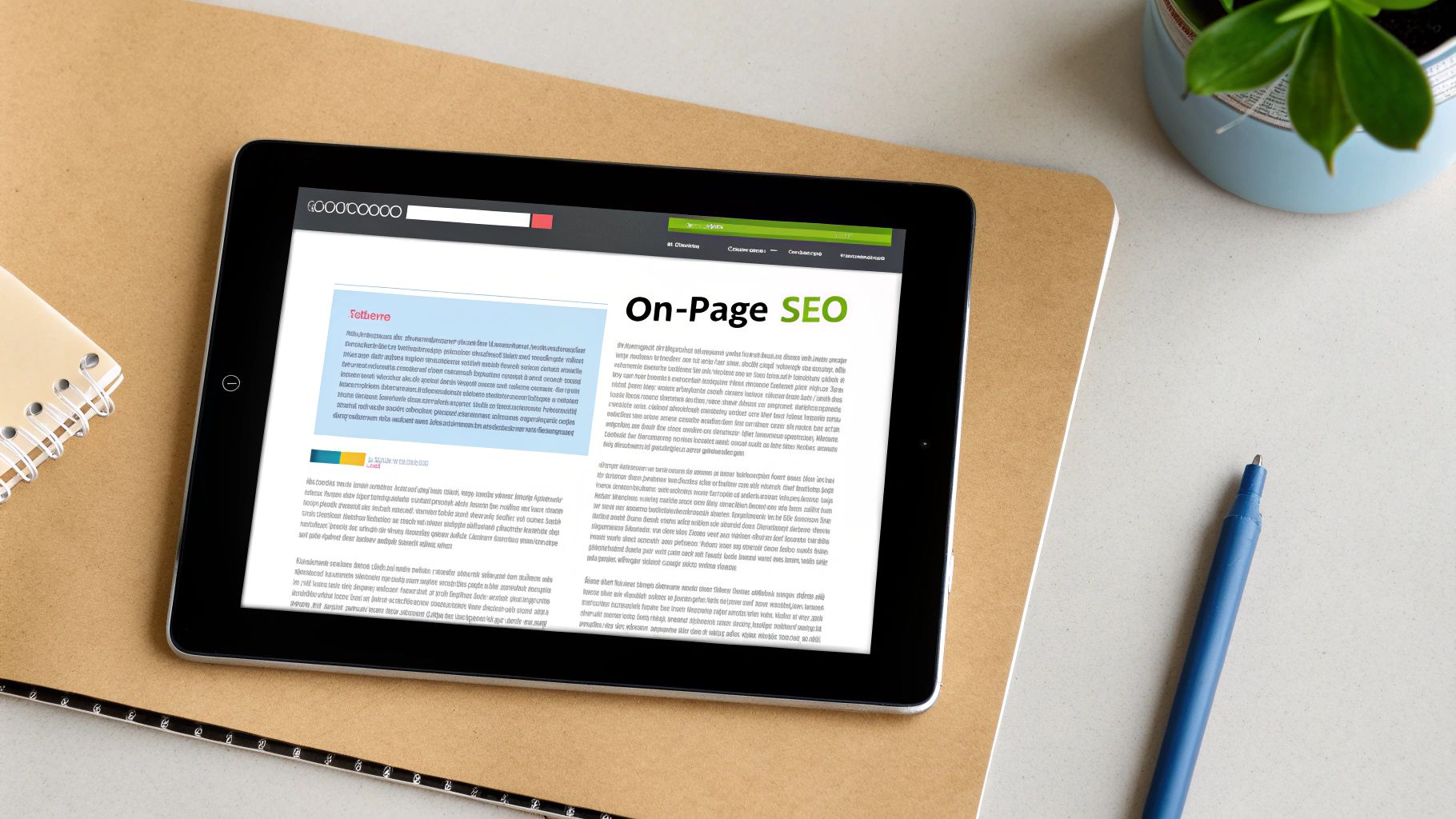
Decoding User Intent for Smarter Content
So much of modern SEO boils down to one thing: user intent. This is the real purpose behind a search query, and it’s your most valuable insight. Forget chasing high search volumes for a moment and think about what the user actually wants to achieve.
When you nail the intent, your content doesn’t just rank; it satisfies. A happy user is a massive signal to Google.
Understanding the nuances of https://gfctech.co.uk/keyword-research-in-seo/ is fundamental. We generally break intent down into four main types. By matching your content format to the user’s goal, you serve them what they actually need, not what you want to sell them.
To get this right, it helps to map out the different types of search intent and align your content formats accordingly.
Keyword Intent Analysis
Here’s a simple breakdown of how different UK search queries map to specific intents and the kind of content that works best for each.
| Search Intent | Example UK Query | Ideal Content Format |
|---|---|---|
| Informational | “how to fix a dripping tap” | In-depth “how-to” guide or video tutorial |
| Navigational | “GFC Tech blog” | Your website’s blog homepage or a direct link |
| Commercial | “best boilers for small homes UK” | Detailed comparison article or a buyer’s guide |
| Transactional | “emergency plumber in Epsom” | A service page with clear contact details and pricing |
Getting this alignment right is critical. If someone is looking for “how-to” information, a detailed guide will serve them far better than a hard-sell sales page. It builds trust and positions you as a helpful expert right from the first click.
From Keywords to High-Value Content
Once you understand the why, you can create the what. Your goal should be to produce content that is so genuinely useful that people might even pay for it but you’re giving it away for free. This is how you build the trust and authority that Google loves.
Instead of short, 500-word posts, focus on creating cornerstone assets that solve real-world problems. Think bigger.
- In-Depth Guides: Create the definitive resource on a core topic, like a complete guide to choosing a web designer in Surrey.
- Original Case Studies: Show, don’t just tell. Showcase how you solved a specific problem for a client, providing the social proof that convinces prospects.
- Data-Driven Articles: Analyse industry trends or conduct your own small survey to offer unique insights that others will want to link to.
A key principle I always come back to is what marketing expert Marcus Sheridan calls “They Ask, You Answer.” Identify the tough, awkward questions your customers are asking about pricing, problems, or how you stack up against competitors and answer them head-on. This is an untapped goldmine of SEO opportunities that most of your rivals are too scared to touch.
Organising Content With the Topic Cluster Model
A disorganised blog is like a library with no catalogue. It’s chaotic for users and confusing for search engines. To signal your deep expertise to Google and help visitors find related information easily, you need to structure your content logically using the topic cluster model.
It’s a simple but powerful concept:
- A Pillar Page: This is your big, comprehensive piece of content on a broad topic (e.g., “Local SEO for Small Businesses”). It covers the subject from A to Z.
- Cluster Content: These are shorter, more specific articles that dive into individual sub-topics (e.g., “Optimising Your Google Business Profile,” “How to Get Local Reviews”).
- Internal Links: This is the magic glue. Each cluster article links back up to the main pillar page, and the pillar page links out to all its supporting cluster articles.
This structure does two things brilliantly. First, it tells Google you’re an authority on the entire “Local SEO” topic, helping the whole cluster to rank higher. Second, it creates a seamless user experience, encouraging visitors to stick around and explore more of your content.
Of course, creating this much high-quality content consistently can be a real challenge. This is where new technologies can lend a hand, helping with things like scaling content creation effortlessly with AI. You can brainstorm ideas and get first drafts down more efficiently, leaving you to focus on injecting your unique human expertise and real-world insights.
Frequently Asked Questions
What is the difference between a keyword and a topic?
Think of it like this: a keyword is a specific phrase a user types in, like “best coffee shops in Reigate.” A topic is the broader subject that keyword belongs to, such as “local coffee culture.” A smart strategy targets broad topics by creating content around multiple, related keywords.
How long should a blog post be for SEO?
There’s no magic number, but longer, more in-depth content (often 1,500 words or more) generally performs better. Why? Because it allows you to cover a topic comprehensively. That said, the real priority is to fully answer the user’s query, whether that takes 800 words or 3,000.
What is a “long-tail keyword”?
A long-tail keyword is a longer, more specific search phrase, usually three or more words long (e.g., “emergency IT support for small business in Guildford”). They typically have lower search volume, but the user intent is much higher, making them incredibly valuable for conversions.
Should I update old content?
Absolutely. Regularly refreshing and updating old blog posts a tactic known as “historical optimisation” is one of the most powerful and underrated SEO strategies out there. It keeps your content accurate and relevant, which is a huge signal of quality to search engines.
How often should I publish new content?
Consistency trumps frequency every time. It’s far better to publish one high-quality, well-researched article each week than to churn out five short, low-value posts. Find a sustainable rhythm that allows you to maintain quality over the long haul.
Building Authority with Modern Link Building
Once you’ve sorted your content and technical foundation, the next challenge in learning how to improve website SEO is building authority. In Google’s world, authority is basically a measure of trust. The main way it works this out is through off-page SEO actions taken away from your own website. Link building is at the heart of this, but it’s time to forget the old-school idea of just collecting links for the sake of it.
Modern link building is all about earning genuine votes of confidence from other respected websites. Think of each high-quality backlink as a referral, telling search engines your content is credible and valuable. It’s what separates a good website from a great one.
Earning Links Instead of Just Building Them
The most sustainable way to build authority is to create something so good that other people want to link to it. This flips the script from constantly asking for links to creating resources that naturally draw them in. It’s a powerful, long-term approach that really works.
Here are a few “linkable asset” ideas to get you started:
- Original Research or Data: Run a quick survey of your local Surrey clients on an industry trend. Turn the findings into a sharp-looking article with charts. Journalists and bloggers are always on the lookout for fresh data to cite.
- Ultimate “How-To” Guides: Aim to create the single best, most detailed guide on a topic relevant to your audience. If you’re a local tradesperson, this might be “The Definitive Homeowner’s Guide to Boiler Maintenance in the UK.”
- Free Digital Tools: Develop a simple but genuinely useful calculator or checklist. A local financial advisor, for instance, could create a “UK Stamp Duty Calculator” that property and finance blogs would be happy to link to.
Scenario: A UK Fintech Startup Earning Authority
Let’s imagine a UK fintech startup trying to make waves in the mortgage industry. Their big goal is to earn backlinks from major financial news sites and established property blogs a tough nut to crack.
Instead of just sending out emails asking for links, they produce a meaty research report titled “The 2024 UK First-Time Buyer Affordability Index.” They dig into public data to highlight the most and least affordable towns for first-time buyers across the country.
This isn’t just another blog post; it’s a newsworthy asset. They then use digital PR to pitch the story to journalists at The Guardian Money, This is Money, and popular property blogs. Because it offers a unique, data-backed angle, the story gets picked up. The result? They land a handful of incredibly powerful backlinks from high-authority domains, giving their search rankings for competitive terms like “first-time buyer mortgage” a massive boost.
Authority isn’t built overnight. It’s the cumulative effect of consistently creating value and demonstrating expertise. A single, powerful link earned through genuine merit is worth more than a hundred low-quality links you paid for.
The Power of Guest Blogging and Brand Mentions
Strategic guest blogging is another solid way to build authority. The secret is to focus on relevance and quality, not just grabbing a link from any old site. For a Surrey-based business, writing for a respected blog like the Surrey Chamber of Commerce is far more valuable than a generic, global business site. It puts your brand in front of a relevant local audience and earns you a backlink that makes sense in context.
Don’t overlook unlinked brand mentions, either. When your business gets a positive shout-out online, even without a direct link, search engines can still pick up on these signals as a sign of credibility. Encouraging and keeping an eye on online reviews on platforms like Google Business Profile and Trustpilot is also a crucial part of this. These reviews build social proof for customers and add to the overall picture of a trusted, legitimate business that Google wants to rank.
Frequently Asked Questions
What is the difference between on-page and off-page SEO?
On-page SEO covers all the optimisations you make directly on your website, like improving content and fixing technical bits. Off-page SEO is everything you do away from your site to raise its profile, with the most important part being earning backlinks from other websites.
Are all backlinks equally valuable?
Not even close. A single backlink from a highly relevant and authoritative source (like the BBC or a major industry publication) is worth exponentially more than hundreds of links from low-quality, spammy directories. Quality always trumps quantity.
Is guest blogging still a good SEO strategy?
Yes, but only when it’s done right. The focus should be on providing real value to another website’s audience, not just bagging a link. Think of it as a PR and brand-building move first, with the backlink as a welcome bonus.
How do online reviews affect my SEO?
Online reviews, especially on your Google Business Profile, are a massive local ranking factor. A high volume of positive reviews tells Google you’re a trustworthy and popular local business, which can directly improve your visibility in local search and on Google Maps.
What is “digital PR”?
Digital PR blends traditional public relations with content marketing and link building. It involves creating compelling stories, data, or other assets and then promoting them to journalists and publications to earn media coverage and high-quality backlinks.
Winning the Local Search Battle in the UK
If your business serves a specific town, city, or region, getting a handle on local search isn’t just a good idea it’s your most direct route to customers who are actively looking to buy.
Think about it. When someone in Manchester searches for an “emergency plumber,” they need someone local, not a company based in London. Winning this local battle is non-negotiable if you want to drive real-world enquiries and foot traffic through your door.
The absolute cornerstone of any local SEO work is your Google Business Profile (GBP). This free listing is often the very first impression a potential customer gets of your brand. Leaving it half-finished is like having a shop with a broken sign and boarded-up windows; it just doesn’t inspire confidence.
Optimising Your Google Business Profile
To turn your GBP from a simple listing into a powerful customer-generating machine, you need to give it the same attention you give your website’s homepage. That means methodically filling out every single section Google offers you.
- Services: Don’t just list “Plumbing.” Get specific. Add “Boiler Repair,” “Blocked Drain Clearance,” “Leaky Tap Fixes,” and “Central Heating Installation.” This is how Google matches you to those very specific, high-intent searches.
- Photos: Make a habit of uploading high-quality photos. Show your team at work, your finished jobs (with permission, of course), your branded van, and your office or shop if you have one. This builds trust and proves you’re an active, legitimate business.
- Posts: Use Google Posts to share updates, special offers, or links to new blog articles. Treat it like a mini-blog right on your search profile. A post about “Winter Boiler Checks” in October shows you’re relevant and proactive.
- Q&As: Don’t wait for customers to ask questions answer them ahead of time. Add common questions like “What are your call-out charges?” or “Do you offer a 24-hour service?” and provide the answers yourself. This lets you control the narrative and save everyone time.
Your Google Business Profile isn’t a static directory listing; it’s a dynamic, living profile of your business. The more active you are adding photos, creating posts, and responding to reviews the more signals you send to Google that you are a relevant and authoritative local choice.
Building Local Authority and Trust
Beyond your GBP, Google looks for consistent signals across the web that confirm your business’s location and reputation. This is where local citations and reviews become critical. A strong local SEO strategy is essential for any small business looking to make an impact, as it focuses directly on attracting nearby customers. You can learn more by reading our detailed guide on local SEO for small business.
Recent data on UK marketing trends shows just how vital this has become. A huge 56% of UK businesses with an SEO strategy now focus specifically on Local SEO. This isn’t a niche tactic anymore; it’s a mainstream recognition that optimising for “near me” searches is one of the most effective ways to grow.
Frequently Asked Questions About Local SEO
1. What is a local citation?
A local citation is simply any online mention of your business’s name, address, and phone number (NAP). The key here is consistency. Your NAP must be identical everywhere, from your website to directories like Yell and your local Chamber of Commerce page.
2. How do I get more local reviews?
The easiest way? Just ask. The perfect time is right after you’ve completed a job successfully. You can send a quick follow-up email or message with a direct link to the review section on your Google Business Profile. Make it as simple as possible for happy customers to share their feedback.
3. Do I need a physical address to rank locally?
It helps, but it’s not essential. If you run a service-area business (like our Manchester plumber who travels to customers), you can hide your address in your Google Business Profile and instead specify the postcodes or areas you serve.
4. What are location-specific pages?
These are pages on your website dedicated to a particular town or area you serve (e.g., “Plumber in Stockport,” “Boiler Repair in Altrincham”). They allow you to create super-targeted content that speaks directly to customers in that location, which can massively improve your chances of ranking for those local searches.
5. How long does it take for Local SEO to work?
You can often see the first results from Local SEO, like better visibility in Google Maps, within a few months. But building solid, lasting authority through citations and reviews is an ongoing effort that delivers compounding benefits over time.
Measuring SEO Performance and Adapting Your Strategy
Real SEO isn’t a set-and-forget task; it’s a constant loop of action, measurement, and smart adjustments. To truly master how to improve your website’s SEO, you need to stop guessing and start thinking like a data-savvy strategist. This is how you turn a simple website into a hard-working, constantly improving asset for your business.
Your command centre for all this is right at your fingertips, and it’s free. Tools like Google Analytics 4 and Google Search Console give you all the essential data to see what’s working and, just as importantly, what isn’t. Forget about vanity metrics; we’re focusing on what actually moves the needle.

Key Metrics You Should Actually Track
Don’t get lost in a sea of data. Start by keeping a close eye on a handful of core indicators. These will give you a clear, no-nonsense picture of your SEO health over time.
- Organic Traffic Growth: Is the number of visitors finding you through search engines going up month-on-month? This is your top-level sign of success.
- Keyword Ranking Improvements: Are you climbing the ranks for the keywords that matter to your business? Use Google Search Console to monitor your average position for your main terms. A steady climb is exactly what you want to see.
- Click-Through Rate (CTR): Of all the people who see your site in the search results, what percentage actually clicks? If your CTR is low, it’s a strong hint that your title tags and meta descriptions need a rewrite to be more compelling.
Beyond these top-level numbers, digging into specific key content performance metrics can give you game-changing insights. This helps you figure out which content formats and topics are hitting the mark, so you can double down on what works.
Adapting to Google’s Core Updates
The world of search is always changing, mostly because of Google’s core updates. These major algorithm shifts can send rankings on a rollercoaster, and the worst thing you can do is react with panic. The smart move is to stay informed and act strategically.
The impact of a Google Core Update on UK website SEO performance can be massive. For instance, after one recent update, 85% of UK websites we monitored saw their search impressions double, then almost double again the next day. This kind of surge shows just how much these updates can shake things up, reinforcing why you need to adapt and stay aligned with Google’s latest guidelines.
The goal is to build a resilient SEO strategy. By consistently measuring performance and adapting to changes with a cool head, you create a foundation that not only survives but thrives in a constantly evolving environment.
Frequently Asked Questions About Measuring SEO
1. What is the most important SEO metric to track?
For most businesses, organic traffic is the king of metrics. It’s the clearest indicator of whether your SEO efforts are successfully attracting more potential customers from search engines over time.
2. How often should I check my SEO performance?
A monthly review is a solid rhythm for most small businesses. It’s often enough to spot trends but gives your strategies enough time to actually work. Checking daily is a recipe for knee-jerk reactions you’ll later regret.
3. What’s the difference between impressions and clicks in Google Search Console?
An impression means your website simply appeared in a search result. A click means someone was interested enough to click on your link and visit your site. You need impressions to get clicks, but clicks are what really count.
4. My traffic dropped after a Google update. What should I do first?
First, don’t panic. Confirm it was an official core update. Then, take a hard look at your content and compare it against Google’s quality rater guidelines. More often than not, these updates are designed to reward sites that demonstrate better expertise, authority, and trustworthiness.
5. Which tool is better for tracking SEO, Google Analytics or Search Console?
They’re a team, not rivals. Search Console is your go-to for understanding how you perform on Google (your keywords, clicks, impressions). Google Analytics tells you what people do after they land on your site. You need both to get the full picture.
Frequently Asked Questions about Improving Website SEO
1. How long does it take to see results from SEO?
SEO is a long-term strategy. While you might see initial movement in 3-6 months, it typically takes 6-12 months to see significant, lasting improvements in traffic and rankings. The timeline depends on your industry’s competitiveness, your starting point, and the consistency of your efforts.
2. What is the most important part of SEO for a small business?
For most small businesses, the highest-impact area is a combination of Local SEO and having a technically sound, mobile-friendly website. Optimising your Google Business Profile and gathering local reviews can drive immediate, tangible results from customers in your area.
3. Can I do SEO myself or should I hire an expert?
You can definitely handle basic on-page SEO, content creation, and Google Business Profile management yourself. However, for more complex areas like technical SEO audits, advanced keyword strategies, and authoritative link building, hiring an expert or agency can provide the specialised skills needed to compete effectively.
4. How much should I budget for SEO?
SEO budgets vary widely. Instead of thinking about a fixed cost, consider it an investment. A small business might start with a modest budget for essential tools and content, while a larger company in a competitive market will need to invest more heavily in content, technical expertise, and link-building campaigns to see a return.
5. Is SEO a one-time task?
Absolutely not. SEO is an ongoing process. Search engine algorithms are constantly updated, competitors are always working to outrank you, and your audience’s behaviour changes. Continuous effort in content creation, technical maintenance, and authority building is essential for sustained success.
Ready to turn these insights into action? At GFC Tech, we partner with Surrey businesses to build powerful, sustainable SEO strategies that deliver measurable results. Get in touch with us today to discuss how we can help your website climb the ranks.
Adam is a Founder of GFC Tech, a company dealing in SEO and website design and development services. Adam has been an SEO expert for the past 8 years and has been working with different companies in this field. He is an SEO consultant and a marketing strategist and works closely with his clients to ensure that his marketing plans and strategies provide them with the marketing advantages they need to grow their business. Adam’s main role is an SEO consultant, but he is also involved in all technical aspects. Adam also develops WordPress websites, designs them professionally and performs SEO for them so they can rank on the first page of google.


