

Trying to nail down the cost of a new WordPress website in the UK can feel a lot like asking, “how long is a piece of string?” The truth is, the final figure depends entirely on your project’s ambition. A simple brochure site might only set you back a few hundred pounds, whereas a complex eCommerce store can easily climb into the tens of thousands.
- A Realistic Look at Your WordPress Website Cost in the UK
- Why WordPress and How That Shapes Your Budget
- Breaking Down the Foundational Website Costs
- Choosing Your Build Path: DIY vs Freelancer vs Agency
- Planning for Ongoing and Hidden Website Costs
- Crafting a Realistic WordPress Website Budget
- Frequently Asked Questions About WordPress Costs
A Realistic Look at Your WordPress Website Cost in the UK
To get a real-world idea of your budget, it helps to think about WordPress sites in different tiers. Each level comes with more complexity, customisation, and professional firepower, which directly shapes the final WordPress website cost in the UK. Let’s put some numbers to these tiers to give you a clearer financial snapshot.
Before we dive into the nitty-gritty of what influences these prices, here’s a quick overview to help you see where your project might land on the cost spectrum.
Estimated WordPress Website Costs at a Glance
| Website Type | Typical Upfront Cost (UK) | Typical Monthly Cost (UK) |
|---|---|---|
| Basic Brochure/Blog | £500 – £1,100 | £40 – £100 |
| Bespoke Small Business | £960 – £15,000 | £100 – £350 |
| eCommerce Store | £15,000 – £60,000 | £350 – £800+ |
| Enterprise/SaaS Platform | £60,000+ | £500 – £1,500+ |
This table gives a bird’s-eye view, but what do those different website types actually involve? Let’s break it down.
From Simple Blogs to Complex Platforms
The investment needed for your WordPress website is tied directly to your business goals. Research shows a clear cost ladder:
- A basic brochure or portfolio site, often a DIY job or built by a freelancer, typically lands between £500 and £1,100. This is the perfect starting point for micro-businesses needing a simple, professional online presence.
- Bespoke small business websites with custom features and a unique design fall into a much broader range, from £960 to £15,000 for the initial build.
- For growing businesses needing a powerful eCommerce solution to sell products online, upfront costs can jump to anywhere between £15,000 and £60,000.
- At the very top end, large-scale enterprise or SaaS platforms built on WordPress can easily exceed £60,000, with some projects pushing past £100,000.
And don’t forget the running costs. Ongoing monthly fees for hosting, maintenance, and support must be factored in, ranging from around £40 for basic sites to over £500 for complex eCommerce platforms. For a deeper dive into what drives these figures, check out this insightful guide to UK website costs.
Why Is There Such a Wide Price Range?
The huge variation in cost boils down to one simple idea: customisation and expertise.
A straightforward website using a pre-made template is like buying a suit off the rack it’s affordable, looks smart, and you can have it almost instantly. A fully bespoke enterprise site, on the other hand, is like getting a suit tailor-made on Savile Row. It involves detailed strategy sessions, custom design, unique functionality, and a whole team of specialists.
Think of it this way: WordPress is the free, high-quality fabric. The final cost is determined by who you hire to cut, stitch, and design it into a functional garment that perfectly fits your business.
Getting your head around this distinction is the first step to setting a realistic budget. Your specific needs from how unique the design is to how many other systems it needs to talk to will ultimately decide where your project lands on the cost spectrum. In the next sections, we’ll break down exactly what you’re paying for.
Why WordPress and How That Shapes Your Budget
To get a handle on the WordPress website cost UK businesses are looking at, you first have to grasp why WordPress is such a dominant force. It’s not just a piece of software; it’s a massive global ecosystem. This community of developers, designers, and plugin creators has created a competitive marketplace, much like a bustling high street with everything from budget-friendly stalls to luxury boutiques.
This ecosystem is the single biggest reason for the wide spectrum of prices you’ll encounter. Because so many UK professionals work with WordPress, you have a huge range of options at your fingertips. You can find an affordable freelancer for a quick start, or you can partner with a specialist agency for a high-end, bespoke build. It’s this choice that ultimately puts you in control of your budget.
The LEGOs vs Custom Sculpture Analogy
Think of building your website in one of two ways. Using a pre-designed WordPress theme is like building with a LEGO set. You get all the pieces and a clear set of instructions, letting you put together something functional and recognisable relatively quickly and affordably. It’s a brilliant way to get started without a huge initial outlay.
A custom-built WordPress site, on the other hand, is like commissioning an artist to create a unique sculpture. The artist your developer or agency starts with a raw block of clay (the core WordPress software) and shapes it precisely to your vision. This process is far more intensive, requires specialised skill, and results in a one-of-a-kind creation perfectly aligned with your brand.
Both methods use WordPress as their foundation, but the approach, time, expertise, and cost are worlds apart. This flexibility is a core reason why so many businesses choose WordPress. If you want to explore this further, we’ve broken down the top 10 reasons to choose WordPress for your business.
The real power of WordPress lies in its scalability. You can start with a simple LEGO-like template site and, as your business grows, gradually add custom-sculpted features without having to tear everything down and start from scratch.
This ability to scale is a huge asset for any growing business. The platform’s market dominance also ensures a constant stream of new tools and talent, making it a future-proof choice for your online presence.
Market Dominance and Its Impact on Price
WordPress’s immense popularity directly influences what you’ll pay for development. It powers an incredible 43.6% of all websites on the internet, which creates a highly competitive market for services here in the UK.
This competition means you can find a developer or agency at almost any price point. You could pay a modest £500 for a simple site built from a template, or you could invest £10,000 or more for a feature-rich, custom-built project with complex needs like e-commerce or a membership system.
Breaking Down the Foundational Website Costs
Every house needs a solid foundation, and every website has core costs you simply can’t get around. Before you even start thinking about fancy designs or features, you need to get your head around these essential building blocks. They’re the non-negotiable expenses that form the baseline for any WordPress website cost in the UK.
I like to call these the “Big Three” for getting your website online: your domain name, your web hosting, and an SSL certificate. Without them, your beautifully designed website would have no address, no plot of land to live on, and no security guard at the door.
Your Domain Name: The Digital Address
Your domain name is your website’s unique address on the internet, like yourbusiness.co.uk. It’s how customers find you, and frankly, it’s a huge piece of your brand identity.
- Cost: A standard
.co.ukdomain will typically set you back £10 to £20 per year. - Analogy: Think of it as the postcode for your digital shop. It needs to be memorable, easy to spell, and obviously linked to your business name.
Nailing this first step is crucial. It’s a small but absolutely essential ongoing expense.
Web Hosting: The Plot of Land
If your domain is the address, then web hosting is the actual plot of land where your website’s files, images, and content are stored. The type of hosting you pick has a massive impact on your site’s speed, security, and how much you’ll pay.
To make it clearer, let’s compare hosting to renting property:
Shared Hosting: This is like renting a room in a shared flat. You’re sharing the server resources (space, power, memory) with lots of other websites. It’s the cheapest way to start, usually £5 – £15 per month, but performance can dip if one of your “neighbours” gets a sudden rush of traffic.
VPS (Virtual Private Server) Hosting: This is more like a semi-detached house. You’re still in the same building (the main server), but you get your own partitioned space with guaranteed resources. It delivers much better performance and security, costing somewhere between £20 – £60 per month.
Dedicated Hosting: This is your own private mansion. You rent an entire server just for your site, giving you maximum power, control, and security. It’s the go-to for high-traffic or busy eCommerce sites and usually costs £80 – £300+ per month.
SSL Certificate: The Digital Security Guard
An SSL (Secure Sockets Layer) certificate is what puts the “s” in https:// and adds that little padlock icon in the browser bar. It encrypts the connection between your website and your visitors, keeping their data safe from prying eyes.
These days, an SSL certificate is completely non-negotiable. Google actively flags sites without one as “Not Secure,” which is enough to scare away potential customers and sink your search rankings. Thankfully, most decent UK hosting providers now include a free SSL certificate with their plans. If not, expect to pay £50 – £150 per year.
Beyond the basic WordPress setup, don’t forget that these foundational costs often include small investments in essential WordPress plugins which add vital functions like security scans or better SEO.
Choosing Your Build Path: DIY vs Freelancer vs Agency
Deciding how to get your WordPress site built is one of the most important calls you’ll make. It directly shapes your final WordPress website cost in the UK, how long it takes, and what your new site can actually do. There are three main routes, each with its own set of trade-offs. The right choice for you will come down to your budget, your technical comfort level, and where you see your business heading.
So, let’s break down these paths: the hands-on DIY approach, the balanced expertise of a freelancer, and the all-in-one service of a web design agency.
The Do-It-Yourself (DIY) Route
Building a WordPress site yourself is, without a doubt, the cheapest option upfront. This path means you’ll be picking a theme, wrestling with page builders like Elementor or The Divi Builder, and figuring out all the settings on your own. Think of it like flat-pack furniture; you get all the bits and pieces, but the final assembly and quality are entirely in your hands.
- Best for: Startups, hobby bloggers, or micro-businesses on a shoestring budget who have the time and desire to learn.
- Cost: Very low to start. You’re mainly paying for hosting, a domain name, and maybe a premium theme or a few plugins, typically adding up to £100 – £400.
- Main Trade-off: What you save in cash, you spend in time. The learning curve can be surprisingly steep. Worse, without a professional eye, it’s easy to miss crucial details on security, speed, and SEO that can come back to bite you later.
Hiring a WordPress Freelancer
Bringing in a freelancer is the classic middle-ground option. You get professional skills without the big overheads of an agency. A good UK-based freelancer can deliver a high-quality, semi-custom site that’s secure, fast, and looks the business. They’ve been around the block, so they know how to dodge common mistakes and produce a far more polished site than most DIY efforts.
It’s like hiring a skilled joiner to assemble and customise your flat-pack furniture. They have the right tools and the experience to make it look professionally fitted, saving you a world of time and frustration while guaranteeing a solid end product.
Key Insight: A freelancer is often the sweet spot for small businesses that have outgrown the DIY phase but don’t yet need the deep strategic muscle of an agency. It’s a cost-effective way to get a professional, tailored website that actually gets results.
Partnering with a Web Design Agency
Going with a web design agency is the premium choice, and for good reason. This isn’t just about building a website; it’s a strategic partnership. An agency brings a whole team to the table strategists, project managers, UX/UI designers, developers, and marketers all collaborating on your project. The process is far more in-depth, often kicking off with discovery workshops, competitor analysis, and mapping out user journeys before a single line of code is written.
This route is like commissioning an architect and a crew of master builders to design and construct a custom home from the ground up. Every detail is planned, bespoke, and built to the highest standard for peak performance and longevity. Naturally, this comprehensive service is reflected in the higher wordpress website cost uk that agencies command.
- Best for: Established businesses, ambitious scale-ups, and eCommerce stores that see their website as a critical, high-performance business asset.
- Cost: This is the highest level of investment, with projects often starting from £3,000 and scaling up from there.
- Main Benefit: You get a top-tier, completely unique website built around your specific business goals, backed by a team of diverse experts and often including ongoing strategic support.
To help you weigh these options, here’s a quick comparison of the three main approaches.
Comparing Website Build Options: DIY vs Freelancer vs Agency
| Factor | DIY Approach | Hiring a Freelancer | Partnering with an Agency |
|---|---|---|---|
| Cost | Lowest (£100 – £400+) | Mid-range (£2,000 – £8,000+) | Highest (£10,000+) |
| Time Investment | Very High | Low | Very Low |
| Skill Level Required | High (or steep learning curve) | None (you’re hiring skills) | None (you’re hiring a team) |
| Customisation | Limited to themes/plugins | High (semi-custom to bespoke) | Complete (fully bespoke) |
| Strategic Input | None (it’s all on you) | Varies (some offer advice) | Comprehensive (core to process) |
| Support | Community forums, self-help | Direct, one-to-one | Dedicated project manager & team |
Ultimately, there’s no single “best” path only the one that fits your current needs, budget, and future ambitions.
No matter which path you take to get your site launched, don’t forget that the initial build is just the start. Ongoing costs are a crucial piece of the puzzle.
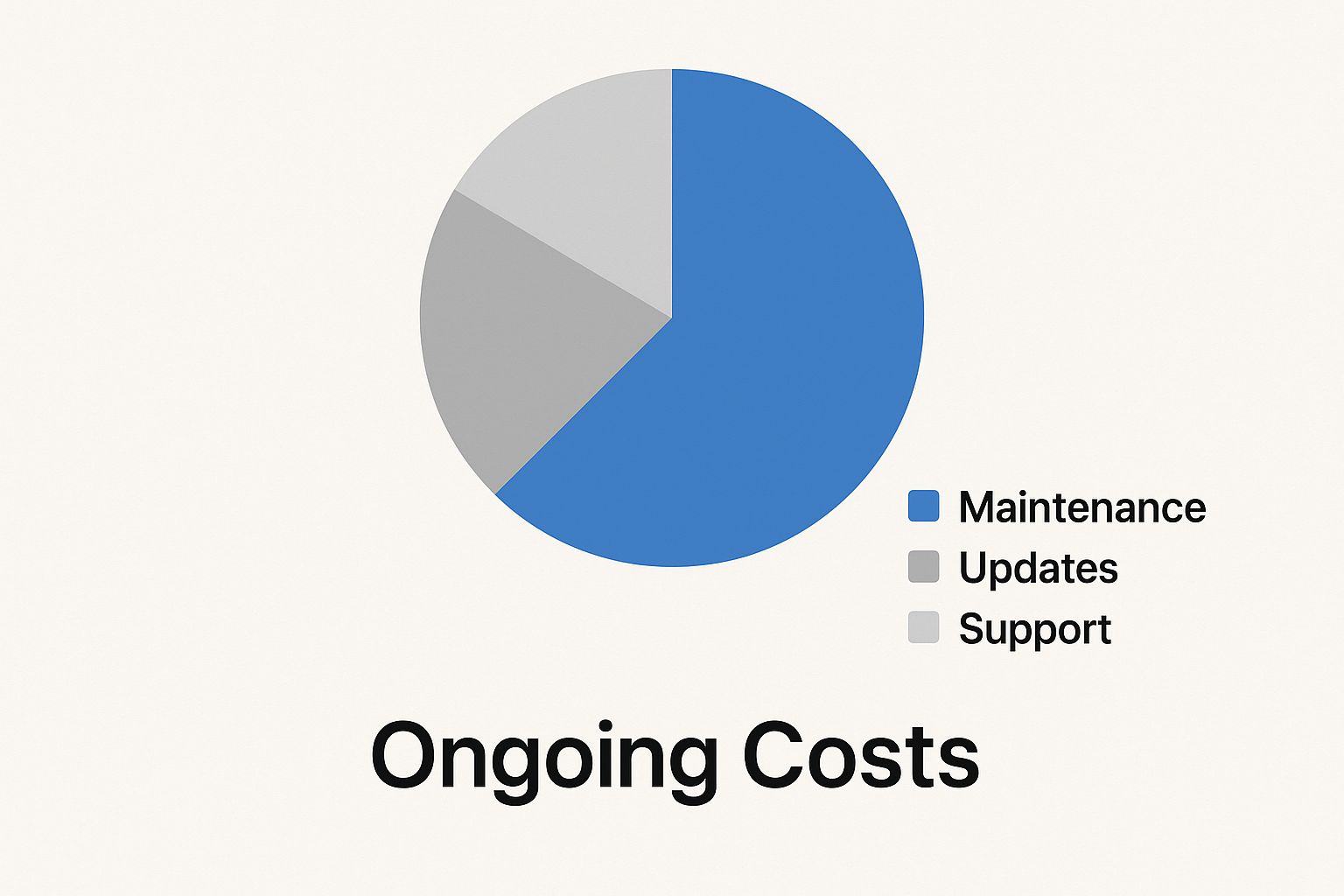
As the image shows, the real journey begins after launch. Continuous investment in maintenance, security, and updates is what keeps a website healthy and effective in the long run.
Planning for Ongoing and Hidden Website Costs
Getting your website live is the starting line, not the finish. It’s a common pitfall for businesses to focus all their attention on the initial build price, only to get blindsided by the recurring costs needed to keep the site healthy, secure, and actually doing its job long-term.
It helps to think of your website like a new car. The upfront purchase is the big one, sure, but you wouldn’t expect it to run forever without fuel, insurance, or an annual MOT. Your website is no different; it needs continuous investment to perform well and deliver a return.
Getting your head around these long-term financial commitments is crucial for creating a budget that doesn’t fall apart after a few months. Let’s break down the most common ongoing costs you need to plan for beyond the initial launch.
Essential Website Maintenance and Care
Just like the software on your computer, the bits and pieces that make up your WordPress site the core system, plugins, and theme get regular updates. These aren’t optional; they’re critical for plugging security gaps and boosting performance.
Regular website maintenance is your first line of defence against hackers and slowdowns. A typical care plan from a freelancer or agency here in the UK will likely cost between £40 and £250 per month. This service usually covers the essentials:
- Software Updates: Keeping WordPress core, plugins, and themes current.
- Regular Backups: Creating secure copies of your site, so it can be restored quickly if the worst happens.
- Security Monitoring: Actively scanning for malware and any suspicious activity.
- Performance Checks: Making sure your site stays fast and responsive for your visitors.
A well-maintained website is a secure and fast website. Neglecting these tasks is like leaving your digital front door unlocked it’s not a matter of if you’ll have a problem, but when.
Recurring Premium Plugin and Theme Licences
While tons of excellent WordPress plugins are free, the most powerful and reliable tools often come with an annual subscription fee. This fee gets you access to ongoing updates and, crucially, professional support when you really need it.
These recurring costs can add up, so it’s vital to audit them each year. Common subscriptions you might have include:
- Premium Page Builders (e.g., Elementor Pro)
- Advanced Form Builders (e.g., Gravity Forms)
- eCommerce Extensions (e.g., specific WooCommerce add-ons)
- SEO Tools (e.g., Yoast SEO Premium)
Forgetting to renew a licence can break a key feature on your site or leave it wide open to attack. Budgeting for these renewals, which can range from £50 to £500+ per year, is a non-negotiable part of managing the ongoing WordPress website cost UK businesses face.
Investments in Growth and Visibility
A brilliant website that nobody can find is just an expensive digital ornament. To attract visitors and actually generate leads, you need to invest in digital marketing. Search Engine Optimisation (SEO) is the most vital long-term strategy for organic growth, involving the continuous work of optimising your site to rank higher in Google for the terms your customers are searching for. If you’re wondering about the investment required, you can learn more about how much SEO costs in our detailed guide.
Beyond SEO, your growth budget might also cover:
- Content Creation: Writing regular blog posts or creating new page content.
- Pay-Per-Click (PPC) Advertising: Running Google or social media ad campaigns.
- Email Marketing: Paying for a platform like Mailchimp or ActiveCampaign.
These aren’t so much hidden costs as they are strategic investments. Allocating a monthly budget for marketing is what turns your website from a passive online brochure into an active lead-generation machine.
Crafting a Realistic WordPress Website Budget

Alright, let’s turn all this information into a proper financial plan. Building a solid budget for your website isn’t about plucking a number out of thin air; it’s about a structured process that gives you control over the final WordPress website cost in the UK. This framework will help you get from a vague idea to an actionable plan.
Your first move is to define exactly what you need, in as much detail as you can muster. Go beyond a simple “I need a new website” and list out every single function and feature you want. This detailed brief is the most important document you’ll create, as it forms the bedrock of any quote you get from a freelancer or agency.
Must-Haves vs Nice-to-Haves
Once you have your wish list, it’s time for some honest prioritisation. Split your requirements into two columns: the ‘must-haves’ and the ‘nice-to-haves’.
- Must-Haves: These are the non-negotiable features your site needs to function and achieve its main goal. For an online shop, this means product pages, a shopping cart, and a secure checkout. No compromises here.
- Nice-to-Haves: These are the bells and whistles that would be great to have but aren’t critical for launch day. Think customer login areas, advanced search filters, or even a blog.
This simple exercise is your secret weapon for budget management. If the first quotes come back a bit punchier than you hoped, your ‘nice-to-haves’ list is the first place you’ll look to postpone features to a later phase, bringing the project back in line with your funds. You can find more practical advice on our guide to understanding small business website design costs.
Key Insight: One of the smartest moves you can make is building a contingency fund right into your budget. Tuck away an extra 10-20% of the total project cost. This acts as a safety net for any unexpected needs or brilliant ideas that pop up mid-project, stopping them from derailing your launch.
For instance, if you’re building an online shop, don’t just budget for the design. You need to dig into the specific costs associated with running a WooCommerce store to get a truly realistic picture. This level of detail ensures you don’t get hit with surprises later on.
Frequently Asked Questions About WordPress Costs
Trying to pin down the financial side of a new website can bring up a lot of questions. We get it. Here, we’ll tackle the most common queries businesses have when trying to understand the WordPress website cost UK developers and agencies quote, giving you clear, straightforward answers.
Can I Get a WordPress Website for Free?
While the core WordPress software is open-source and genuinely free to download, getting a professional, public-facing website live is never truly a zero-cost exercise. There are a couple of unavoidable costs you have to account for right from the start.
At the bare minimum, you’ll need to pay for:
- A Domain Name: This is your site’s address on the web (like
yourbusiness.co.uk). You can expect this to cost around £10 to £20 per year. - Web Hosting: This is the online space where your site’s files live. Basic hosting plans start from as little as £5 to £10 per month.
And while there are thousands of free themes and plugins, you’ll quickly find that for a serious business site, premium options are a necessary investment. They simply offer better features, tighter security, and dedicated support when you need it most.
How Much Does an eCommerce WordPress Site Cost in the UK?
Building a website to sell products online is a much bigger job than a simple brochure site, so it naturally costs more. The final price really hinges on the scale of your operation and the specific features you need. For a small business using WooCommerce (the go-to eCommerce plugin for WordPress), a build from a UK-based freelancer could start in the £2,500 – £7,000 region.
If you’re after a more scalable, custom-designed eCommerce platform from a web design agency, the investment ramps up considerably. You should budget for an initial cost anywhere from £15,000 to £60,000, and sometimes more. That higher figure covers advanced features like custom payment gateway integrations, complex shipping rules, and sophisticated inventory management systems.
Why Do Agency Prices Vary So Much?
The wide swing in agency pricing boils down to differences in team size, depth of experience, the rigour of their process, and the overall level of service you get. A larger agency has higher overheads, but you’re also paying for a dedicated team often including a project manager, strategist, designer, and developer all working on your project.
An agency’s higher price tag reflects a more strategic, in-depth partnership. Their process often includes discovery workshops, user experience (UX) research, competitor analysis, completely custom design, and rigorous testing, all contributing to a higher-quality, more effective final product.
This approach is fundamentally different from just “building a website”; it’s about creating a strategic business asset designed for real growth.
What Are the Typical Monthly Maintenance Costs?
Monthly maintenance is an absolutely vital ongoing cost. Neglecting it is a huge risk to your site’s security, speed, and overall health. A basic maintenance plan from a freelancer or small agency in the UK typically costs between £40 and £100 per month. This usually covers core software updates, routine security scans, and daily or weekly backups.
For more complex sites, especially online stores, you’ll need a more robust plan. These can range from £100 to over £500 per month, often including performance monitoring, uptime checks, a set number of support hours for small tweaks, and more detailed reporting.
Does a Custom Theme Cost More Than a Premium Template?
Yes, a custom theme costs significantly more, and it’s important to understand the distinction. A premium template is an off-the-shelf design you buy for a one-time fee, usually around £50 – £100. It’s a product, sold to thousands of people.
A custom theme, on the other hand, is a bespoke service. It’s designed and coded from the ground up, exclusively for your brand and your specific business goals. This involves the dedicated time and expertise of strategists, UX/UI designers, and developers. The cost for this service, which can easily start from £5,000 and go much higher, is factored into the total project price when you partner with a professional freelancer or agency.
Ready to build a high-performing WordPress website that drives real results for your business? At GFC Tech, we combine technical expertise with a strategic, client-first approach to create bespoke websites and SEO strategies for small businesses across Surrey. Contact us today for a no-obligation chat about your project.
Adam is a Founder of GFC Tech, a company dealing in SEO and website design and development services. Adam has been an SEO expert for the past 8 years and has been working with different companies in this field. He is an SEO consultant and a marketing strategist and works closely with his clients to ensure that his marketing plans and strategies provide them with the marketing advantages they need to grow their business. Adam’s main role is an SEO consultant, but he is also involved in all technical aspects. Adam also develops WordPress websites, designs them professionally and performs SEO for them so they can rank on the first page of google.


