

Bringing more visitors to your website isn’t about finding a single magic trick. It’s about combining a solid technical setup, smart SEO, and content that people genuinely want to read. The whole game is about building a site that search engines can understand and that real people actually love to visit.
Building Your Foundation for Traffic Growth
Before you start chasing after traffic, you need to get your foundations right. Too many website owners jump straight into tactics without figuring out their site’s real purpose. It’s like trying to build a house on sand. A strong foundation makes sure that every bit of effort you put in contributes to long-term, sustainable growth, not just temporary visitor spikes.
This groundwork starts with knowing exactly who you’re trying to reach. In the UK, this is especially crucial. As of January 2025, the country had 67.8 million internet users that’s a penetration rate of 97.8%. With nearly everyone online, the only way to cut through the noise is to deliver something exceptionally relevant and high-quality that grabs their attention.
Defining Your Website’s Core Purpose
First things first: what is your website actually for? Is its main job to generate leads for your Surrey-based business, sell products online, or position you as the go-to expert in your field? Without a crystal-clear answer, your efforts will be scattered and ineffective.
Your purpose should be the guiding star for every decision you make, from the blog topics you choose to the layout of your landing pages. A local plumber’s website, for instance, has a completely different goal than a national e-commerce shop, and their strategies for getting traffic must reflect that.
A website without a clear purpose is just a digital brochure that no one reads. Defining your primary objective is the first and most critical step in creating a strategy that actually attracts the right kind of traffic.
Understanding Key Traffic Sources
Traffic doesn’t just appear from one place. The most successful websites build several streams of visitors to create a reliable and consistent flow. These sources generally fall into a few key categories.
Before diving into the specifics of attracting visitors, it’s helpful to see the bigger picture. The main ways people will find your site can be grouped into a few core pillars, each with its own goals and actions.
Core Pillars of Website Traffic Growth
| Pillar | Primary Goal | Key Actions |
|---|---|---|
| Organic Search (SEO) | Attract high-intent visitors from search engines. | Keyword research, on-page optimisation, content creation, link building. |
| Content Marketing | Build authority and engage your target audience. | Blogging, creating guides, making videos, sharing infographics. |
| Social Media | Drive community engagement and referral traffic. | Posting updates, sharing content, running targeted ad campaigns. |
| Paid Advertising (PPC) | Generate immediate, targeted traffic. | Google Ads, social media ads, display advertising. |
| Email Marketing | Nurture leads and drive repeat visits. | Sending newsletters, automated sequences, promotional campaigns. |
| Referral Traffic | Gain visitors from other trusted websites. | Guest posting, PR, securing backlinks, affiliate partnerships. |
This table serves as a quick reference, but remember that the best results come from weaving these pillars together into a cohesive strategy. Each one supports the others.
This infographic breaks down the most common channels that bring traffic to a website.
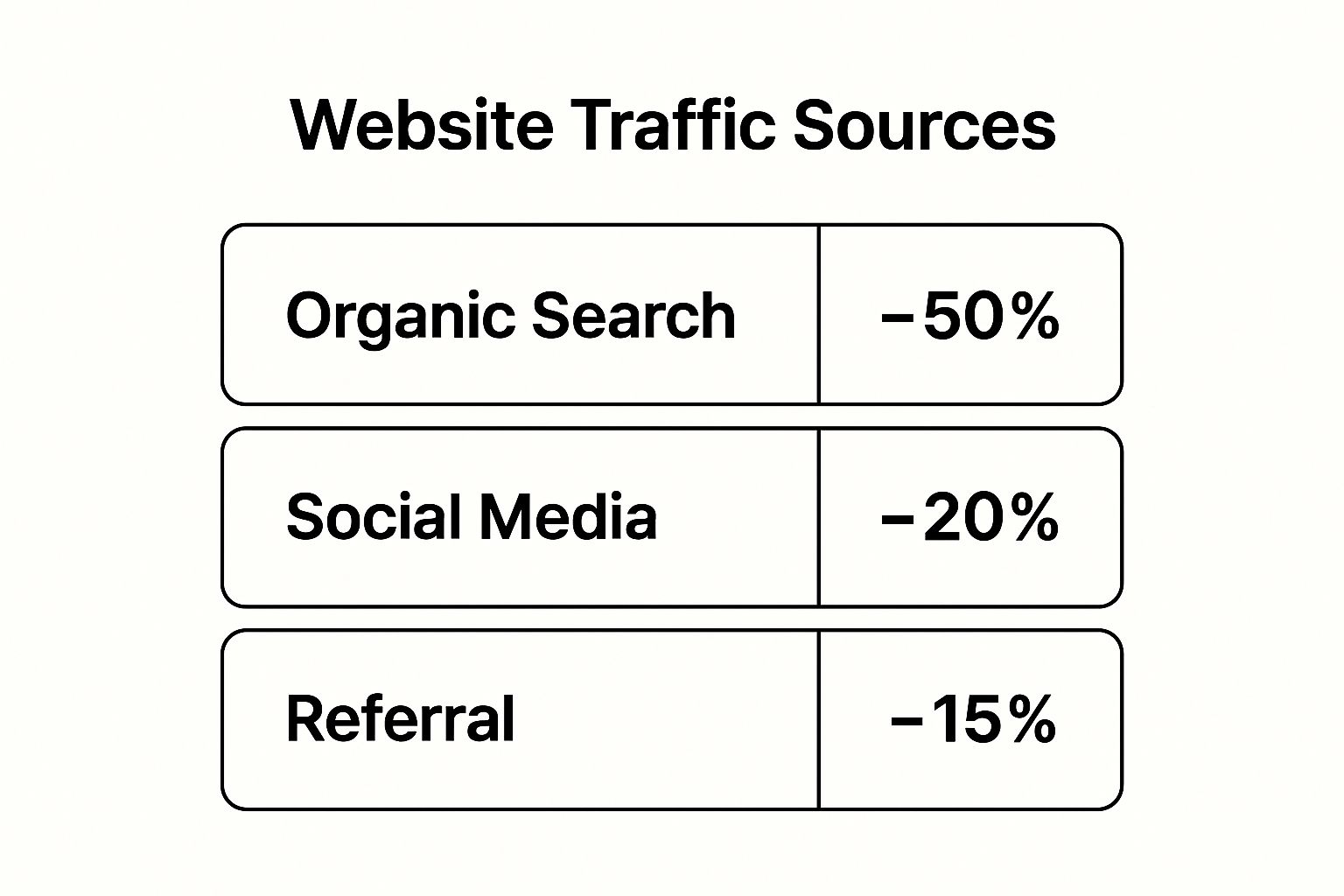
As you can see, organic search is the clear winner here, which underscores just how vital SEO is. But a healthy mix of social media and referral traffic is what creates a truly resilient, well-rounded strategy. With your foundation sorted.
Mastering SEO to Capture Search Traffic
Search Engine Optimisation, or SEO, is the single most powerful engine for driving a steady flow of high-quality traffic to your website. This isn’t about trying to trick Google; it’s about genuinely understanding what your audience is looking for and then creating the absolute best, most relevant answer to their question. Nail this, and you’ll earn your spot on the first page of the search results where over 90% of all clicks happen.
For a business here in Surrey, this means you have to get specific. Forget targeting a broad, nationwide term like “plumber.” A much smarter approach is to focus on what real people are actually typing in, like “emergency plumber in Guildford” or “boiler servicing in Reigate.” This shift from vague keywords to long-tail, intent-driven phrases is your golden ticket to attracting local customers who are ready to pick up the phone.
Crafting Pages That Search Engines and Users Love
Once you’ve figured out what people are searching for, you need to build your pages to meet that need head-on. This is what we call on-page SEO, and it involves a few key elements that work together to signal relevance and quality to search engines.
It all starts with your page titles and meta descriptions. These are the very first things a potential customer sees in the search results. Think of a compelling title and a persuasive description as your digital shop window they need to be enticing enough to make someone choose your result over a competitor’s.
But it doesn’t stop there. Several other on-page factors are just as crucial:
- User-Friendly URLs: Keep your web addresses short, clean, and descriptive. For instance,
your-site.co.uk/services/boiler-repairis worlds better than a messy URL likeyour-site.co.uk/p?id=123. - Smart Headings: Use headings (like H2s and H3s) to give your content a logical structure. This helps both human readers and search engine crawlers quickly grasp the hierarchy of your information.
- Internal Linking: Weaving links between relevant pages on your own site is a massively underrated tactic. It helps visitors discover more of your great content and spreads authority across your entire website, giving all your pages a lift. For a deeper look, check out our guide on how to improve website SEO.
Satisfying Search Intent The Right Way
At the end of the day, Google’s one and only goal is to serve up the most helpful result for any given query. This is what’s known as satisfying search intent. If someone searches “how to fix a leaking tap,” they’re looking for a step-by-step guide or maybe a quick video tutorial not a hard sales page. Giving them the right information, in the right format, is critical for ranking well.
SEO is never a “set it and forget it” job. Search engine algorithms are constantly evolving to better understand user intent and content quality. Staying on top of these changes is essential if you want to maintain and grow your traffic.
For example, major algorithm updates can completely shake up the search results. We saw this first-hand in the UK following Google’s June 2025 core algorithm update, which caused a dramatic surge in website impressions for businesses that were prepared. This is precisely why adapting your strategy is so crucial for long-term success.
Ultimately, mastering SEO is about creating a seamless, valuable experience. It’s about delivering well-structured content that directly answers your audience’s questions, turning casual searchers into loyal visitors.
Frequently Asked SEO Questions
- What is the difference between on-page and off-page SEO?
On-page SEO covers all the optimisations you do on your own website, like improving your content and meta tags. Off-page SEO, on the other hand, involves actions taken off your site to build its authority, mostly by earning backlinks from other reputable websites. - How long does it take for SEO to work?
It’s a marathon, not a sprint. While you might spot minor improvements in a few weeks, seeing significant organic traffic growth from SEO typically takes 4-6 months. It’s a long-term strategy that builds sustainable results over time. - Are keywords still important for SEO?
Yes, absolutely, but their role has evolved. The old-school tactic of “keyword stuffing” is long gone. Today, the focus is on using them naturally within high-quality, relevant content that genuinely addresses the user’s search intent. - Do I need technical skills to do SEO?
Not necessarily. While some aspects of technical SEO can get complex, many of the foundational practices are very accessible. Writing great content, optimising your page titles, and creating a user-friendly site structure are things most business owners can tackle. - Is local SEO different from regular SEO?
Yes, it is. Local SEO is a specialised field focused on making you visible in a specific geographic area, like Surrey. It involves optimising your Google Business Profile, building local citations, and targeting keywords that include your location.
Creating Content That People Want to Read

Let’s be honest: great content is the single most powerful magnet you have for attracting visitors. But it’s time to move past the vague advice of just “writing good stuff”. If you genuinely want to increase traffic to your website, you need to create content that solves real-world problems for your audience, making your site the go-to resource in your field.
This means every article, guide, or case study must have a crystal-clear purpose before you even type a single word. Who is this for? What problem does it fix for them? Answering these questions is what separates content that gets ignored from content that pulls in consistent, valuable traffic.
Brainstorming Topics That Solve Problems
Your best content ideas will almost always come directly from your audience’s pain points. Instead of guessing what people want, you need to find out for real.
A simple but incredibly effective method is to put yourself in your customer’s shoes. For a local business in Surrey, what are people constantly asking? A tradesperson might find their customers always have questions about project costs, timelines, or material choices. Each of these questions is a fantastic starting point for a blog post.
Here are a few other proven ways to find topics that hit the mark:
- Analyse Competitor Content: See which articles are driving traffic for your competitors. Can you create something more detailed, more up-to-date, or more practical?
- Browse Online Communities: Forums like Reddit or Q&A sites like Quora are absolute goldmines for discovering the exact language people use when describing their problems.
- Listen to Your Customers: Pay close attention to the questions you get via email, phone calls, or face-to-face. These are direct, unfiltered insights into what your audience needs to know.
Using Different Formats to Keep Readers Engaged
Not every piece of content should be a standard blog post. Varying your formats is key to keeping your audience interested and allows you to tackle topics from different angles. It’s a core part of what we call content marketing the whole cycle of creating and sharing valuable stuff to attract a specific audience.
Think beyond the article. Consider these powerful formats to build out your content arsenal:
- In-Depth Guides: These are comprehensive articles that cover a topic from start to finish. They become cornerstone assets that can attract links and traffic for years.
- Original Research: Surveying your audience or analysing industry data can produce unique insights that others will want to cite, building your authority and earning valuable backlinks.
- Case Studies: Showcasing how you helped a client achieve real results provides powerful social proof and demonstrates your expertise in a tangible way.
- Landing Pages: While not a blog post, a well-designed landing page is essential for converting the traffic your content generates. You can learn more by reading our complete guide on how to create landing pages.
Building Authority with Topic Clusters
One of the most effective strategies for organising your content and signalling expertise to search engines is the topic cluster model. This involves creating a main “pillar” page on a broad topic, which is then supported by several “cluster” articles that dive into more specific subtopics.
The topic cluster model moves your site from being a collection of random blog posts to an organised library of expertise. It shows search engines you have deep knowledge on a subject, which is critical for ranking well.
For instance, a marketing agency could create a pillar page on “Digital Marketing for Small Businesses.” This page would then link out to cluster posts like “Local SEO Basics,” “Creating a Social Media Calendar,” and “Email Marketing Tips.” This structure not only helps users find related information easily but also builds your site’s topical authority in the eyes of Google.
Frequently Asked Questions About Content Creation
1. How often should I publish new content?
Consistency beats frequency, every time. It’s far better to publish one high-quality, well-researched article per week than three rushed, low-value posts. Start with a schedule you can realistically stick to.
2. How long should my blog posts be?
The length should be dictated by the topic’s complexity. Your goal should be to create the most comprehensive resource on the subject. While longer content (over 1,500 words) often performs better in search results, don’t add fluff just to hit an arbitrary word count.
3. Should I delete old content?
Not necessarily. Instead of deleting, identify underperforming old posts and give them an update. Improving the content, adding new information, and re-optimising it for current SEO best practices can give it a whole new lease of life.
4. How do I come up with ideas when I feel stuck?
Look at your most popular existing posts and create follow-up content that dives deeper into a specific aspect. You can also repurpose content turn a blog post into an infographic, a video, or a handy checklist.
5. Is it okay to write about topics outside my main niche?
It’s best to stick closely to topics that are directly relevant to your core business and audience. Writing about unrelated subjects can dilute your site’s authority and confuse both users and search engines about what your brand truly represents.
Optimising Your Site for People and Search Engines

You could have the most brilliant content and a flawless SEO strategy, but if your website is slow, clunky, or confusing, it all falls apart. A visitor’s experience isn’t just a nice-to-have; it’s a non-negotiable factor that determines whether they stay, leave, or ever consider coming back. These technical health and user experience elements are the foundation for keeping the traffic you work so hard to earn.
Here in the UK, building a great site means thinking mobile-first, not as an afterthought. It’s not just a trend; it’s how people live and browse. As of December 2023, a staggering 66.02% of all web traffic in the UK originated from mobile devices. This isn’t a blip it’s a sustained reality that confirms a slick mobile experience is essential. You can dig deeper into these mobile browsing habits and see what they mean for businesses like yours.
This goes beyond your site simply looking okay on a smaller screen. The entire journey, from loading the page to finding information, has to be fast and intuitive for someone on their phone.
Making Your Website Lightning Fast
Page speed isn’t some obscure technical metric for developers to worry about. It’s a core part of the user experience. A slow-loading page is a frustrating one, and a frustrated visitor is one click away from heading straight to your competitor. Search engines like Google know this, which is why they prioritise fast-loading websites in their rankings.
Here are a few quick wins to boost your site’s speed:
- Optimise Your Images: Massive, uncompressed image files are one of the biggest culprits behind slow load times. Use tools to shrink your images before uploading them, and make sure you’re using modern formats like WebP where possible.
- Leverage Browser Caching: Caching is a clever trick that stores parts of your site (like logos and footers) on a visitor’s browser. When they return, their browser doesn’t have to reload everything from scratch. This can dramatically speed things up for repeat visitors.
- Minify Your Code: Think of this as decluttering your website’s backend. Minification strips out unnecessary characters, comments, and spaces from your CSS and JavaScript files, making them smaller and quicker for browsers to download and process.
Building a Secure and Clear Website
Beyond pure speed, two other technical pillars are absolutely crucial for building trust with both your visitors and search engines.
First up is security. That little padlock you see in the browser bar, indicating an HTTPS connection, is no longer optional. It encrypts the data shared between your site and its visitors, protecting their information and signalling that your site is trustworthy. Google even uses it as a ranking signal, so an insecure site is actively damaging your chances of getting traffic.
Second is a clean site architecture. This is essentially the floor plan of your website. A logical structure with clear, intuitive navigation helps users find what they’re looking for without getting lost or frustrated. It also makes it much easier for search engine crawlers to discover, understand, and index all of your valuable content. A well-organised site is a true win-win, improving both user happiness and your SEO performance.
A fast, secure, and easy-to-navigate website is the bedrock of any successful traffic strategy. These technical elements directly influence whether visitors stay and engage or leave in frustration.
Common Questions About Website Optimisation
1. How do I test my website’s speed?
You can use free tools like Google’s PageSpeed Insights. It gives you a clear performance score for both mobile and desktop and, more importantly, provides specific, actionable recommendations on what you need to fix.
2. What is mobile-first design?
It’s a design philosophy where you start by designing your website for the smallest screen (a mobile phone) and then scale the design up for larger screens like tablets and desktops. This approach forces you to prioritise the experience for the majority of modern users.
3. Is having an SSL certificate the same as HTTPS?
Essentially, yes. An SSL (Secure Sockets Layer) certificate is the piece of technology that enables the secure HTTPS connection. It’s what creates the encrypted link between a visitor’s browser and your website’s server.
4. How does site architecture affect SEO?
A good architecture helps spread link authority (often called “link juice”) throughout your site via a smart internal linking strategy. It also makes it far simpler for search engines to crawl and understand all your pages, which is fundamental to getting them ranked.
5. Can I fix these technical issues myself?
Many basic optimisations, like compressing images, are straightforward and can be handled with simple online tools or website plugins. However, more complex tasks like minifying code or setting up advanced server-side caching might be better left to a developer.
Promoting Content to Amplify Your Reach
Creating great content is only half the battle. Hitting ‘publish’ without a smart promotion plan is like preparing a fantastic meal and then forgetting to invite any guests. Without promotion, even the most valuable article can sit unnoticed, failing to increase traffic on your website. The goal is to get your content in front of the right people and build multiple streams of visitors.
This means moving beyond just dropping links on social media. It’s about starting genuine conversations on the platforms where your UK audience actually spends their time. Think less about broadcasting and more about engaging. Share a key insight from your article and ask a thought-provoking question to kick-start a discussion.
Driving Repeat Visits with Email Marketing
Your email list is one of your most valuable assets. These aren’t just random visitors; they are people who have actively chosen to hear from you. Tapping into this relationship is a powerful way to drive repeat traffic and build a loyal following.
Instead of just sending a newsletter with your latest post, think about setting up an automated email series for new subscribers. This lets you introduce them to your best, most helpful “cornerstone” content over time. For example, a new subscriber could get a welcome email, followed a few days later by a link to your most popular guide, and then a case study the week after. This method keeps your audience engaged and consistently drives traffic back to your older, high-value articles.
Your most engaged audience is your email list. They are far more likely to read and share your content than a casual social media follower. Nurturing this list is a direct investment in sustainable traffic growth.
Smart Promotion and Ethical Link-Building
Beyond your own channels, reaching new audiences often involves outreach and building relationships. This is where ethical, practical link-building comes into play. The aim is to create resources so helpful that other people want to cite them.
Consider these practical approaches:
- Contribute to Online Communities: Participate genuinely in relevant forums or groups. Answer questions thoroughly and only link to your content when it provides a direct, helpful solution to the person’s problem.
- Strategic Guest Posting: Write for other respected blogs in your niche. This puts your expertise in front of an established audience and can drive highly relevant referral traffic back to your site.
- Build Linkable Assets: Create original research, a free tool, or a comprehensive guide. These types of content naturally attract links from others who want to reference your work.
These strategies work hand-in-hand. For example, your social media efforts can support your SEO goals. You can learn more about how to get the most from the connection between social media and SEO in our detailed guide. Additionally, for a wider reach, explore guides on securing valuable PR and media features to amplify your message and drive significant traffic.
Frequently Asked Questions About Content Promotion
- How much time should I spend promoting content?
A good rule of thumb is the 80/20 rule: spend 20% of your time creating content and 80% promoting it. This ensures your hard work gets the visibility it deserves. - Is it better to focus on one social media channel?
Yes, especially for small businesses. It’s much more effective to master one or two platforms where your target audience is most active than to spread yourself too thinly across all of them. - How can I encourage people to share my content?
Make it easy by having prominent social sharing buttons. More importantly, create content that is genuinely useful, entertaining, or thought-provoking, and don’t be afraid to simply ask your readers to share it if they found it valuable. - Does email marketing still work for driving traffic?
Absolutely. Email marketing consistently delivers one of the highest returns on investment. It’s a direct line to your most interested audience, making it incredibly effective for driving repeat traffic. - What’s the difference between promotion and link-building?
Promotion is the broad act of sharing your content (e.g., on social media, in newsletters). Link-building is a specific type of promotion focused on acquiring hyperlinks from other websites to yours, which is a major factor in SEO.
Common Questions About Website Traffic
https://www.youtube.com/embed/hsIP4iH25Wg
Navigating the world of website traffic can feel like trying to solve a puzzle with half the pieces missing. Below, we’ve tackled some of the most common questions we hear from business owners, offering straight-talking advice to help you cut through the noise and focus on what really works.
How Long Does It Take to See an Increase in Website Traffic?
This is the big one, and the honest answer is: it depends. If you’re playing the long game with SEO and content marketing, you need to be patient. You might spot a few small wins early on, but seeing a significant, needle-moving increase in organic traffic typically takes 4-6 months.
Why so long? It takes time for search engines like Google to discover your new content, index it, and start trusting it enough to show it to searchers. Paid advertising, on the other hand, can bring visitors to your site almost instantly. But remember, SEO is building a long-term asset that pays you back for years. Consistency is everything.
Should I Use Paid Ads or Focus On Organic Traffic?
It’s not an either/or question; the smartest approach almost always involves a blend of both. Think of it as a two-pronged attack for getting more eyes on your business.
- Paid Traffic (Google Ads, Social Ads): This is your accelerator. It’s perfect for getting immediate results, testing a new offer, or giving a brilliant new piece of content a quick visibility boost.
- Organic Traffic (SEO, Content): This is your foundation. It’s slower to build momentum, but it creates a free, sustainable source of visitors that only becomes more valuable over time.
A great way to start is by investing in your long-term organic strategy while using paid ads tactically for short-term goals.
The ideal mix isn’t about choosing one over the other; it’s about making them work together. Use paid ads to get data and quick wins, and use those insights to fuel your long-term organic strategy.
Which Social Media Platform Drives the Most Traffic?
There’s no magic bullet here. The “best” platform is wherever your specific audience hangs out. A common mistake we see is businesses trying to be everywhere at once, spreading their efforts so thin that nothing makes an impact.
Instead, do your research. Find out where your ideal customers are most active and pour your energy into one or two platforms. For many B2B companies, LinkedIn is a goldmine for driving relevant traffic. For highly visual brands in food or fashion, Pinterest and Instagram are often the clear winners.
How Important Are Backlinks for Gaining More Traffic?
In a word: very. Backlinks are still one of the most powerful ranking signals for search engines. Think of them as a vote of confidence from another website a recommendation that tells Google your content is credible and valuable.
Getting high-quality links from relevant, authoritative sites can give your rankings a significant lift, which directly translates into more organic search traffic. The key is to focus on earning quality links through fantastic content and genuine outreach. A single great link is worth far more than hundreds of low-quality, spammy ones.
How Can I Track if My Traffic Efforts Are Working?
If you can’t measure it, you can’t improve it. Thankfully, the two most essential tools for tracking your progress are completely free: Google Analytics and Google Search Console.
In Google Analytics, keep an eye on core metrics like ‘Users’ and ‘Sessions’ to see the overall trend. More importantly, dive into the ‘Acquisition’ report. This is where you’ll see which channels (Organic Search, Social, Referral, etc.) are actually bringing people to your site.
Over in Google Search Console, you’ll want to track ‘Impressions’ and ‘Clicks’. This tool gives you an unfiltered look at how your SEO is performing, showing you exactly which pages and keywords are driving traffic from Google search results. It’s invaluable.
Frequently Asked Questions
1. What is the quickest way to increase website traffic?
The quickest method is typically paid advertising, such as Google Ads or social media ads. These campaigns can start driving targeted traffic to your site almost immediately. However, this traffic stops as soon as you stop paying. For long-term, sustainable growth, a combination of SEO and content marketing is more effective, though it takes several months to show significant results.
2. How much does it cost to increase website traffic?
The cost varies dramatically depending on the methods you choose. SEO and content marketing are investments of time and expertise, which can mean paying an agency or investing your own hours. Paid advertising costs depend on your budget and industry competitiveness. There are many free methods, like basic on-page SEO, social media posting, and email marketing, but they require consistent effort to be effective.
3. Why is my website traffic going down?
A drop in traffic can be caused by many factors. Common culprits include increased competition, a recent Google algorithm update that impacted your rankings, technical issues on your site (like slow page speed), or a decline in promotional efforts. Use tools like Google Analytics and Google Search Console to investigate which traffic sources have dropped and which pages are most affected to diagnose the problem.
4. What is more important: getting more traffic or getting better quality traffic?
Getting better quality traffic is almost always more important. High-quality traffic consists of visitors who are genuinely interested in your products or services and are more likely to convert into customers. 100 highly-targeted visitors who are ready to buy are far more valuable than 10,000 random visitors who leave your site immediately. Focus your efforts on attracting your ideal customer.
5. Can I increase my website traffic for free?
Yes, you absolutely can. Strategies like optimising your site for search engines (SEO), publishing valuable content on a blog, being active on relevant social media channels, and building an email list can all be done without a direct advertising spend. While these methods aren’t “free” in terms of the time and effort they require, they are powerful ways to build a sustainable flow of visitors without paying for ads.
At GFC Tech, we specialise in creating bespoke digital marketing strategies that turn your website into a powerful lead-generation tool. If you’re a small business in Surrey ready to see real growth in your website traffic, let’s talk. Contact us today for a personalised consultation.
Adam is a Founder of GFC Tech, a company dealing in SEO and website design and development services. Adam has been an SEO expert for the past 8 years and has been working with different companies in this field. He is an SEO consultant and a marketing strategist and works closely with his clients to ensure that his marketing plans and strategies provide them with the marketing advantages they need to grow their business. Adam’s main role is an SEO consultant, but he is also involved in all technical aspects. Adam also develops WordPress websites, designs them professionally and performs SEO for them so they can rank on the first page of google.


