

At its heart, local SEO for small business is simply the process of making your company more visible in local search results on Google. It’s how you connect with customers right on your doorstep who are actively searching for the exact products or services you offer, turning their online searches into real-world foot traffic.
Why Local SEO Is Your Biggest Untapped Opportunity
As a small business, trying to compete against larger, national chains can feel like an impossible task. They have the brand recognition and the massive marketing budgets. But here’s the secret: your greatest advantage isn’t about outspending them. It’s about being the absolute best choice for customers in your own community, and local SEO is the tool that makes that happen.
The way customers behave has completely changed. People don’t just search for “plumbers” anymore; they search for “plumbers near me” or “best coffee in Guildford”. These aren’t casual queries—they show real, immediate intent. The user needs something, and they need it now.
The link between someone making a local search and walking into a physical shop is incredibly direct. It highlights the straight line between showing up in Google’s Map Pack and having a new customer walk through your door, often on the same day.
This isn’t just another marketing fad. It’s about fundamentally aligning your business with how your customers find things today. By optimising for local search, you’re not just chasing rankings on a screen; you’re making it effortless for your neighbours to find, choose, and support you.
Turning Proximity into Profit
Think about a small, independent bookshop in Reigate. It can’t possibly compete with Amazon on price or inventory. But it can be the very first result someone sees on Google when they search for “independent bookshops near me”. That’s a customer the online giants can never serve in the same immediate, personal way.
The impact is direct and easy to measure. In fact, a solid local SEO for small business strategy is proven to drive serious foot traffic. The numbers speak for themselves: over 75% of “near me” searches are reported to result in a physical store visit within 24 hours. This shows just how quickly that online visibility can become an offline sale. You can dig into more data on the impact of local optimisation and its benefits from the experts at Grapefruit SEO.
Ultimately, local SEO completely levels the playing field. It allows you to:
- Build Community Trust: When you become a familiar and reliable name in local search results, you build credibility right where it counts.
- Attract High-Quality Leads: You’re reaching people who are specifically looking for your services in your area, which means they are far more likely to become customers.
- Gain a Competitive Edge: So many small businesses are still neglecting local SEO. This gives you a golden opportunity to stand out, get noticed, and dominate your local market.
The table below offers a quick snapshot of how specific local SEO actions can lead to tangible business growth, showing the clear return on your investment.
The Immediate Impact of Local SEO on Small Business Growth
| Local SEO Action | Direct Business Outcome |
|---|---|
| Google Business Profile Optimisation | Increased map visibility, more phone calls and direction requests. |
| Building Local Citations | Stronger local authority and more consistent brand information online. |
| On-Page Geo-targeting | Higher rankings for “near me” and location-specific search terms. |
| Generating Positive Reviews | Enhanced trust, higher click-through rates, and better local rankings. |
| Creating Local Content | Attracts a targeted local audience and establishes community relevance. |
By taking these steps, you’re not just optimising a website; you’re actively building a more resilient and profitable local business.
Making Your Google Business Profile Work For You

Think of your Google Business Profile (GBP) as your digital shop window. When a potential customer in your area searches for your services, this profile is often their first impression of your brand. Does it look welcoming, informative, and compelling enough to turn a casual search into a new customer? Or is it a neglected, bare-bones listing that makes you look like you’ve shut up shop?
A well-optimised GBP is without doubt the most powerful tool in your local SEO for small business arsenal. It’s not just a directory listing; it’s a dynamic platform where you control the narrative, engage with customers, and directly influence your visibility in Google Maps and the local search results.
Getting this right goes far beyond simply entering your name and address. A passive listing is a huge missed opportunity. The goal is to transform your profile into an active, lead-generating machine that works for you 24/7.
Nailing the Fundamentals From the Start
Before you can even think about advanced tactics, you need to get the foundational information on your GBP absolutely perfect. Accuracy and completeness are non-negotiable here, as Google relies on this data to understand and, crucially, trust your business.
Your business name should be your actual, real-world trading name. Resist the temptation to stuff it with keywords like “Best Plumber in Epsom.” This is a classic policy violation that can land you with penalties or even get your profile suspended.
Likewise, your address must be a physical location you can access, not just a P.O. box or a virtual office. If you’re a service-area business that travels to customers, you’ll set up a service area instead and have the option to hide your physical address from the public.
Key Takeaway: Consistency is king. The Name, Address, and Phone number (NAP) on your GBP must match exactly with the details on your website and across all other online directories. A simple discrepancy, like using “Ltd.” in one place and “Limited” in another, can confuse search engines and water down your local authority.
Choosing Categories That Capture Your Business
Selecting the right categories is one of the most critical optimisation steps you can take. Your primary category carries the most weight and should represent the main service you offer. For instance, if you’re a café that also sells coffee beans on the side, your primary category must be “Café,” not “Coffee Wholesaler.”
Put yourself in the customer’s shoes: what term would they actually search for to find your core service?
After you’ve set your primary category, you can add several secondary ones. This is your chance to cover all the other aspects of your business. That same café could add:
- Coffee Shop
- Restaurant
- Breakfast Restaurant
- Espresso Bar
Be thorough and select every single relevant category that applies. This helps Google understand the full scope of what you do, allowing you to show up in a much wider range of local searches.
Crafting a Compelling Business Description
Your business description is your chance to tell your story. You have 750 characters to explain who you are, what you do, and why a local customer should choose you over anyone else. Don’t just list your services here—that’s what your categories and service features are for.
Instead, use this space to connect with your local audience. Mention your connection to the community, your years of experience, or what makes your approach unique. A family-run bakery in Guildford, for example, could talk about using locally sourced ingredients or being a neighbourhood staple for over 20 years.
This text helps both users and Google understand the context of your business. While it isn’t a heavy-hitting ranking factor on its own, a well-written, persuasive description can be the thing that convinces a user to get in touch. If you need a bit more guidance, our complete guide on how to optimise Google Business Profile provides a deeper look into crafting the perfect description.
Bringing Your Profile to Life with Visuals
A profile without photos is like a shop with boarded-up windows. Photos and videos are essential for building trust and showing customers exactly what to expect. In fact, research shows that businesses with photos on their GBP receive 42% more requests for driving directions and 35% more clicks through to their websites than businesses without them.
Aim for a good mix of high-quality images:
- Exterior Shots: Show your shopfront from a few different angles so people can spot you easily.
- Interior Shots: Give a feel for the atmosphere and layout of your space.
- Team Photos: Put a friendly face to your business and make it more personal.
- Products/Services in Action: Showcase what you do best, whether that’s a finished meal, a completed project, or a product on the shelf.
Crucially, geotag your photos before you upload them. Geotagging embeds location data (latitude and longitude) into the image file itself, giving Google yet another strong signal that your business is located right where you say it is.
Actively Engaging with GBP Features
A static profile is an invisible one. Google rewards businesses that actively manage their listings, and you can do this by using features like Google Posts and the Q&A section.
Google Posts are like mini-adverts or social media updates that appear right on your profile. Use them to announce special offers, new products, upcoming events, or even to share a link to your latest blog post. Posts expire after seven days (unless they are for an event), so they’re a great way to show that your profile is current and active.
The Q&A section is a goldmine for tackling customer questions before they even ask. You can and should ask and answer your own frequently asked questions. Think about what people typically ask on the phone or via email—”Do you offer free parking?”, “Are you dog-friendly?”, “Do you provide free estimates?”—and answer them publicly. This not only saves you time but also shows that you’re helpful and transparent.
Building Authority with Citations and Local Links
For a local business, building online authority comes down to two things: trust and consistency. Once your Google Business Profile is polished, the next job is to broadcast that trust across the web. This is where we get into the nitty-gritty of citations and local links.
Think of citations as digital breadcrumbs all leading back to your front door. Every time your business’s core details—that’s your Name, Address, and Phone number (NAP)—are mentioned online, that’s a citation. You’ll find them on local directories, industry-specific sites, and social media platforms.
Why NAP Consistency Is Non-Negotiable
Google’s number one priority is giving searchers accurate, dependable information. When its crawlers find the same NAP details for your business on dozens of reputable websites, it’s a huge stamp of approval. It tells Google you’re a real, operational business at a specific, verified location.
But inconsistencies? They create confusion and doubt. A tiny variation, like listing “123 High St” on one directory and “123 High Street” on another, might seem trivial to you. To an algorithm, however, it’s a red flag. These small errors can chip away at your local authority and directly hurt your rankings in the local search results.
This whole process of establishing credibility through consistent information is the bedrock of any solid local SEO plan. The infographic below maps out the key stages for boosting your local visibility, from the initial research right through to ongoing optimisation and monitoring.
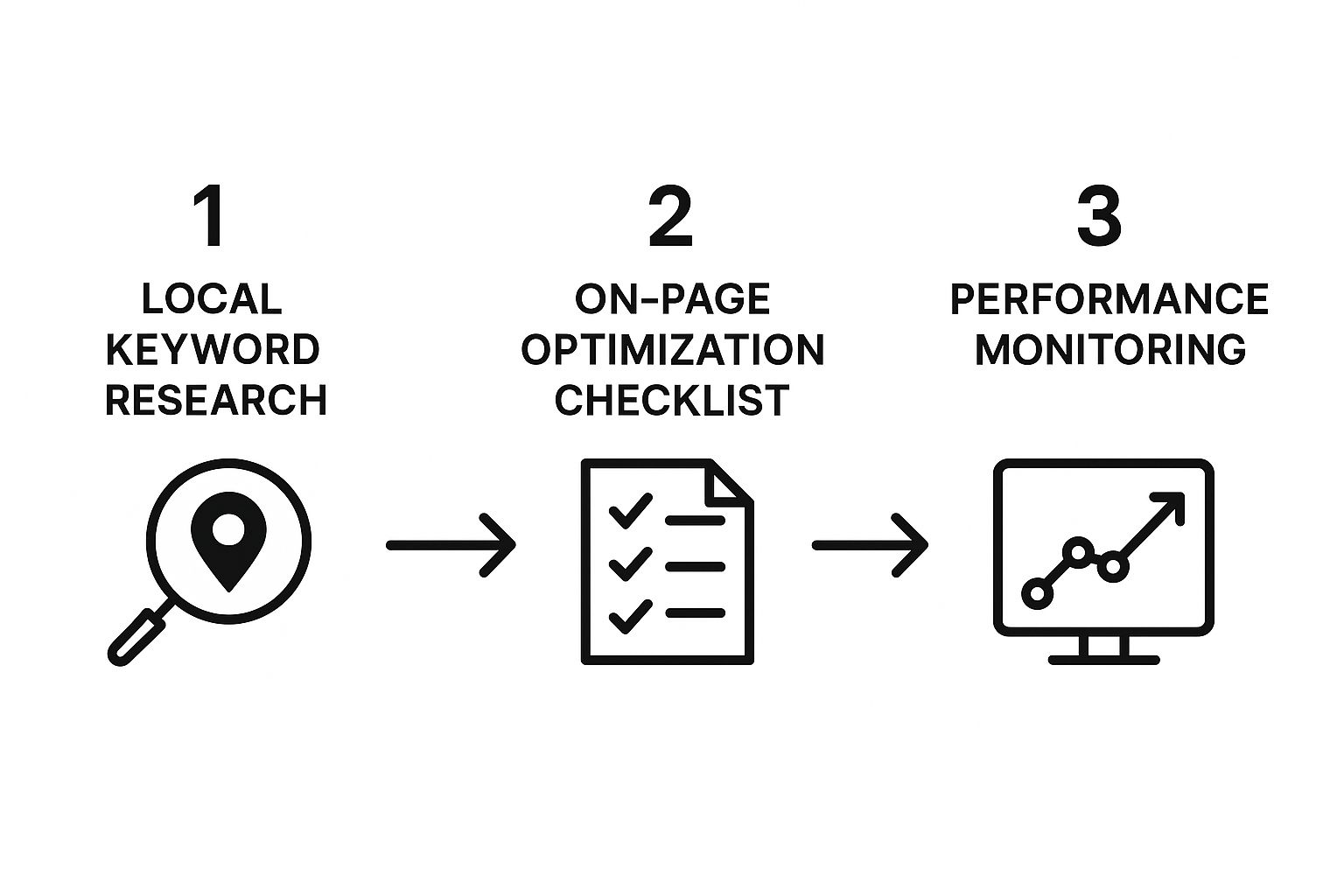
As you can see, all the effective on-page work and monitoring rest on a solid foundation of research. This is where you identify key local terms and opportunities—like building citations—that set you up for success.
Conducting Your Citation Audit
Before you start building new citations, you have to tidy up what’s already out there. A citation audit is simply the process of finding every mention of your business online and checking it for accuracy. The easiest way to start is by searching for your business name plus variations of your address and phone number.
I find it helps to track everything in a simple spreadsheet. Note down every platform where your business appears and double-check the NAP for any mistakes.
- Correct Listings: Mark these as accurate and leave them be.
- Incorrect Listings: These need to be flagged for correction. You’ll either have to claim the listing yourself or contact the site admin to ask for an update.
- Duplicate Listings: Make a note of any duplicates on the same website. These should be either merged or removed to avoid confusing Google.
I won’t lie, this can be a tedious job, but it’s absolutely essential for building a clean, authoritative presence online. For a more detailed look, you can dig into what SEO citations are and why they matter in our dedicated guide.
Must-Have UK Citation Sources
While you could get listed on hundreds of directories, quality is always better than quantity. Your first port of call should be getting listed on well-known, high-authority UK sites.
A strong presence on a handful of trusted local directories is far more valuable than hundreds of listings on low-quality, spammy sites. Prioritise relevance and authority to send the strongest signals to Google.
Here’s a starting list I recommend for any UK small business:
- Yell.com: One of the UK’s most famous business directories.
- Thomson Local: A trusted source for local business info that has been around for ages.
- The Independent: A listing in a reputable newspaper directory carries significant weight.
- Scoot: A powerful network that pushes your data to other major sites like The Sun and The Mirror.
- Yelp: A globally recognised review site with very strong local authority.
- Your Local Chamber of Commerce: Getting listed here provides a powerful, geographically relevant trust signal.
The Power of Hyperlocal Link Building
While citations are just mentions, local links are actual clickable hyperlinks from other local websites back to yours. These are gold for local SEO for small business because they act as direct, personal endorsements from one local entity to another.
The goal here isn’t just generic link building. You want to earn links that shout “local relevance” from the rooftops. For instance, a Reigate-based bakery could team up with a coffee shop down the road for a joint promotion. If the coffee shop writes a blog post about it and links back to the bakery’s website, that’s a perfect local link.
Here are a few actionable ideas to get you started:
- Sponsor a Local Event: Get involved with a local fair, a school fete, or a charity fun run. These events nearly always have websites where they thank their sponsors, giving you a highly relevant link.
- Host a Workshop: If you’ve got a skill to share, offer to run a free workshop at a local library or community centre. They’ll often promote the event—and your business—on their own website.
- Partner with Other Businesses: Work with non-competing local businesses on something mutually beneficial, like a “locals-only” discount card. Cross-promotion often leads to natural links from their websites.
By actively building both consistent citations and relevant local links, you create a robust digital footprint. This proves your legitimacy and deepens your connection to the community you serve, telling Google you’re not just a business, but the local business to trust.
How to Optimise Your Website for Local Customers

While your Google Business Profile acts as a digital shop window, your website is the full-blown showroom. It’s where you have total control to tell your story, prove your expertise, and convince potential customers you’re the best choice in town. Getting your website right is a non-negotiable piece of the local SEO for small business puzzle.
Your site needs to send crystal-clear signals to Google about who you are, what you do, and—most importantly—where you do it. This process, known as on-page SEO, involves fine-tuning your content and site structure to match what local people are searching for. It’s about turning a generic website into a powerful local marketing asset.
The goal is to make it painfully obvious to both users and search engines that you serve a specific geographic area. When someone in Kingston searches for a service you offer, your website should scream, “We’re right here, and we’re exactly what you need.”
Create Hyper-Specific Service Pages
One of the most common mistakes I see small businesses make is lumping everything onto a single, generic “Services” page. A plumber might list “Boiler Repair,” “Blocked Drains,” and “Emergency Call-Outs” all on one page. This is a massive missed opportunity.
A far smarter strategy is to build a dedicated page for each core service you offer in each main location you serve. This lets you target long-tail keywords that signal high purchase intent. Instead of one general plumbing page, you could create:
- Emergency Plumbers in Manchester
- Boiler Installation Services in Stockport
- Drain Unblocking in Salford
Each page should be treated as a highly focused landing page, speaking directly to a customer in that specific area with a specific problem. You can mention common issues in that neighbourhood, talk about your quick response times to that postcode, and even drop in a testimonial from a nearby client. This is the kind of detail that turns searchers into leads.
Weave Local Flavour into Your Content
To truly click with your local audience, your website content has to reflect the community it serves. This goes way beyond just listing your town name. It’s about naturally weaving in local context that shows your business is a genuine part of the neighbourhood.
For instance, a coffee shop in Reigate could write a blog post about the “Best Walking Routes near Reigate Hill,” mentioning grabbing a post-walk coffee. An estate agent in Guildford could create a guide to the best primary schools in the area, flexing their local knowledge.
Think about mentioning:
- Local landmarks (e.g., “just a stone’s throw from Guildford Castle”)
- Neighbourhood or district names
- Well-known streets or parks
- Community hubs or event venues
This isn’t just about peppering your site with keywords. It shows you’re genuinely embedded in the community, not some faceless business targeting a location from miles away.
The creation of locally relevant content—such as articles about community events, pages featuring nearby landmarks, and localised landing pages—boosts SEO rankings because Google algorithms reward businesses attuned to regional interests. This not only raises search rankings but also builds business authority and trust within the community. Discover more insights on why local content is essential in the latest analysis from Armadillo.
This approach establishes you as a local expert, building trust and credibility that bigger, national competitors simply can’t replicate.
Make Your Location Obvious
Your business address and phone number should be impossible to miss. Best practice is to include your full Name, Address, and Phone number (NAP) in the footer of every single page. This keeps it constantly visible for users and reinforces your location to Google across your entire site.
Better yet, embed a Google Map directly onto your contact page. This is a powerful local signal. It’s not just for user convenience; it’s a direct API call to Google that visually confirms your verified business location. It’s a simple but highly effective way to strengthen your geographic relevance.
A dedicated “Contact Us” or “Find Us” page is essential. Here’s what it absolutely must include:
| Element | Purpose |
|---|---|
| Embedded Google Map | Visually confirms your location for users and Google. |
| Full NAP Details | Provides consistent Name, Address, and Phone data. |
| Opening Hours | Manages customer expectations and prevents wasted trips. |
| Contact Form | Offers an easy way for potential customers to get in touch. |
| Written Directions | Adds local context by mentioning nearby landmarks. |
By optimising these on-page elements, you give visitors a seamless experience and send all the right signals to Google. You’re not just telling search engines where you are; you’re proving it with relevant, localised content and clear, consistent data. This is how you transform your website into a magnet for local customers.
Turning Customer Reviews into Your Best Marketing Tool
When it comes to local SEO for small business, customer reviews are pure gold. They’re raw, unfiltered social proof that tells potential customers—and Google—that you’re a trusted, quality business. Think about your own habits for a second. When choosing between two local cafes, are you more likely to pick the one with 150 glowing reviews or the one with none?
The answer is obvious. A steady stream of positive feedback is a massive local ranking factor. It builds trust and directly influences whether someone decides to buy from you. But getting customers to leave that feedback can feel a bit awkward. The secret is to make it incredibly easy and part of your natural process.
You don’t need to be pushy. A simple, well-placed prompt is often all it takes. For instance, a small QR code at your till linking directly to your Google review page can work wonders for a retail shop or a restaurant. It catches customers at their happiest moment.
Encouraging a Flow of Feedback
For service-based businesses, a friendly follow-up email or text message a day or two after the job is done is highly effective. The key is to keep it brief and personal.
Instead of a generic “Please review us,” try something like: “Hi [Customer Name], it was a pleasure helping you with [Service] yesterday. If you have a moment, we’d love to hear your thoughts on our service. You can leave a review here: [Direct Link].”
This simple, personal touch makes the request feel less like a marketing task and more like a genuine check-in. This proactive approach helps you build a solid bank of reviews over time, which is essential. To really get under the bonnet of the mechanics, it’s worth exploring how Google reviews impact your search rankings to fully grasp the connection.
The Art of Responding to Every Review
Getting reviews is only half the battle. The real magic happens when you respond to them—and yes, I mean every single one. Responding to positive reviews shows you appreciate your customers and reinforces their good decision to choose you. A simple “Thank you so much for your kind words, [Customer Name]! We look forward to seeing you again soon” is perfect.
But what about negative reviews? It’s tempting to ignore them, but this is your moment to shine. A thoughtful, professional response to a bad review can be more powerful than ten positive ones. It shows everyone watching that you take feedback seriously and are committed to customer satisfaction.
Key Insight: A negative review is not a disaster; it’s a public opportunity to demonstrate outstanding customer service. Your response is not just for the unhappy customer but for every future customer reading it.
Here’s a simple framework for your reply:
- Acknowledge and Apologise: Start by thanking them for their feedback and apologising that their experience didn’t meet expectations.
- Show Empathy, Not Excuses: Express that you understand their frustration. Avoid getting defensive or blaming the customer at all costs.
- Take it Offline: Offer a direct point of contact, like an email address or phone number, to resolve the issue privately. This shows you’re proactive.
This strategy is a core part of building a resilient online presence. Managing this feedback effectively is so crucial that it’s become a specialisation in itself. You can find more comprehensive strategies in our guide on online reputation management for small business, which provides further tactics for handling all types of customer feedback. By mastering your reviews, you build a reputation that precedes you, turning customer voices into your most powerful marketing tool.
Your Local SEO Questions Answered
When you’re running a small business, you need clear, straightforward answers. This section tackles the most common questions UK business owners have about local SEO for small business, cutting through the jargon to give you practical advice.
Even with a perfectly optimised website and Google Business Profile, questions always pop up. Let’s get them answered.
How Long Does Local SEO Take to Show Results?
This is the big one, and the honest answer is: it depends. Unlike turning on a tap, local SEO results build over time. You might see an initial boost in calls or map views within the first few weeks, especially after a thorough GBP optimisation.
But achieving strong, stable rankings for competitive terms typically takes between three to six months of consistent effort. This includes building citations, earning local links, and regularly publishing new content. Patience is key here; think of it as a marathon, not a sprint.
What Is the Difference Between SEO and Local SEO?
Think of it like this: traditional SEO is about competing on a national or even global stage. A nationwide e-commerce shop uses SEO to be found by anyone in the country. It’s a broad, highly competitive field.
Local SEO, on the other hand, adds a crucial geographic filter. It’s all about making your business the most visible and relevant choice for customers in a specific town or service area, like Guildford or Reigate. The focus shifts to signals like your address, local reviews, and “near me” searches, connecting you directly with nearby customers who have an immediate need.
For UK small businesses, getting to the top of local search is essential. With 99.37% of searchers never going past the first page, those top spots are incredibly valuable. Local SEO is a sustainable and cost-effective way to get there, often outperforming paid ads in the long run. You can explore more about the value of SEO for UK businesses to understand its full impact.
Do I Need a Website for Local SEO?
While your Google Business Profile is incredibly powerful, having your own website is highly recommended. Your website is a digital asset you completely own and control, acting as the central hub for your entire online presence.
A well-optimised website lets you:
- Create detailed service pages that target specific local keywords.
- Publish blog content that establishes you as a local expert.
- Build a stronger brand identity that a GBP listing alone just can’t provide.
Your GBP and website work hand-in-hand. The profile attracts searchers, and your site is where you convert them into customers.
How Much Should I Budget for Local SEO?
Budgeting for local SEO can vary widely, depending on how competitive your industry is and what you want to achieve. You could start by handling the basics yourself—like optimising your GBP and managing reviews—which costs nothing but your time.
For a more structured approach that includes citation building, content creation, and technical optimisation, working with an agency or consultant is usually more effective. Costs can range from a few hundred pounds for a one-off audit to several thousand for a comprehensive monthly campaign. It’s best to see it as an investment in sustainable growth rather than a one-time expense.
Navigating the world of local SEO can be complex, but you don’t have to do it alone. The team at GFC Tech specialises in helping Surrey-based businesses get found online. If you want a partner who understands the local market and delivers real results, get in touch with us today.
Adam is a Founder of GFC Tech, a company dealing in SEO and website design and development services. Adam has been an SEO expert for the past 8 years and has been working with different companies in this field. He is an SEO consultant and a marketing strategist and works closely with his clients to ensure that his marketing plans and strategies provide them with the marketing advantages they need to grow their business. Adam’s main role is an SEO consultant, but he is also involved in all technical aspects. Adam also develops WordPress websites, designs them professionally and performs SEO for them so they can rank on the first page of google.


