

At its heart, a content strategy is about connection. It’s the art of figuring out what your business needs to achieve, understanding what your audience genuinely cares about, and then creating a clear path with content to bring those two things together. This process makes sure every article, video, or social post you create isn’t just noise, but has a real, measurable job to do.
- Building Your Foundation for a Winning Strategy
- Defining Your Content Pillars and Core Topics
- Integrating SEO for Maximum Discoverability
- Choosing Channels for Effective Content Distribution
- Building a Realistic Editorial Calendar
- Measuring Performance and Refining Your Approach
- Frequently Asked Questions
Building Your Foundation for a Winning Strategy

Before you even think about writing a single word, every great content strategy needs a rock-solid foundation. This is where you stop chasing vague ideas like ‘more traffic’ and start defining what success actually looks like for your business. It’s the difference between randomly throwing content at the wall and executing a deliberate plan built for growth.
This groundwork isn’t just a ‘nice-to-have’ anymore. In the UK, 81% of marketers now see their content strategy as a central part of their overall business plan. Better yet, companies that actually document this plan see a 33% higher return on investment than those who don’t.
Set Clear and Measurable Objectives
Your goals are the compass for your entire SEO strategy. But if they’re too broad, they’re useless. This is where a framework like SMART (Specific, Measurable, Achievable, Relevant, Time-bound) comes in handy, turning fuzzy ambitions into concrete targets that link your content directly to business results.
Let’s look at a couple of real-world examples:
- Vague Goal: “Increase website traffic.”
- SMART Goal: “Increase organic blog traffic by 25% over the next six months by publishing two SEO-optimised articles per week.”
- Vague Goal: “Get more leads.”
- SMART Goal: “Generate 50 new marketing qualified leads (MQLs) per month from our downloadable e-book by the end of Q3.”
See the difference? These specific targets give your team a clear finish line and make it dead simple to measure whether you’ve won or not.
Conduct Deep Audience Research
You can’t write compelling content if you don’t have a clue who you’re talking to. Proper audience research goes way beyond basic demographics; it’s about getting inside your customer’s head to understand the real human motivations that drive their searches.
The aim here is to build a buyer persona a semi-fictional profile of your ideal customer. This persona should be the guiding star for every content decision you make, from the topics you choose to the tone of voice you write in.
To bring this persona to life, you need to dig into their pain points, figure out what makes them tick, and discover where they hang out online. Are they scrolling LinkedIn for industry news, or are they asking for advice in a niche Facebook group? Knowing this is how you make sure your content doesn’t just get seen, but is actually valued.
Defining Your Content Pillars and Core Topics

Now that you have your goals sorted and a solid picture of your audience, it’s time to decide what you’re actually going to talk about. This is where content pillars come in.
Think of them as the three to five core themes your brand can genuinely own the foundational subjects you’ll come back to, time and time again.
These pillars aren’t just topics you pluck out of thin air. They live at the intersection of your audience’s biggest problems, your unique business expertise, and the gaps your competitors have left wide open. They give you the structure to build topical authority, which is a massive signal to search engines that you’re a credible expert in your field.
Identifying Your Core Themes
To find your pillars, start by brainstorming broad topics that feel right. For a Surrey-based digital marketing agency like us, potential pillars might be things like “Local SEO,” “Small Business Web Design,” and “Lead Generation.”
Why those? Because they tie directly to what we do and solve the biggest headaches for our local business clients.
From there, you can break each pillar down into a cluster of related subtopics. This creates a logical map for all your future content, making sure every article and video has a clear purpose.
- Pillar Example: Local SEO for Surrey Businesses
- Subtopic Cluster: Optimising Google Business Profile, local keyword research, building local citations, getting more online reviews.
This “topic cluster” model is brilliant for SEO. It helps organise your content creation and builds a dense web of internal links between related pieces. Each of those subtopics can become a detailed article, a video tutorial, or a downloadable guide. For a deeper look at the nuts and bolts of writing these, check out our guide on how to write blog posts that people and search engines will both love.
By consistently creating content around these core pillars, you’re not just publishing articles; you’re building a library of expertise. This process systematically establishes your brand as the go-to authority in your niche.
Validating Your Pillar Ideas
Once you’ve got a list of potential pillars, you need to put them to the test. A good pillar has to have staying power and align with your business goals.
Ask yourself these four critical questions:
- Audience Relevance: Does this topic hit on a major pain point for my buyer persona? Is it something they’re actively searching for?
- Business Alignment: Does this pillar naturally lead people towards my products or services without feeling like a hard sell?
- Competitive Landscape: Can I offer a unique angle or go into more depth than my competitors are on this topic? Is there a gap I can fill?
- Longevity: Is this a subject that will still matter in a few years, or is it just a passing trend?
Answering these questions honestly makes sure your content pillars aren’t just relevant today, but are also sustainable for the long haul. They become the backbone of a strategy designed for steady, predictable growth, giving you a pipeline of ideas that will consistently attract and engage the right people.
Integrating SEO for Maximum Discoverability
Creating amazing content is only half the battle. If people can’t find it, all that effort goes to waste. That’s why search engine optimisation (SEO) isn’t just an add-on; it needs to be baked into your content workflow right from the start. This means going beyond chasing high-volume keywords and getting to grips with the real intent behind every search someone makes.
This focus on discoverability is where modern content strategies either win or lose. In fact, most experts I talk to attribute 40-60% of a website’s entire SEO success directly to its content. By weaving SEO principles into your process from day one, you build a powerful engine for organic growth that keeps on giving.
Mastering Keyword Research with User Intent
Effective keyword research today is less about finding single, high-traffic terms and more about understanding the problems your audience is trying to solve. When you get inside their head and understand their intent, you can create content that genuinely helps them, not just ranks.
Think about the different types of search intent:
- Informational: The user wants to learn something (e.g., “how to improve local SEO”).
- Navigational: The user is looking for a specific website (e.g., “GFC Tech blog”).
- Commercial: The user is researching before a purchase (e.g., “best web design agency Surrey”).
- Transactional: The user is ready to buy or take action (e.g., “hire SEO consultant”).
Your content strategy needs to cater to all these stages, guiding potential customers from their first casual question right through to making an enquiry. Of course, this approach only works if your website’s technical foundations are solid. You can get up to speed on the mechanics by reading our guide explaining what is technical SEO.
Structuring Content for Readers and Search Engines
How you structure your articles matters a lot. Search engines love content that’s easy for people to read and logically organised. This means using clear headings (H2s, H3s), short paragraphs, and bullet points to break up long blocks of text.
A well-structured article doesn’t just improve the reader experience; it gives search engines clear signposts about your content’s main topics, helping it rank for the right queries. Good structure is a win-win for both humans and algorithms.
Your on-page SEO is also critical. This is about naturally placing your target keywords in a few key areas:
- The article title (H1 tag)
- The SEO title and meta description
- The first 100 words of your introduction
- At least one subheading (H2 or H3)
- Image alt text
The infographic below shows how businesses are spreading their content efforts across different formats to capture audience attention.
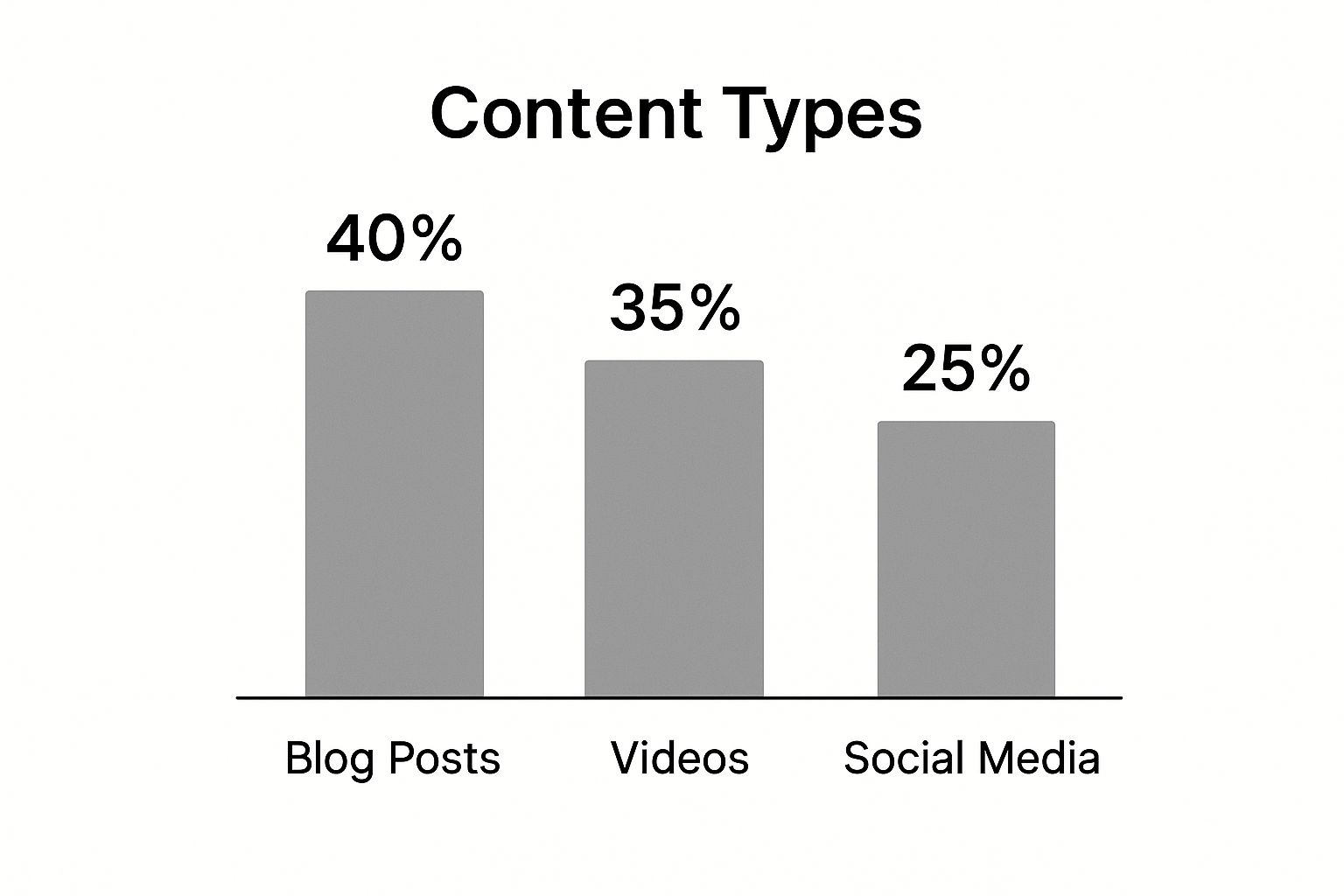
As you can see, there’s a heavy reliance on blog posts which are brilliant for SEO complemented by more engaging visual formats like video and social media content.
Keeping Your Content Fresh and Relevant
Your work isn’t done once you hit ‘publish’. Regularly updating existing content is one of the most powerful (and underrated) SEO tactics out there. For UK businesses, a recent survey found that 40% recommend quarterly updates, while another 40% favour biannual refreshes to keep their search rankings strong.
Even better, a whopping 70% of professionals expect to see ranking improvements within just two to four weeks of optimising old content. It’s a quick win.
A simple content refresh might involve updating statistics, adding new information, improving internal links, or rewriting a few sections for clarity. This tells search engines that your content is still current and valuable, helping it hold its authority and rank for the long term.
To keep your content library in top shape, it helps to follow a structured update schedule. Different types of content need refreshing at different intervals to maintain their value and visibility.
Effective Content Update Cadence
| Content Type | Recommended Update Frequency | Primary Goal of Update |
|---|---|---|
| Cornerstone Articles | Every 6-12 months | Refresh statistics, add new insights, and check internal links. |
| Topical Blog Posts | Annually or as needed | Update with recent trends, new data, or link to newer content. |
| Product/Service Pages | Every 3-6 months | Ensure features, pricing, and calls-to-action are current. |
| “Best Of” Listicles | Quarterly | Check for new entries, remove outdated ones, and update rankings. |
By sticking to a cadence like this, you create a system for maintaining your content’s relevance, which is a massive signal to search engines that your site is an active and authoritative resource.
Choosing Channels for Effective Content Distribution

Creating brilliant content is half the battle. The other half and the one that so many businesses forget is getting it in front of the right people. This isn’t about blasting your message across every platform you can find; it’s about making smart, deliberate choices where your work will have the most impact.
The trick is to meet your audience where they already hang out. Take social media, for instance. As of January 2025, an incredible 79% of the UK population that’s around 54.8 million people are active on social platforms. It’s a massive pool of potential customers. You can dive deeper into the UK social media usage stats on sproutsocial.com.
Pinpointing Your Primary Platforms
The biggest mistake you can make is spreading yourself too thin. Instead, focus your energy on the one or two channels where your ideal customer spends most of their time. This is where your earlier audience research really pays off.
- Selling to other businesses? LinkedIn is almost always the right answer for sharing in-depth articles, case studies, and industry news.
- Got a visually stunning product? Instagram or Pinterest are your best bet for showcasing high-quality images, short videos, and glowing customer photos.
- Targeting a younger crowd? TikTok and Instagram Reels are where you’ll connect through short, punchy, and engaging video content.
The goal is to become a familiar, trusted presence on a couple of key platforms, not a faint whisper on a dozen. This focused effort builds a much more engaged community and, frankly, delivers a far better return on your time.
Your content distribution plan is just as important as your content creation plan. One without the other is a recipe for missed opportunities. Don’t let great content go unseen by treating distribution as an afterthought.
Mastering Content Repurposing
A single, well-researched blog post can fuel your content calendar for weeks if you get clever with repurposing. It’s a cornerstone of any efficient content strategy, letting you squeeze every last drop of value from each piece you create.
Think about how one long-form article can be broken down and reshaped:
- Key takeaways can become a series of insightful LinkedIn posts or a punchy Twitter thread.
- Compelling stats can be transformed into a visually appealing infographic for Instagram.
- The main story can be adapted into a script for a short YouTube video or a sequence of Instagram Stories.
This approach doesn’t just save you time. It also presents your core message in different formats, appealing to different audience preferences across various platforms. This is a fundamental concept in digital marketing for small businesses, as it helps maximise the impact of a limited content budget.
Building a Realistic Editorial Calendar
Consistency is the engine that drives any good content strategy. Without a solid plan to manage your workflow, even the most brilliant ideas can gather dust. An editorial calendar is your tactical backbone, turning your high-level strategy into a manageable, day-to-day process that keeps everyone aligned and kills the last-minute panic.
This isn’t just about plugging dates into a spreadsheet. It’s about creating a single source of truth for your entire content lifecycle. From the initial idea and keyword research to drafting, approvals, and finally hitting ‘publish’, a well-organised calendar gives the whole team total clarity on who does what, and when.
Choosing the Right Tool for the Job
Let’s be clear: the perfect tool is the one your team will actually use. I’ve seen teams get bogged down trying to implement a hugely complex platform when all they really needed was something simple. Don’t overcomplicate it.
- Simple Spreadsheets (Google Sheets/Excel): Ideal for solo creators or small teams just starting out. They’re free, flexible, and perfect for tracking the basics like topic, author, deadline, and status.
- Project Management Tools (Trello/Asana): A great step up for growing teams. These tools use visual boards to track content through different stages (e.g., ‘Idea’, ‘Drafting’, ‘In Review’, ‘Published’), making it easy to see progress at a glance.
- Specialised Content Platforms (CoSchedule/Airtable): Best for larger teams managing multiple channels. These platforms often bring social media scheduling, team collaboration, and even performance analytics into one place.
No matter your choice, the goal is the same: organise your workflow so you can deliver a steady, predictable stream of high-quality content.
Mapping Out Your Content Pipeline
A good rule of thumb is to plan your content at least four to six weeks in advance. This buffer gives your team plenty of breathing room for research, creation, and proper reviews without anyone feeling rushed. Having that longer-term view also helps you strategically plan for seasonal events, product launches, or major industry campaigns.
Your calendar should capture the vital details for each piece of content.
| Calendar Field | Purpose | Example |
|---|---|---|
| Publish Date | The date the content will go live. | 15 October 2025 |
| Topic/Title | A clear working title for the piece. | How to Optimise Your Google Business Profile |
| Content Pillar | Which core theme it supports. | Local SEO |
| Format | The type of content being created. | Blog Post |
| Author | Who is responsible for creating it. | Sarah Jones |
| Status | The current stage in the workflow. | In Review |
A realistic editorial calendar is more than a schedule; it’s a commitment to consistency. It builds momentum, holds your team accountable, and is the operational backbone of any effort to create content that delivers real results.
By planning ahead and clearly defining who’s doing what, you transform content creation from a chaotic scramble into a streamlined, effective process.
Measuring Performance and Refining Your Approach
A content strategy isn’t something you create once and file away. Think of it as a living document. To make it work for your business, you need to get into a rhythm of tracking what’s landing with your audience and what’s falling flat. This means looking past the ego-boosting numbers like page views and digging into the Key Performance Indicators (KPIs) that actually link back to your business goals.
This constant feedback loop is what turns a good strategy into a great one. It’s how you optimise over time and ensure your content efforts are delivering a real, tangible return on investment.
Focusing on the Right Metrics
First things first, you need to identify the KPIs that genuinely matter. It’s easy to get excited by a spike in traffic, but high page views don’t pay the bills. Instead, focus on the numbers that signal genuine engagement and bottom-line impact.
Here are the key metrics I always track:
- Conversion Rate: This is the big one. It’s the percentage of visitors who take a desired action, like filling out your contact form or downloading a guide. It directly measures how effective your content is at persuading people.
- Lead Quality: Are the enquiries coming through from your content actually relevant to your services? Tracking this helps you tweak your topics to attract your ideal customer, not just tyre-kickers.
- Time on Page & Scroll Depth: These two metrics tell you if people are actually reading what you’ve written. If visitors are spending several minutes on a post and scrolling right to the end, you know the content is hitting the mark.
- Backlinks Acquired: When other credible websites link to your content, it’s a massive vote of confidence. It’s also one of the most powerful signals for boosting your authority in Google’s eyes.
The most valuable insights come from connecting content performance directly to business outcomes. A blog post that generates three high-quality leads is far more successful than one with thousands of views but zero conversions.
Using Data to Refine Your Strategy
Tools like Google Analytics are your best friend here. They let you see exactly how your content is performing, which pieces are your top performers, and where you need to improve. I recommend setting aside time for a proper content audit at least once a quarter to turn these numbers into a solid action plan.
As you review, start looking for patterns. Which of your content pillars are driving the most conversions? Are blog posts getting more engagement than your case studies? Understanding how to apply these learnings is just as important as gathering them. For some great advice on this, check out this guide on Turning Insights Into Actionable Strategies.
This kind of analysis is what helps you decide what content to create more of, which pieces to update, and what to stop doing altogether. It’s how you make smarter decisions, month after month.
Frequently Asked Questions
As you start piecing your content strategy together, a few common questions always seem to pop up. Here are some quick, practical answers based on what I’ve seen work time and time again.
What is the first step in creating a content strategy?
The very first step is to define your business goals. Before you think about topics or keywords, you must understand what you want your content to achieve. Are you trying to increase brand awareness, generate leads, or drive sales? Your goals will be the foundation for every other decision you make.
How often should I publish new content?
There’s no magic number here. What matters far more than frequency is consistency and quality. For most businesses, aiming for one or two high-quality, well-researched blog posts per week is a fantastic and sustainable goal. It’s always better to publish one brilliant piece that resonates than to churn out four mediocre ones that nobody reads.
What’s the difference between a content strategy and a content plan?
It’s easy to get these two mixed up, but the distinction is crucial. Your content strategy is your high-level ‘why’. It’s the big picture that defines your business goals, who you’re talking to, and the core message you want to get across. Your content plan, which includes your editorial calendar, is the tactical ‘what, when, and where’ that brings that strategy to life.
How do I measure the ROI of my content strategy?
Measure the metrics that tie directly to business outcomes. Track conversion rates (e.g., how many readers filled out a contact form), lead quality, and customer acquisition cost. By assigning a value to a lead, you can calculate how much revenue your content is generating versus the cost of creating and promoting it.
How long does it take for a content strategy to show results?
Patience is key. While you might see small wins early on, a content strategy is a long-term investment. Meaningful results, like a steady stream of organic traffic and qualified leads, typically take 6 to 12 months to materialize. It builds authority and momentum over time.
Adam is a Founder of GFC Tech, a company dealing in SEO and website design and development services. Adam has been an SEO expert for the past 8 years and has been working with different companies in this field. He is an SEO consultant and a marketing strategist and works closely with his clients to ensure that his marketing plans and strategies provide them with the marketing advantages they need to grow their business. Adam’s main role is an SEO consultant, but he is also involved in all technical aspects. Adam also develops WordPress websites, designs them professionally and performs SEO for them so they can rank on the first page of google.


