

At its heart, GDPR compliance is about treating personal data with respect. It’s a set of strict rules governing how you collect, use, and protect the information of individuals in the UK and EU. Think of it less as a legal hurdle and more as a commitment to transparency a way to earn and keep customer trust by handling their data responsibly.
- What GDPR Compliance Really Means for Your Business
- Does Your Business Need to Comply with UK GDPR?
- The Seven Principles at the Heart of GDPR
- Balancing Your Obligations with Individual Rights
- Your Actionable GDPR Compliance Checklist
- How Legitimate Interests Can Simplify Compliance
- Frequently Asked Questions About GDPR Compliance
What GDPR Compliance Really Means for Your Business

Imagine you’re the custodian of your customers’ most valuable digital possessions. When they share their personal information a name, email address, or phone number they’re lending it to you for a specific reason. So, what is GDPR compliance? It’s the framework that governs this trust, making sure you act as a responsible guardian of that data.
This legal standard isn’t just about dodging hefty fines; it’s about building stronger, more transparent relationships with your audience. When you respect their data privacy, you show that your business is trustworthy and ethical. In today’s market, that’s a powerful way to stand out.
The UK GDPR: A Post-Brexit Reality
The UK’s departure from the EU added a unique twist to data protection. The UK simply adopted its own version, the UK GDPR, which mirrors the EU regulation almost exactly. This means any business processing the personal data of UK residents has to follow these rules, no matter where in the world they are based.
One of the most critical rules? You must report any data breach to the supervisory authority within 72 hours of discovering it. It’s a tight deadline that underscores the seriousness of data protection.
At its core, compliance is about accountability. It means you need to know exactly what data you have, why you have it, where it’s stored, and who can access it. This foundation of data governance is central to protecting customer privacy.
Understanding your obligations is the first step. You can see how we apply these principles by taking a look at our own comprehensive privacy policy. Getting this right ensures you handle information lawfully, securely, and with the transparency your customers not only expect but deserve.
Does Your Business Need to Comply with UK GDPR?

Many business owners, particularly those running smaller outfits, often ask: “Does UK GDPR really apply to me?” The answer catches most people by surprise. If your organisation handles the personal data of anyone in the UK, the rules almost certainly apply, no matter your size or where you’re based.
The law isn’t concerned with borders; it follows the data. It makes no difference whether your business is in Surrey or Sydney. If you offer goods or services to people in the UK or monitor their behaviour (like tracking their website visits), you’re on the hook for compliance. It’s all about creating a consistent standard of data protection for UK residents.
This is the tripwire for so many businesses. You don’t need a physical office or a massive UK customer base to fall under its scope. Even what feels like minor, everyday data handling can trigger your legal obligations.
Real-World Scenarios of GDPR Application
Let’s ground this in reality. The scope is far wider than most people think, covering activities that are just part of running a modern business.
- The Local Cafe: A coffee shop in Reigate starts a loyalty programme, collecting customer names and email addresses. The moment they collect and use that personal data, they are ‘processing’ it and must be UK GDPR compliant.
- The Online Retailer: A small e-commerce store based in the US ships handmade crafts to customers in the UK. Because they’re offering goods to UK residents and handling their delivery addresses, they fall squarely under the regulation.
- The Freelance Consultant: A sole trader provides online coaching and has a simple “contact me” form on their website. If someone from the UK fills it out, that simple act of data collection means the freelancer must follow UK GDPR principles.
These examples hammer home the key point: it’s not about the size or nature of your business, but whose data you’re handling. Grasping this is central to knowing what is GDPR compliance really means for your day-to-day operations.
Frequently Asked Questions about UK GDPR Applicability
- Does UK GDPR apply to Business-to-Business (B2B) companies?
Yes. If you process personal data, which includes a business email address likefirstname.lastname@company.com, the rules apply. A generic address likeinfo@company.comisn’t personal data, but individual contacts most certainly are. - What if I only have a few customers in the UK?
The number of customers is irrelevant. The regulation applies even if you process data for just one UK resident. There’s no minimum threshold. - Do non-profit organisations need to comply?
Absolutely. Charities and non-profits must comply with UK GDPR if they handle the personal data of UK residents, which could be donors, members, or volunteers. - My website gets visitors from the UK. Does that mean I need to comply?
Not automatically, no. But if your site actively targets UK residents for example, by showing prices in GBP or referencing UK locations or if you use cookies to track their behaviour for marketing, then compliance becomes mandatory. - Does the UK GDPR apply to employee data?
Yes, 100%. The regulation protects your employees’ personal data just as it does your customers’. This covers everything from payroll information and HR records to performance reviews.
The Seven Principles at the Heart of GDPR
To get to grips with what GDPR compliance actually means day-to-day, you need to understand the seven core principles that form its backbone. These aren’t just abstract legal rules; they’re the guiding philosophy for handling personal data properly and ethically. Think of them as the constitution for data protection, shaping every decision you make.
Instead of wading through dense legal jargon, let’s break each one down with a simple, practical analogy to make them easy to remember and apply.
1. Lawfulness, Fairness, and Transparency
This is the bedrock of GDPR. Every piece of data you process must be handled lawfully, fairly, and with complete transparency.
Imagine you’re a librarian. You need a patron’s clear permission to borrow their book (lawfulness), you must treat it with care and respect while you have it (fairness), and you must be crystal clear about why you’re borrowing it and when you’ll give it back (transparency). It’s that simple.
2. Purpose Limitation
You can only collect personal data for specific, explicit, and legitimate reasons. You can’t just gather an email for a newsletter and then start using it for market research without asking first.
It’s like borrowing your neighbour’s lawnmower to cut your grass. You can’t then decide to rent it out to the entire street for a profit. You had one specific purpose, and you must stick to it.
This accompanying diagram shows how GDPR compliance branches out into key business benefits.
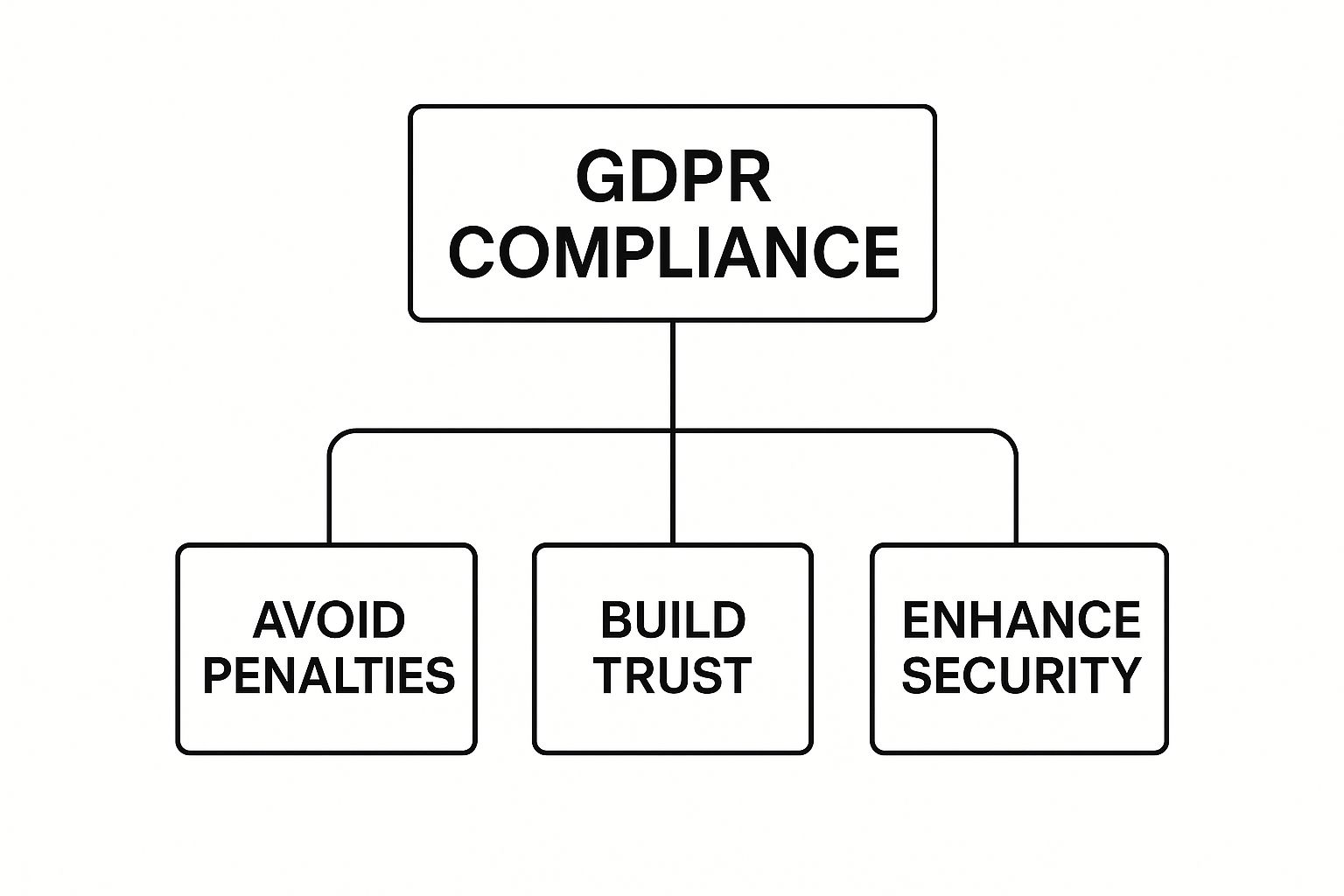
As the infographic illustrates, sticking to these principles isn’t just about dodging fines; it’s a direct route to building customer trust and making your whole security setup stronger.
3. Data Minimisation
Only collect the data you absolutely need for your stated purpose, and nothing more. If you’re signing someone up for an email newsletter, you definitely need their email address. Do you need their date of birth? Almost certainly not.
It’s about taking just enough. Think of it as packing for a weekend trip you only take the essentials, not your entire wardrobe.
The principle of data minimisation is a cornerstone of privacy by design. By collecting less data, you automatically reduce your risk in the event of a breach and simplify your compliance headaches.
4. Accuracy
You have to take every reasonable step to make sure the personal data you hold is accurate and kept up to date. Inaccurate data is not just messy; it can lead to bad decisions and real-world harm.
If a customer updates their address, you must correct it promptly. This is just good digital housekeeping, like ensuring the contact list in your phone is current so you don’t end up calling the wrong person.
The Final Three Core Principles
Rounding out the seven are storage limitation, integrity and confidentiality, and accountability. These principles hold the whole framework together.
- 5. Storage Limitation: Don’t be a data hoarder. Once you no longer need personal data for the reason you collected it, it must be securely deleted. This means you need to have clear data retention policies in place.
- 6. Integrity and Confidentiality (Security): This one is non-negotiable. You must protect the data you hold from hackers, accidental loss, or destruction. This means using the right security measures, like encryption and solid access controls.
- 7. Accountability: This final principle makes you responsible for everything. You must be able to prove you’re compliant with all the other principles, keeping clear records of your data processing activities to show you’re meeting your obligations.
By embedding these seven principles into your operations, the answer to “what is GDPR compliance?” stops being about a scary checklist. Instead, it becomes a culture of respect for personal data.
Balancing Your Obligations with Individual Rights
Getting to grips with the seven principles is one half of the puzzle. The other is knowing how they translate into your legal duties as a business and the specific rights they give your customers. True GDPR compliance is a balancing act, weighing your responsibilities against your customers’ control over their personal information.
This isn’t just a one-sided list of rules to follow. Think of it as a framework for a more transparent relationship. For every obligation you have, there’s a corresponding right an individual can exercise. It’s a system of checks and balances designed to build trust.
Your Key Business Responsibilities
Before you even think about processing any personal data, you have to establish a lawful basis for it. This is your legal justification, your reason for needing the data in the first place. The UK GDPR gives you six options, but for most small businesses, it usually boils down to two: consent (the person has clearly agreed) or legitimate interests (you have a genuine and valid business reason).
Another critical obligation is accountability. For some organisations, this means appointing a Data Protection Officer (DPO). A DPO is your in-house or external expert on all things data protection, overseeing compliance. You’re required to have one if you’re a public authority or if your core activities involve large-scale, systematic monitoring of people.
The Eight Fundamental Rights of Your Customers
Empowering individuals is what GDPR is all about. Your customers have eight fundamental rights that you must be ready to honour at any time.
- The right to be informed: You must tell people how you’re using their personal data, usually through a clear and easy-to-find privacy policy. No jargon, no hiding things in the small print.
- The right of access: Customers can ask for a copy of all the personal data you hold on them. This is often called a Subject Access Request (SAR).
- The right to rectification: If their data is wrong or incomplete, they have the right to get it corrected. Simple as that.
- The right to erasure: Also known as ‘the right to be forgotten’, this allows people to request that you delete their personal data.
- The right to restrict processing: In certain situations, individuals can ask you to limit how you use their data.
- The right to data portability: This lets people get and reuse their personal data for their own purposes across different services.
- The right to object: Individuals can object to you processing their personal data, especially for things like direct marketing.
- Rights related to automated decision making and profiling: This protects people against potentially damaging decisions made without any human involvement.
Understanding these rights is crucial. It’s not just a box-ticking exercise; it’s about respecting your customers’ autonomy. When a customer knows they can easily see or delete their data, their confidence in your brand skyrockets.
By connecting each of your business responsibilities directly to these rights, the complex answer to what is GDPR compliance becomes much clearer. It’s about building a fair and transparent system where your business needs and individual privacy can coexist. This balance is the hallmark of a truly compliant and trustworthy organisation.
Your Actionable GDPR Compliance Checklist

Knowing the principles of GDPR is one thing, but rolling up your sleeves and putting them into practice is where the real work begins. To turn the complex answer to what is GDPR compliance into a manageable project, you need a clear, step-by-step plan. This checklist is your straightforward roadmap to get your organisation on the right track.
When you approach compliance methodically, what seems like a daunting task breaks down into a series of achievable goals. Each step builds on the last, creating a solid foundation for protecting your customers’ personal data with confidence.
1. Conduct a Thorough Data Audit
First things first: you need to map your data. You can’t protect what you don’t know you have. A data audit means identifying every single piece of personal data your business collects, handles, and stores, from a customer’s email address to their IP address.
For each type of data, you need to be able to answer:
- What data are you collecting (e.g., names, emails, delivery addresses)?
- Why are you collecting it (what’s your lawful basis)?
- Where is it stored (your CRM, email platform, a forgotten spreadsheet)?
- How long will you keep it (your data retention period)?
This process sheds light on your entire data landscape and is the bedrock for everything that follows. Getting this right early on is a huge advantage, particularly for smaller businesses looking to build a strong foundation. For broader context on how this fits into your marketing, our guide on https://gfctech.co.uk/local-seo-services-for-small-business/ can help.
2. Update Your Privacy Policy and Procedures
With your data map complete, the next step is to make sure your privacy policy is transparent, concise, and easy for a real person to understand. It needs to clearly tell users about their rights and how you handle their information. No jargon, no fluff.
At the same time, you need to set up internal procedures for honouring those rights. For example, what happens when someone submits a Subject Access Request (SAR) or asks for their data to be deleted? Having a clear, documented process ensures your team can respond quickly and correctly every time.
3. Implement Robust Security Measures
GDPR requires you to put “appropriate technical and organisational measures” in place to protect personal data. This isn’t a one-size-fits-all rule; what’s ‘appropriate’ for you depends entirely on your specific risks and the type of data you hold.
Your security measures should be proportional to the sensitivity of the data you hold. Basic measures include using strong passwords, enabling two-factor authentication, and encrypting devices that store personal data. More advanced steps might involve regular security audits and vulnerability scanning.
One of the most vital and often overlooked parts of this is regular IT security awareness training for all staff. Your team can be your strongest defence against data breaches, but only if they know what to look for.
On the horizon, changes like the upcoming Data Protection and Digital Information Bill aim to simplify some of these obligations. This reform is expected to be a big help for small businesses, which reportedly spend nearly 40% of their IT budgets on data protection activities. The changes could save UK SMEs around £100 million a year by cutting down on unnecessary red tape.
4. Prepare a Data Breach Response Plan
Let’s be realistic: it’s not a question of if a breach will happen, but when. Having a clear, well-rehearsed plan is crucial for managing the situation effectively and meeting that strict 72-hour reporting deadline.
Your plan should spell out:
- Immediate steps to contain the breach.
- Who is responsible for assessing the risk and impact.
- The process for notifying the Information Commissioner’s Office (ICO).
- The criteria for when and how you’ll inform the people affected.
By following these steps, you build a structured, accountable approach to data protection that moves beyond theory and into tangible action.
To help you stay organised, here’s a simple checklist you can use to track your progress.
GDPR Compliance Checklist
| Step | Key Action | Status (To-Do/In Progress/Complete) |
|---|---|---|
| 1. Data Audit | Map all personal data collected, processed, and stored. Identify lawful basis and retention periods. | To-Do |
| 2. Privacy Policy | Review and update the privacy policy to be clear, transparent, and comprehensive. | To-Do |
| 3. Internal Procedures | Establish clear processes for handling data subject rights (e.g., SARs, erasure requests). | To-Do |
| 4. Security Measures | Implement technical and organisational security controls (e.g., encryption, 2FA, access controls). | To-Do |
| 5. Staff Training | Conduct regular IT security and data protection awareness training for all employees. | To-Do |
| 6. Breach Response Plan | Create and document a data breach incident response plan. | To-Do |
| 7. Ongoing Review | Schedule annual reviews of all policies, procedures, and data processing activities. | To-Do |
This table provides a high-level overview to keep your compliance project on track and demonstrate accountability.
5. Frequently Asked Questions for Your Checklist
- What is the first step in creating a GDPR checklist?
Always start with a comprehensive data audit. This mapping exercise is the foundation for all other compliance activities, as it tells you exactly what data you have and why. - How often should I review my GDPR compliance?
GDPR compliance is an ongoing process, not a one-time task. You should review your policies, procedures, and data audit at least annually, or whenever you introduce new data processing activities. - Do I need special software for GDPR compliance?
While not mandatory, various software tools can help manage data inventories, track consent, and handle subject access requests, making the process more efficient, especially as your business grows. - Is employee training really that important for compliance?
Yes, it is critical. Many data breaches are caused by human error. Regular training ensures your staff understand their responsibilities and can identify potential threats like phishing scams. - What’s the most common mistake businesses make with GDPR?
A common mistake is treating GDPR as a one-off IT project. It’s a business-wide cultural commitment to data privacy that requires ongoing attention and accountability from everyone in the organisation.
How Legitimate Interests Can Simplify Compliance
Getting your head around the lawful bases for processing data is a huge part of understanding what GDPR compliance really means, and thankfully, recent UK updates are set to ease some of that admin burden. A major change introduces the idea of ‘Recognised Legitimate Interests’, a move designed to make certain data processing activities far more straightforward for businesses.
This update means you can process personal data for specific, pre-approved reasons like preventing fraud or shoring up network security without having to complete a full Legitimate Interest Assessment (LIA) every single time. An LIA is the traditional three-part test businesses had to run to prove their data processing was necessary and didn’t override individual rights.
Streamlining Your Processes
Let’s be honest, this change is a practical step to cut down on repetitive paperwork. A key shift coming in 2025 introduces the ‘recognised legitimate interest’ rule into UK GDPR, allowing organisations to process personal data for certain pre-defined purposes without grinding through an exhaustive LIA for every case. This can free up a massive amount of time and resources, particularly when you’re dealing with routine security measures. You can find more insights on this UK GDPR update and its impact over at captaincompliance.com.
Of course, this isn’t a free pass to ignore your other duties. You still have to be completely transparent and tell people how you’re using their data. On top of that, smart strategies like learning how to create anonymous surveys can make your life even easier by reducing the amount of personal data you collect in the first place.
At the end of the day, using data ethically is the bedrock of turning website visitors into loyal customers. To see how that connection plays out in practice, you might find our guide on how to generate leads online for UK businesses useful.
Frequently Asked Questions on Legitimate Interests
- What exactly is a Legitimate Interest Assessment (LIA)?
Think of it as a three-step test. You have to show that your reason for processing data is valid, that it’s necessary, and that your interests don’t unfairly outweigh the individual’s rights. - Does this new rule mean I never have to do an LIA again?
Not quite. The ‘recognised’ interests only cover a specific list of activities. For any other processing where you’re relying on legitimate interests, you’ll still need to conduct and document a full LIA. - What are some examples of recognised legitimate interests?
Common ones include processing data for direct marketing, fraud prevention, keeping your network and information systems secure, and internal data transfers for administrative purposes. - Do I still have to tell people I’m using their data?
Yes, absolutely. The principle of transparency is non-negotiable. You must clearly inform individuals how their data is being used, even if it falls under a recognised legitimate interest. - Does this change affect individual rights?
No. People still have the right to object to their data being processed. If they do, you must stop unless you can demonstrate compelling, legitimate grounds that override their rights.
Frequently Asked Questions About GDPR Compliance
Even with a good grasp of the principles, the practical side of GDPR can throw up some tricky questions. To clear up the most common points of confusion, we’ve put together straightforward answers to the queries we hear most often from businesses just like yours.
1. What Happens If My Business Is Not GDPR Compliant?
Non-compliance can be costly. The Information Commissioner’s Office (ICO) has the power to issue serious penalties. Fines can go as high as £17.5 million or 4% of your annual global turnover—whichever is higher. Beyond the financial risk, a data breach can cause lasting damage to your reputation and destroy the trust you’ve built with your customers.
2. My Business Is Tiny, Does GDPR Still Apply?
Yes, it does. UK GDPR applies to any organisation that processes the personal data of UK residents, right down to sole traders and freelancers. While there are some record-keeping exemptions for businesses with fewer than 250 employees, the core principles of lawful and secure data handling apply to everyone, regardless of size.
3. Does GDPR Apply to My Email Marketing List?
Absolutely. To send marketing emails, you must have a clear lawful basis, which is almost always explicit consent. This means someone must actively and freely agree to receive your emails, knowing exactly what they’re signing up for. You also have to provide a simple, no-fuss way for them to unsubscribe in every email.
4. How Long Can I Keep Customer Data For?
There’s no single answer, as it’s guided by the ‘storage limitation’ principle. In simple terms, you should not keep personal data for longer than is necessary for the original purpose you collected it. It’s your business’s responsibility to define and document your data retention periods based on operational needs and any legal requirements.
5. Do I Need to Appoint a Data Protection Officer (DPO)?
Probably not, but it depends. You are legally required to appoint a DPO if you are a public authority, or if your main business activities involve large-scale, systematic monitoring of people. It’s also mandatory if you process a large amount of sensitive data. For most small to medium-sized businesses, it is not a requirement.
Getting GDPR right is crucial for your online success and customer relationships. GFC Tech offers expert digital marketing and IT consultancy, ensuring your small business not only stays compliant but also builds the kind of trust that lasts. Visit us at https://gfctech.co.uk to see how we can help.
Adam is a Founder of GFC Tech, a company dealing in SEO and website design and development services. Adam has been an SEO expert for the past 8 years and has been working with different companies in this field. He is an SEO consultant and a marketing strategist and works closely with his clients to ensure that his marketing plans and strategies provide them with the marketing advantages they need to grow their business. Adam’s main role is an SEO consultant, but he is also involved in all technical aspects. Adam also develops WordPress websites, designs them professionally and performs SEO for them so they can rank on the first page of google.


