

The key to getting more Google reviews is surprisingly simple: just ask. Better yet, make it ridiculously easy for your happy customers to share their feedback. The best way I’ve found is to give them a direct review link, turning what could be a chore into a single, satisfying click.
- Why Google Reviews Are Your Strongest Local Asset
- Optimising Your Google Business Profile to Attract Reviews
- Make It Effortless for Customers to Leave a Review
- Proven Techniques for Requesting Customer Reviews
- How to Manage and Respond to Every Review
- Frequently Asked Questions About Getting Google Reviews
Why Google Reviews Are Your Strongest Local Asset

In a competitive market like Surrey, trust isn’t just handed over; it has to be earned. These days, Google reviews are the digital version of a good old-fashioned recommendation from a friend, and they have a massive impact on your local search ranking and whether a new customer chooses you. A steady stream of authentic, positive feedback gives your business a real, tangible edge.
Think about it from your own perspective. When you need a plumber in Guildford or fancy trying a new café in Reigate, what’s the first thing you do? For most of us, it’s a quick search on our phone, followed by a scan of the star ratings and what recent customers have to say.
The Modern Word-of-Mouth
This online vetting process has become second nature for UK consumers. The numbers don’t lie. By 2025, an estimated 81% of UK consumers use Google reviews to check out local businesses, and a staggering 88% read them before picking one. What’s more, over half (54.7%) will read at least four reviews before they feel confident enough to make a decision.
A strong review profile is so much more than a vanity metric. It’s a crucial investment in your business’s visibility and growth. It signals to both Google and potential customers that you’re a trusted, active, and reliable choice in the local area.
Turning Clicks into Customers
This kind of social proof achieves two critical things at once:
- It Builds Immediate Trust: Positive reviews act as unbiased endorsements. They reassure potential customers that they’re making a smart choice by picking you.
- It Boosts Your Local SEO: Google’s algorithm actively rewards businesses that get frequent, positive reviews. The payoff? Better visibility in local search results and on Google Maps.
A solid review strategy isn’t just a nice-to-have; it’s a core piece of any smart marketing plan. For a deeper look at how this fits into the bigger picture, check out our guide on local SEO services for small businesses. The link is undeniable: great reviews lead to better visibility, which brings more customers through your door.
Optimising Your Google Business Profile to Attract Reviews

Before you even think about asking for your first review, you need to get your digital shop front in order. Think of your Google Business Profile (GBP) as the first impression a potential customer has of your business. If it’s incomplete, outdated, or unprofessional, why would anyone trust you enough to leave a glowing review?
Getting this right is the foundation for your entire review generation strategy. It’s not just about listing your name and address; it’s about creating a vibrant, detailed showcase that signals quality and local expertise.
Make Your Profile Work for You
A fully fleshed-out profile tells both Google and your customers that you’re a credible, active business worth their time. Here’s where to focus your attention to make a real difference:
- Service Categories: Don’t just settle for “Builder.” Get specific. If you’re a builder in Surrey, choose precise categories like “Loft Conversions” or “Kitchen Fitter.” This is crucial for showing up in hyper-local, relevant searches.
- High-Quality Photos: Upload pictures that tell a local story. Show off that landscaping project you just finished in Woking or your team smiling outside your Guildford shop. It’s not just for show; businesses with photos receive 42% more requests for driving directions on Google Maps. That’s real footfall.
- Compelling Description: Write a description that speaks directly to Surrey residents. Mention the towns you serve and what makes you the go-to choice for them. This is your chance to connect on a local level.
A well-maintained profile acts as a silent salesperson, working 24/7 to convince people that your business is worth their time and trust. This pre-built confidence is what turns a happy customer into a willing reviewer.
For a deeper dive into making your profile truly stand out, explore different strategies for optimizing your Google Business Profile. And if you’re ready to get started, you can find our comprehensive guide on how to optimise Google Business Profile right here on our blog. Nailing these details is the first and most important step in learning how to get Google reviews consistently.
Make It Effortless for Customers to Leave a Review

Let’s be honest, the biggest hurdle between a happy customer and a glowing review is usually just a little bit of hassle. If leaving feedback feels like a chore, most people simply won’t bother. Your job is to make the process so ridiculously simple that it becomes a natural, one-click final step for anyone you’ve worked with.
The secret weapon here is your direct Google review link. Instead of vaguely telling customers to “find us on Google,” you hand them a link that instantly opens the review box. No searching, no faffing about.
Create Your One-Click Review Link
Getting your hands on this unique link is surprisingly easy. Just search for your business name on Google, click on your reviews, and then find the “Get more reviews” button. Google gives you a shareable short link right there.
This simple link is your most powerful tool in your review generation kit. It transforms the request from a vague instruction into a direct, immediate action. No searching, no confusion, just one click.
Once you have this link, it’s time to put it to work everywhere you can think of:
- QR Codes: These are brilliant. Generate a free QR code online and stick it everywhere – on your receipts, invoices, business cards, or even a small sign by the till. A quick scan with a phone is all it takes.
- Email Signatures: Add a simple, friendly line like, “Happy with our service? We’d love it if you could leave us a review!” linked directly to your review page.
- SMS & WhatsApp: After finishing a job, a quick, personalised text can work wonders. A simple message including the direct link makes it incredibly convenient for customers to give feedback on the spot.
Proven Techniques for Requesting Customer Reviews
Making it easy for customers to leave a review is one thing; knowing how and when to ask is another game entirely. This is where you move from having a system in place to having a real strategy. It’s about being personal, timely, and respectful turning a simple request into a natural end to a great customer experience.
The core process is pretty straightforward, as this visual shows.
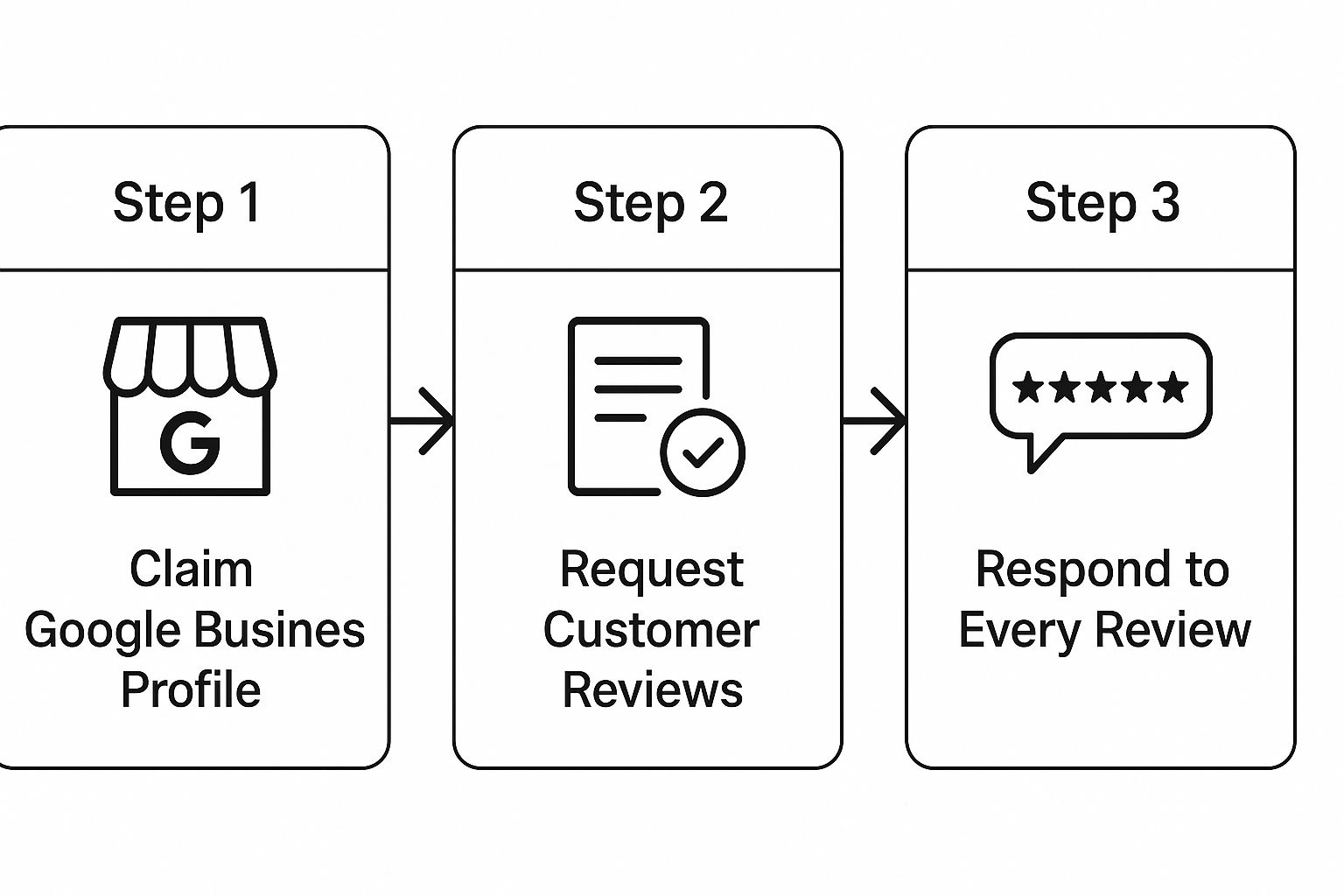
It all boils down to this: a well-managed profile makes asking for reviews possible, and engaging with the feedback you get completes the loop.
Timing and Personalisation Are Everything
The single most important factor in getting a positive review? Timing. You have to ask when the customer’s satisfaction is at its peak. Think about it. For a restaurant, that’s right after they’ve polished off a fantastic meal. For a builder in Surrey, it’s the exact moment the homeowner sees their finished extension for the first time.
Don’t just ask for a review; ask at the right moment. The goal is to catch the customer when they are feeling most positive about your service. This personal touch dramatically increases the likelihood of a response.
A generic, automated email sent weeks later just doesn’t cut it. It feels impersonal and is far too easy to ignore. A quick, friendly follow-up email from the actual person they dealt with, on the other hand, can make a world of difference.
Crafting the Perfect Email Request
Your email doesn’t need to be a long-winded essay. In fact, shorter is almost always better. The key is to be direct, appreciative, and crystal clear about the next step.
Here’s a simple, effective structure you can adapt for your own business:
- Personal Greeting: Always use their name. “Hi Sarah,” is miles better than “Dear Customer.”
- Express Gratitude: Start with a thank you. “Thanks again for choosing us for your recent garden project in Epsom.”
- The Ask: Be direct but polite. “We’d be so grateful if you could share your experience on Google. It helps our local business immensely.”
- The Link: This is non-negotiable. Always include your direct review link to make it effortless.
This approach feels genuine and shows you respect their time. It’s not just a marketing tactic; it’s the natural, positive conclusion to a job well done.
Review Request Method Comparison
Choosing how you ask for a review can be just as important as when you ask. Some methods feel more personal, while others are all about efficiency. Here’s a quick breakdown to help you decide which approach is right for different situations your Surrey business might face.
| Method | Best For | Pros | Cons |
|---|---|---|---|
| In-Person Request | Face-to-face services (e.g., cafés, retail, consultations) where the customer is clearly happy. | Highly personal and effective. You can gauge their mood and ask at the perfect moment. | Can feel awkward if not timed well. Relies on the customer remembering to do it later. |
| Email Follow-up | Service-based businesses (e.g., tradespeople, consultants, B2B) after a project is complete. | Can be personalised and automated. Provides a direct, clickable link. | Easily lost in a busy inbox. Can feel impersonal if not worded carefully. |
| SMS/Text Message | Quick transactions or appointment-based services (e.g., hairdressers, mechanics). | High open rates and immediate delivery. Very convenient for mobile users. | Can feel intrusive if unexpected. Message needs to be very short and to the point. |
| Printed Card/Flyer | Businesses with high footfall (e.g., restaurants, local shops) or for leaving after a home service. | A physical reminder for the customer. Can include a QR code for easy access. | Lower conversion rate. Relies on the customer taking an extra step. |
Ultimately, the best strategy is often a mix of these methods. For a local tradesperson, a friendly in-person mention followed by a personalised email with the link is a powerful combination. A bustling Guildford café, however, might get better results with a QR code on their receipts. Experiment and see what works for your customers.
How to Manage and Respond to Every Review
https://www.youtube.com/3eDR8RskpHk
Getting reviews is just the first part of the puzzle. The real magic happens in how you handle that feedback. It’s what cements your reputation and shows potential customers you’re a business that genuinely listens. Responding to every single review good, bad, and everything in between is simply non-negotiable for building trust.
Responding to Positive Reviews
When a customer leaves a glowing review, your response is your chance to reinforce their positive feelings and show them they’re appreciated. A simple “Thanks” just doesn’t cut it. You need to get personal.
Mentioning the specific service they enjoyed or a detail from their feedback makes your reply feel authentic, not automated. For instance, instead of a generic response, a Surrey landscaper could say: “Thanks so much for the kind words, Jane! We’re thrilled you loved the new patio we installed at your home in Epsom. It was a pleasure working with you.” That small touch validates their experience and, as a bonus, subtly advertises your work to anyone else reading.
Responding promptly and personally to both positive and negative feedback demonstrates excellent customer service and is a key part of effective online reputation management for small business.
Handling Negative and Fake Reviews
Let’s be honest, getting a negative review stings. But your public response is a massive opportunity to turn a bad situation around. The key is to stay calm, professional, and genuinely helpful.
Always start by thanking them for their feedback, acknowledge their specific concern without getting defensive, and then offer to take the conversation offline to find a resolution. This shows everyone watching that you take criticism seriously and are committed to making things right.
This really matters, especially when you consider how people use reviews. Recent data shows about a third of UK consumers will filter out any business with less than 4 stars, while a picky 10% exclusively consider 5-star companies. You can dig deeper into how customers use reviews by exploring the full survey findings.
What if you get a review you’re certain is fake or malicious? If it violates Google’s policies, you can flag it directly from your Business Profile dashboard. While getting it removed isn’t always guaranteed, it’s a vital step in protecting the integrity of your hard-earned reputation.
Frequently Asked Questions About Getting Google Reviews
Here are answers to some of the most common questions business owners have about how to get Google reviews.
1. Is it okay to offer incentives for Google reviews?
No, you should never offer incentives like discounts or gifts in exchange for reviews. This is a direct violation of Google’s policies and can lead to your reviews being removed and other penalties. Stick to providing great service and making the review process easy.
2. How should I handle a negative review?
Always respond publicly with a calm, professional tone. Thank them for the feedback, state your side of the story concisely and without emotion, and offer to take the conversation offline to resolve it. If the review clearly violates Google’s content policies (e.g., it’s spam or hate speech), you can flag it for removal.
3. How many reviews do I really need?
Focus on consistency, not a magic number. A steady stream of recent reviews is far more valuable to potential customers than a huge batch from two years ago. Data shows that most customers want to see at least four recent reviews before they begin to trust a business’s star rating.
4. Can I ask my staff or family to review my business?
Definitely not. This is a clear conflict of interest and is against Google’s rules. Reviews must come from genuine, paying customers to be considered authentic. Anything else risks damaging your credibility.
5. What if I get a bad review but can’t find the customer in my records?
If you receive a negative review from someone you don’t believe was a customer, it’s still best to respond publicly and professionally. You can politely state that you can’t find a record of their transaction and invite them to contact you directly with more details to help you investigate. This shows other readers that you are diligent and that the review might not be genuine.
Navigating the world of digital marketing can feel overwhelming, but you don’t have to do it alone. If you’re a Surrey-based business ready to improve your online visibility and turn searchers into customers, GFC Tech is here to help. Visit us at gfctech.co.uk to learn how our tailored SEO and web design services can help your business grow.
Adam is a Founder of GFC Tech, a company dealing in SEO and website design and development services. Adam has been an SEO expert for the past 8 years and has been working with different companies in this field. He is an SEO consultant and a marketing strategist and works closely with his clients to ensure that his marketing plans and strategies provide them with the marketing advantages they need to grow their business. Adam’s main role is an SEO consultant, but he is also involved in all technical aspects. Adam also develops WordPress websites, designs them professionally and performs SEO for them so they can rank on the first page of google.


