

Before you can start reeling in leads online, you need to get your house in order. This means building a solid foundation by clearly defining your ideal customer, creating a website that actually encourages people to take action, and having a system ready to handle new enquiries. It’s the essential prep work that separates successful campaigns from a whole lot of wasted effort.

Building Your Lead Generation Foundation
Don’t even think about spending a single pound on ads or an hour on content until you’ve established the core parts of your lead generation engine. Jumping straight into tactics without a solid foundation is like trying to build a house on sand it’s just not going to hold up.
This initial phase is all about creating a system that not only attracts potential customers but gives them a clear, easy path to show they’re interested. It’s about being strategic from the get-go.
Define Your Ideal Customer Profile
You can’t attract the right people if you have no idea who they are. The very first thing you must do is create a detailed Ideal Customer Profile (ICP). This is essentially a fictional snapshot of the perfect customer for your business.
And you need to go deeper than just basic demographics. A strong ICP includes:
- Pain Points: What specific problems keep them up at night that your product or service solves?
- Goals: What are they trying to accomplish, either professionally or personally?
- Online Habits: Where do they hang out online? Which social media platforms, forums, or blogs do they actually trust?
- Decision Triggers: What event or frustration finally pushes them to look for a solution like yours?
For instance, a Surrey-based IT consultancy might define its ICP as a small business owner with 5-15 employees who is fed up with unreliable tech and wants a responsive, local partner they can count on. Knowing this allows them to tune their messaging to speak directly to that person’s real-world frustrations.
Create a High-Converting Website
Think of your website as the central hub for all your lead generation activity. It needs to do more than just look pretty; it has to be engineered to turn visitors into leads. A website that’s slow, confusing, or doesn’t tell people what to do next will leak potential customers like a sieve.
A high-converting website has several non-negotiable elements:
- Seamless User Experience (UX): Navigation should feel natural, and information must be easy to find. One study found that 88% of online consumers are less likely to return to a site after a bad experience.
- Clear Calls-to-Action (CTAs): Every single page should guide the visitor on what to do next, whether that’s “Request a Quote,” “Download Our Guide,” or “Contact Us.”
- Mobile Optimisation: With more than half of all web traffic now coming from mobile devices, your site has to work flawlessly on any screen. No excuses.
To truly build a robust foundation, it’s also crucial to understand the distinction between demand generation and lead generation, as this will shape your entire strategy.
For a deeper dive into making your digital storefront as effective as possible, explore our guide on how to improve website SEO.
Driving Quality Leads with SEO and Content
While paid ads can get you seen quickly, real, sustainable growth comes from attracting prospects who are already looking for what you offer. This is where the powerful partnership between Search Engine Optimisation (SEO) and high-value content marketing really comes into its own, helping you generate leads online, month after month.
This isn’t about chasing quick wins. It’s about building a valuable, long-term asset for your business. When you create content that genuinely solves your ideal customer’s problems, you build trust and establish your brand as an authority. You become the obvious choice when they’re finally ready to make a purchase.
Building Topic Clusters and Pillar Content
Gone are the days of a scattergun approach to blogging writing about whatever comes to mind. To get any real traction with search engines and, more importantly, with your audience, you need a structured content plan built around topic clusters.
A topic cluster is simply a group of interlinked articles all revolving around one central, broad subject. This structure is a powerful signal to Google that you have genuine expertise in that area.
The model is built from two key components:
- Pillar Content: This is your big, comprehensive guide that covers a broad topic from start to finish. For a Surrey-based IT firm, a pillar page might be something like “The Ultimate Guide to Cybersecurity for Small Businesses”.
- Cluster Content: These are shorter, more focused articles that dive into the subtopics mentioned in your pillar page. Following our example, cluster articles could be “5 Signs Your Business Email Has Been Compromised” or “How to Choose the Right Antivirus Software”.
Every cluster article links back to the main pillar page. This creates a neat, organised web of content that’s a breeze for both your visitors and search engines to navigate.
Crafting Content That Solves Problems
Your content needs to do more than just tick a keyword box; it has to solve real-world problems for your audience. When someone lands on your article, they should leave feeling they’ve found the exact answer they were searching for.
Try to focus on a mix of content types to serve different needs:
- In-Depth Guides: These are your pillar-style posts. They establish your authority and are magnets for high-quality backlinks from other websites.
- How-To Blog Posts: These are actionable, step-by-step articles that solve a specific, common problem your customers face.
- Case Studies: These provide powerful proof that your product or service delivers tangible results for businesses just like your reader’s.
For a deeper dive into improving your website’s visibility and attracting more organic leads, consider strategies for optimizing your blog for search engines. Getting this right can make a huge difference in how many people discover your valuable content.
The most effective content not only answers a question but also anticipates the next one. Guide your reader naturally through their journey, showing them you understand their challenges at every stage.
Essential SEO Practices for Visibility
Creating fantastic content is only half the battle. If nobody can find it, it can’t generate any leads for you. This is where on-page and technical SEO come in, ensuring your content is fine-tuned to rank as high as possible in search results.
On-Page SEO Checklist:
- Keyword Placement: Include your main keyword naturally in your page title, your headings, and within the first paragraph.
- Compelling Meta Descriptions: Write a short, enticing summary that makes people want to click on your link when they see it in the search results.
- Internal Linking: Link to other relevant pages and articles on your own site. This keeps visitors engaged and helps spread authority across your website.
Technical SEO Fundamentals:
- Site Speed: Your website has to load quickly, especially on mobile. Slow sites frustrate users and hurt rankings.
- Mobile-Friendliness: Your site must look great and be easy to use on any screen size, from a phone to a desktop.
- Clean URL Structure: Use short, descriptive URLs. For example,
/cybersecurity-guide/is much better than/p?id=123.
The trend is clear: data shows 76% of marketers now use content to attract leads, proving its central role in business growth.
Once you’ve captured a lead through your content, the next job is to nurture that relationship. For expert advice on this, you can learn more about email marketing best practices in our dedicated guide.
Using Paid Ads for Immediate Lead Flow

While SEO and content marketing build your long-term, sustainable growth engine, sometimes you just need leads right now. When speed is the priority, there’s no more direct or powerful tool than paid advertising. It lets you cut to the front of the queue, placing your message right in front of ideal customers the moment they need you.
Unlike organic methods that demand patience, paid ads on platforms like Google, LinkedIn, and Facebook can switch on an immediate flow of traffic and enquiries. The real secret, though, is moving beyond just “boosting” posts and building strategic campaigns designed for maximum return on investment (ROI).
Choosing the Right Ad Platform for Your Business
Throwing money at the wrong ad platform is one of the quickest ways for a small business to burn through its marketing budget. Not all platforms are created equal, and the right choice depends entirely on who you’re trying to reach and what you’re selling.
- Google Ads is perfect for capturing high-intent leads. Think about it: these are people actively searching for a solution, typing in phrases like “emergency plumber near me” or “small business IT support Surrey.” You aren’t creating demand; you’re meeting it head-on.
- LinkedIn Ads is the undisputed champion for most B2B companies. Its major strength lies in its incredible targeting capabilities. You can zero in on prospects based on their job title, industry, company size, and even seniority, making it ideal for reaching specific decision-makers.
- Facebook & Instagram Ads excel at creating demand for B2C products and services. Their power comes from targeting based on interests, life events, and behaviours. This lets you introduce your brand to people who fit your ideal customer profile but might not even know they need you yet.
Imagine a B2B tech firm in Guildford. They’d use LinkedIn to show ads specifically to C-suite executives in the financial sector. In contrast, a new yoga studio in Reigate would use Instagram ads to reach local residents who have shown an interest in health and wellness. The platform has to match the customer.
Building Campaigns That Actually Convert
A successful paid ad campaign is far more than a snappy headline and a pretty picture. It’s a finely-tuned system where your targeting, ad creative, and landing page all work in perfect harmony to persuade a visitor to take action.
Your ad copy has to speak directly to a pain point and offer a clear, compelling solution. It needs to be good enough to stop someone mid-scroll and earn that click. But the click is only the beginning of the journey.
The most brilliant ad in the world will fail if it sends people to a poor landing page. Your landing page must be a seamless continuation of your ad, with a single, clear call-to-action that makes it incredibly easy for visitors to convert.
This is especially true in the competitive UK market. As traditional outreach becomes less effective, business-to-business (B2B) lead generation now leans heavily on these strategic, trust-building digital tactics. To get an edge, companies are crafting targeted campaigns based on deep customer understanding, allowing them to acquire high-quality leads before their rivals even get a look-in.
Tracking and Optimising for Maximum ROI
Launching a campaign is just step one. The real work and where the real profit is made lies in the ongoing tracking and optimisation. You must be prepared to A/B test everything: from your headlines and images to your button colours and landing page copy.
It’s always wise to start with a modest test budget. This lets you gather crucial data on what resonates with your audience without risking a significant sum of money.
Key Metrics to Monitor:
- Cost Per Click (CPC): How much are you paying for each visitor?
- Click-Through Rate (CTR): What percentage of people who see your ad actually click it?
- Conversion Rate: Of those who click, what percentage become a lead?
- Cost Per Lead (CPL): The ultimate measure of efficiency how much does it cost you to get one genuine enquiry?
By watching these numbers like a hawk, you can quickly turn off underperforming ads, shift your budget to the winners, and steadily improve your ROI. This data-driven approach is what transforms paid advertising from a gamble into a predictable system for business growth.
Building a Community That Generates Leads
It’s easy to think of social media as just a digital megaphone for shouting company news into the void. The real magic, though, happens when you flip the script. Instead of broadcasting, you start building relationships the kind that naturally turn into high-quality leads.
When you manage to create a genuine community around your brand, something powerful shifts. You stop chasing leads and start attracting them. Passive followers become vocal advocates who generate powerful word-of-mouth referrals, one of the most effective ways to generate leads online.
Engage Where Your Audience Lives
The first rule of community building is simple: be where your customers are. For many UK B2B companies, especially in professional services, LinkedIn is the go-to platform. Think of it as a 24/7 professional networking event, right at your fingertips.
But don’t just drop links to your latest blog post and disappear. Dive into the conversations. Join relevant industry groups, add thoughtful comments to other people’s posts, and share insights that deliver real value. Do this without asking for anything back, and you’ll build trust long before a sales pitch ever enters the picture.
True engagement isn’t about hijacking conversations; it’s about contributing to them. Your goal is to become a recognised, helpful voice in your niche, making you the first person people think of when they need your services.
This change in mindset is crucial. You’re not just a seller; you’re a trusted member of the community. And the numbers back it up: a staggering 68% of marketers report that social media plays a significant role in their lead generation efforts.
Put Native and Interactive Tools to Work
Social platforms are packed with tools designed to make lead capture almost effortless. Use them smartly, and you can slash the friction that stops a potential customer from reaching out.
- LinkedIn Lead Gen Forms: For B2B, these are an absolute game-changer. When someone clicks your ad, a form instantly pre-fills with their profile data. This simple convenience can send your conversion rates through the roof because it eliminates the chore of manual entry.
- Interactive Polls and Questions: Got a burning question for your market? Use polls on platforms like LinkedIn and Twitter. Asking about your audience’s biggest challenges doesn’t just drive engagement; it’s a goldmine of market research.
- Live Video and Q&A Sessions: Hosting a live Q&A session puts a human face on your brand, positioning you as an approachable expert. Nothing builds trust faster than showing up and answering questions directly.
Turn Followers into Advocates
The ultimate win in community building? Creating a loyal tribe that does your marketing for you. This happens when you consistently deliver value and make your followers feel seen and heard.
Start by listening. Use social listening tools to keep an eye on conversations about your industry, your competitors, and the problems your business solves. You’ll spot countless opportunities to jump in, answer questions, and offer help when it’s needed most.
And when a follower shares your content or says something positive? Acknowledge it publicly. A simple “thank you” goes a surprisingly long way in cementing that relationship. It encourages more of the same, creating a powerful ripple effect of organic promotion.
This strategy isn’t a quick fix, but the payoff is a robust, self-sustaining community that consistently feeds your business with warm, high-quality leads.
Optimising Your Funnel to Convert More Leads
Capturing a lead is a fantastic start, but it’s only the beginning of the story. The real challenge and where the biggest opportunities lie is turning that initial spark of interest into genuine revenue. This is where a well-tuned sales funnel becomes your most valuable asset, guiding prospects systematically from casual browsers into loyal customers.
An effective funnel doesn’t just happen by chance. It’s built by understanding the key stages of your customer’s journey and delivering the right message at the right time. Your goal should always be to make the next step feel natural and helpful, not pushy.
Nurturing Leads with Smart Automation
One of the most powerful tools to generate leads online and then convert them is lead nurturing, which is often powered by smart email automation. When someone downloads your guide or fills out a contact form, they’ve essentially raised their hand. Now, it’s your job to build on that initial engagement.
This is where automated email sequences, or “drip campaigns,” come into their own. These aren’t just for blasting out sales pitches. Instead, they should feel like a helpful, one-on-one conversation that unfolds over time.
- Welcome Email: The very first email should arrive instantly. It confirms their action (e.g., “Here’s the guide you requested!”), thanks them, and sets expectations for what’s to come.
- Value-Driven Follow-ups: Over the next few days or weeks, send a series of emails that offer even more value. Share a related blog post, a useful case study, or a quick tip that solves another one of their problems.
- The Soft Offer: After building that initial layer of trust, you can introduce a gentle call-to-action, like an invitation to a webinar or a free, no-obligation consultation.
The key is to provide value before you ask for a sale. This approach establishes trust and positions you as an expert, not just another salesperson.
The Power of Segmentation and Personalisation
In a world of overflowing inboxes, generic, one-size-fits-all messages simply get deleted. To stand out, you have to personalise your communication. This all starts with segmentation—dividing your lead list into smaller, more specific groups based on their interests or the actions they’ve taken.
For example, you could segment your leads based on:
- The specific page they visited on your website.
- The type of content they downloaded (e.g., a beginner’s guide vs. an advanced pricing sheet).
- Their industry or job role, if you have that data.
When you segment your audience, you can tailor your messaging to be hyper-relevant. A lead who downloaded a guide on “Local SEO” should receive completely different follow-up content from someone who enquired about “WordPress Maintenance.” This simple act of personalisation can dramatically boost your engagement and conversion rates.
To get a better sense of this, the diagram below shows the simple but critical flow of tracking and optimising your channels.
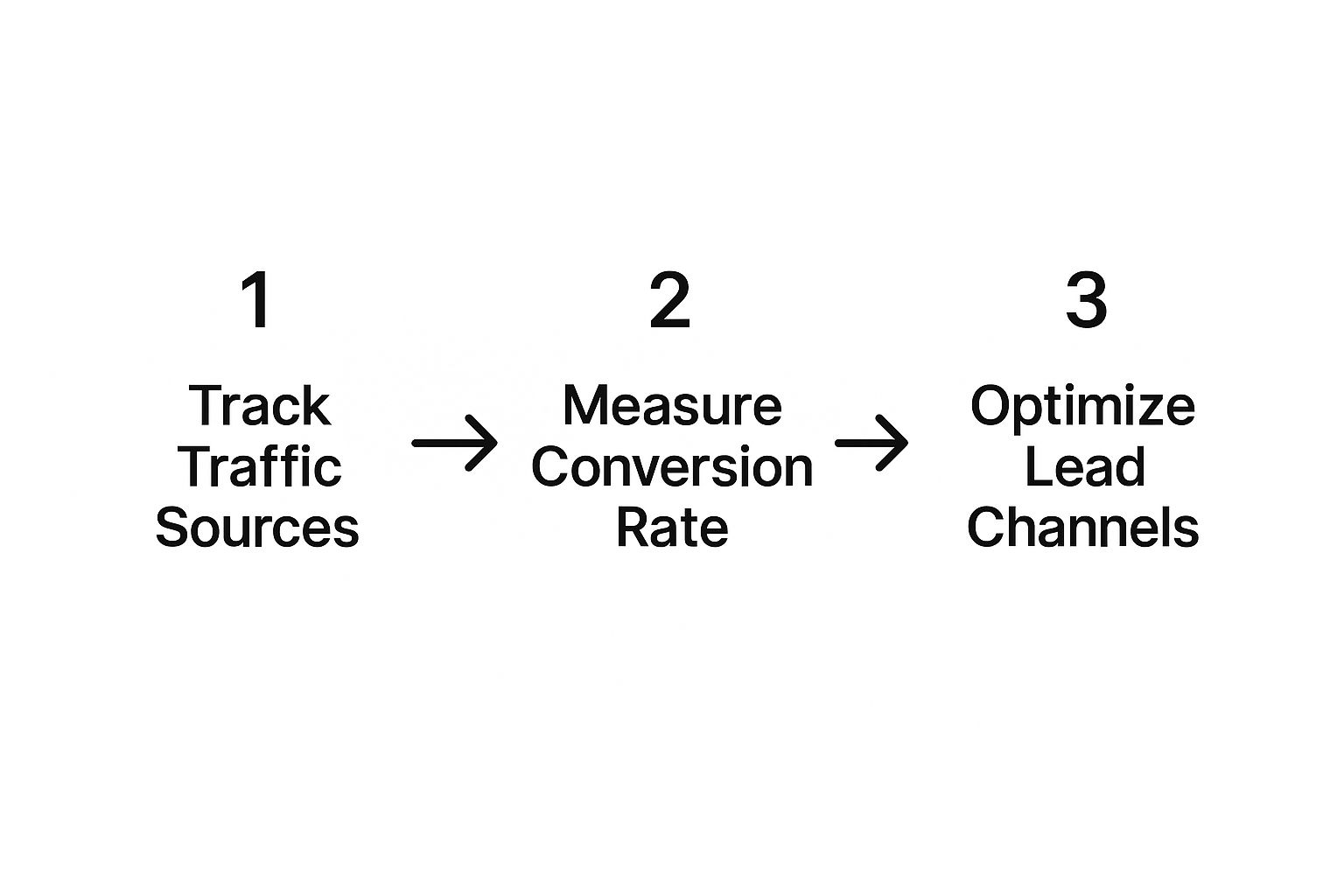
This process highlights that optimisation isn’t a one-time task; it’s a continuous cycle of tracking where leads come from, measuring how well they convert, and then funnelling your resources into the most effective channels.
By adopting a similar mindset of tracking, segmenting, and personalising, even small businesses can create a powerful conversion engine. It’s all about being thoughtful and strategic with every single interaction. For a more detailed look into this process, check out our complete guide to lead generation in digital marketing.
Answering Your Top Lead Generation Questions
Diving into the world of online lead generation always brings up a few common questions. We’ve covered a lot of ground on the strategies and tactics to fill your pipeline, but now it’s time to tackle some of the most frequent hurdles UK businesses face. Here are clear, straightforward answers to help you move forward with confidence.
How Much Should a UK Business Budget to Generate Leads Online?
There’s no magic number, but you can absolutely plan with a strategy. The right budget really depends on your specific industry, how fast you want to grow, and the channels you decide to focus on. As a starting point, it helps to know the average Cost Per Lead (CPL), which often lands between £150-£200 for many UK service businesses.
If you’re testing paid channels like Google or LinkedIn Ads, setting aside a budget of £500 to £1,000 per month is a smart way to gather that crucial initial data. It lets you see what works without a massive upfront commitment.
On the other hand, the investment for SEO and content marketing is more about time and expertise than direct ad spend. The best approach is to start with a budget you can comfortably measure, track your return on investment like a hawk, and then confidently scale up the channels that deliver the best, most profitable results.
What Is the Difference Between an MQL and an SQL?
Getting this right is absolutely vital for making your sales and marketing teams work together smoothly. When this distinction is blurry, you end up with wasted effort and missed opportunities.
A Marketing Qualified Lead (MQL) is someone who has shown interest by interacting with your marketing maybe they downloaded an e-book or signed up for a webinar. They’re curious, but they aren’t ready for a direct sales call just yet.
A Sales Qualified Lead (SQL), however, has signalled a clear intention to buy. This could be by filling out a “Request a Quote” form or asking for a product demo. They are primed and ready for your sales team to reach out.
The secret to aligning your teams is to define clear, agreed-upon criteria for both MQLs and SQLs. It ensures your sales team invests their valuable time on the hottest prospects, which directly improves efficiency and boosts your final conversion rate.
How Long Until I See Results from Online Lead Generation?
Your timeline for results will vary massively depending on the strategy you choose. It’s a crucial expectation to set right from the start.
- Paid Advertising: Platforms like Google Ads can generate leads online almost instantly, sometimes within hours of a campaign going live. The trade-off? The lead flow stops the moment you turn off your ad spend.
- Organic Methods: SEO and content marketing are about playing the long game. You should expect to see a consistent, meaningful flow of leads within 3 to 9 months as your website builds authority. The huge benefit here is creating a sustainable, often lower-cost stream of high-quality leads that works for you 24/7.
A balanced strategy often uses paid ads for quick wins while you build that solid foundation of organic growth for long-term stability.
Which Social Media Platform Is Best for B2B Leads in the UK?
For the vast majority of B2B companies here in the UK, LinkedIn is the undisputed leader. Its entire ecosystem is built from the ground up for professional networking and marketing.
The platform’s real strength lies in its powerful targeting capabilities. You can reach specific decision-makers based on their job title, industry, company size, and seniority a level of precision that’s hard to beat. You can share valuable industry insights to build authority and use slick tools like LinkedIn Lead Gen Forms to capture contact details with minimal friction. While other platforms certainly have their place, LinkedIn consistently delivers higher-quality leads for B2B.
What Are the Most Important Lead Generation Metrics to Track?
To really know if your efforts are paying off, you need to look past vanity metrics and focus on what actually drives business growth. Here are the essentials you should be watching:
- Cost Per Lead (CPL): The ultimate measure of your campaign’s efficiency.
- Conversion Rate: The percentage of visitors who take the action you want and become a lead.
- Lead-to-Customer Rate: This tells you how many of your leads turn into paying customers, revealing the true quality of your leads.
- Channel-Specific Metrics: This covers data like organic traffic from SEO or click-through rates (CTR) from paid ads.
- Customer Lifetime Value (CLV): This ensures the leads you’re generating are actually profitable for the business in the long run.
Tracking these numbers gives you a clear performance dashboard, showing you exactly where to fine-tune your efforts and where to double down.
Ready to stop guessing and start building a predictable lead generation system for your business? At GFC Tech, we combine technical expertise with strategic digital marketing to help small businesses across Surrey and the South East grow. Let’s build a plan that delivers real, measurable results.
Find out how we can help by contacting us at https://gfctech.co.uk/contact-us-gfc-tech-surrey/
Adam is a Founder of GFC Tech, a company dealing in SEO and website design and development services. Adam has been an SEO expert for the past 8 years and has been working with different companies in this field. He is an SEO consultant and a marketing strategist and works closely with his clients to ensure that his marketing plans and strategies provide them with the marketing advantages they need to grow their business. Adam’s main role is an SEO consultant, but he is also involved in all technical aspects. Adam also develops WordPress websites, designs them professionally and performs SEO for them so they can rank on the first page of google.


