
An SEO audit is essentially a deep-dive diagnostic of your website’s performance, uncovering all the issues that are quietly hurting your search engine rankings. Think of it as a comprehensive health check for your site. It gives you an actionable roadmap to improve visibility, stamp out errors, and spot growth opportunities you didn’t even know you had. It’s the foundational first step for any serious SEO strategy.
- Why an SEO Audit Is Your Website's Most Important Health Check
- Deconstructing a Comprehensive SEO Audit
- The Real Business Impact of a Professional SEO Audit
- Your Step-by-Step Guide to the SEO Audit Process
- How to Choose the Right SEO Audit Partner in the UK
- Common Questions About SEO Auditing Services
Why an SEO Audit Is Your Website’s Most Important Health Check
Picture your website as a high-performance engine. Over time, parts get worn, small inefficiencies creep in, and performance starts to dip. You might not even notice the gradual slowdown, but it’s definitely happening. Professional SEO auditing services act as your master mechanic, running a full diagnostic to find every single problem, from a misfiring spark plug (like a broken link) to a clogged fuel line (slow page speed).
Without that check-up, you’re just guessing. You could be spending a fortune on a new paint job (fresh content) when the real issue is a faulty transmission (major technical errors). An audit gets rid of the guesswork completely.
Identifying What’s Holding You Back
A proper audit provides a clear, objective look at your website’s strengths and weaknesses. It goes way beyond simple online checkers to analyse the hundreds of different factors that search engines like Google use to rank websites.
- Uncovering Hidden Technical Flaws: Things like poor mobile usability, incorrect indexing settings, or sluggish load times can make your site practically invisible to search engines.
- Finding Content Gaps and Opportunities: An audit shows you exactly where your competitors are winning and shines a light on new topics you can target to bring in more customers.
- Assessing Your Online Authority: It digs into your backlink profile to make sure you’re earning trust from reputable sources, which is a massive ranking factor in the competitive UK market.
A great SEO audit doesn’t just flood you with data; it gives you clear direction. It turns complex technical jargon into a prioritised to-do list that will have the biggest impact on your traffic and revenue.
To get a better sense of the full potential of these essential check-ups, you can explore this guide on Unlocking Growth with Website Auditing Services.
This diagnostic process is the first step toward building a solid, sustainable online presence. If you’re ready to see what’s really on under the bonnet of your website, our expert team can provide a detailed analysis. Learn more about our complete website SEO audit services to get started.
Deconstructing a Comprehensive SEO Audit

To really get what SEO auditing services deliver, you need to lift the bonnet and have a proper look at the engine. A thorough audit isn’t a single, quick check; it’s a multi-point inspection that covers four core pillars, each vital to how your website performs in search results. Thinking of it this way makes the whole process much less mysterious.
A great way to visualise these moving parts is to break them down into their distinct roles. Each component addresses a different aspect of your site’s health, from the hidden code to the public-facing content.
Key Components of a Full SEO Audit
| Audit Component | Focus Area | Example Checks |
|---|---|---|
| Technical SEO | The website’s foundation and infrastructure. | Site speed, mobile-friendliness, crawlability, indexation status, site architecture. |
| On-Page SEO | Content quality and relevance on individual pages. | Keyword targeting, title tags, meta descriptions, heading structure, internal linking. |
| Off-Page SEO | The site’s authority and reputation across the web. | Backlink profile quality, brand mentions, online reviews, social signals. |
| Competitor Analysis | Market intelligence and strategic positioning. | Competitor keyword gaps, backlink strategies, content strengths and weaknesses. |
Looking at this breakdown, you can see how a comprehensive audit leaves no stone unturned, piecing together a full picture of your site’s performance. Now, let’s explore what each of these means in practice.
Technical SEO: The Engine and Foundation
First up is Technical SEO. If your website were a car, this would be its engine, chassis, and electrical systems. It covers all the behind-the-scenes stuff that search engines need to find, crawl, and understand your site properly. Without a solid technical foundation, even the best content can go completely unnoticed.
A technical audit makes sure your site is fast, secure, and easy for search engine bots to navigate. For instance, an audit might find that your pages are too slow to load on a phone a critical issue when you realise that over 50% of mobile users will abandon a site if it takes more than three seconds to load.
Key areas of a technical review include:
- Site Speed: Analysing how quickly your pages load for real users.
- Mobile-Friendliness: Ensuring a seamless experience on all devices, which is critical for rankings.
- Crawlability & Indexability: Checking if search engines can actually find and list your pages correctly.
- Site Architecture: Reviewing your site’s structure for logical navigation and user flow.
On-Page SEO: Your Digital Storefront
Next, we have On-Page SEO. Think of this as your digital shop front and all the in-store signage. It’s all about the content on your pages and how well it’s presented to both visitors and search engines. This is where you make it crystal clear what you offer and why people should care.
This part of the audit assesses everything from the quality of your writing to your keyword strategy. It checks that your “signage” (your page titles, headings, and meta descriptions) is compelling and accurately reflects what’s “inside” (your actual content).
Off-Page SEO: Your Public Reputation
Third on the list is Off-Page SEO. This is all about your business’s reputation and authority across the wider web. It’s essentially how other websites and users vouch for your credibility. It’s the online equivalent of word-of-mouth.
A massive part of this is your backlink profile the collection of links pointing to your site from other domains. An audit will scrutinise the quality and relevance of these links, not just the quantity.
A professional audit doesn’t just count your backlinks; it assesses their quality. A single authoritative link from a trusted industry source is worth more than a hundred low-quality links from irrelevant sites.
Competitor Analysis: Your Market Intelligence
Finally, no audit is complete without a thorough Competitor Analysis. This is the market intelligence that tells you where you stand against the competition. It involves digging into the SEO strategies of your direct rivals to spot gaps in their approach and find opportunities for you to get ahead.
By understanding what they’re doing well (and not so well), you can build a smarter, more targeted strategy. A great audit provides the blueprint, showing you precisely where to focus your efforts for the biggest impact.
The Real Business Impact of a Professional SEO Audit
It’s one thing to know what’s inside an audit, but the real question is: what does it actually do for your business? A professional SEO audit moves past the technical jargon to deliver tangible, commercial value. This isn’t about ticking boxes; it’s about generating a return on investment that directly hits your bottom line.
Think of it this way: an audit finding like “slow mobile page speed” isn’t just a tech problem. It’s a business problem. It causes potential customers to leave your site in frustration, directly costing you sales. Fixing it isn’t just a technical task it’s a direct move to improve user experience and boost conversion rates.
From Technical Fixes to Commercial Gains
The true power of SEO auditing services lies in their ability to connect technical fixes with real-world results. Every single recommendation is designed to produce a specific, positive business outcome.
- Fixing Indexing Errors: When an audit finds important pages that Google can’t see, the fix leads to immediate visibility for your products or services.
- Content Gap Analysis: Spotting topics your competitors rank for but you don’t opens up entirely new streams of customer traffic, letting you capture a much wider audience.
- Improving Site Structure: A logical site layout doesn’t just please search engines; it helps users find what they need faster, cutting bounce rates and increasing the time they spend on your site.
Each of these actions contributes directly to a stronger online presence, which translates into more leads and, ultimately, more revenue.
An audit reframes SEO from an abstract marketing cost into a strategic investment. It provides a clear roadmap showing how specific actions will lead to measurable growth, justifying every pound spent.
A Lower Cost of Acquiring Customers
One of the biggest impacts is on your customer acquisition cost (CAC). Paid advertising delivers quick traffic, sure, but the costs can spiral, and the leads dry up the moment you stop spending. Organic search, on the other hand, builds a sustainable asset, nurtured by a well-executed audit.
Organic search remains one of the most effective digital marketing channels in the UK, offering a huge return over paid ads. In fact, SEO delivers an average ROI of £22 for every £1 spent, making it a top-performing channel for long-term growth. You can learn more about these powerful SEO statistics.
What this means is that the insights from an audit help you attract qualified customers for a fraction of the cost of pay-per-click campaigns. You end up with a more profitable and resilient business model for the future.
Your Step-by-Step Guide to the SEO Audit Process
So, what actually happens when you hire one of the many SEO auditing services out there? It’s not some mysterious black box where data goes in and a report magically pops out. Far from it. A proper audit is a structured, collaborative journey designed to give you a clear, actionable strategy for growth.
Demystifying this process helps set the right expectations from the start. A great audit is a genuine partnership, not just a data dump. It follows a logical path from initial chats right through to the final recommendations, with each phase building on the last to ensure the action plan is perfectly tuned to your business goals.
Phase 1: Discovery and Goal Alignment
Every good audit begins with a simple conversation. Before a single tool is fired up, a skilled SEO expert needs to get under the skin of your business. What are your commercial objectives? Who are your ideal customers? And most importantly, what does success actually look like to you?
This initial discovery phase is non-negotiable. It’s what ensures the audit zeroes in on metrics that genuinely impact your bottom line, rather than just chasing generic SEO scores. It’s all about aligning the technical deep-dive with your real-world ambitions.
Phase 2: Deep-Dive Data Collection
Once your goals are crystal clear, the data gathering begins. This means setting up and getting access to key analytics platforms to paint a complete picture of your current performance.
- Google Analytics: To see how users behave on your site, where they come from, and what makes them convert.
- Google Search Console: To understand how Google sees your site, including which keywords you’re showing up for and any technical red flags.
- Advanced Crawlers: Tools like Screaming Frog or Ahrefs are set loose to crawl your entire website, mimicking exactly how a search engine would see it.
This phase is all about collecting the raw materials for analysis pulling together thousands of data points that will be interpreted in the next stage.
Phase 3: The Core Analysis
Here’s where the real expertise comes into play. An experienced analyst rolls up their sleeves and dives into the data, looking for patterns, problems, and hidden opportunities. It’s where all the technical, on-page, and off-page elements get put under the microscope. For anyone keen to see the nitty-gritty, we have a detailed guide on how to do a complete SEO audit that breaks this down even further.
This stage is more than just reading numbers; it’s about connecting the dots. For instance, an analyst might link a high bounce rate on a key landing page (from Analytics) to a sluggish load time flagged by the crawler, diagnosing a critical issue that’s actively costing you customers.
Phase 4: Crafting the Action Plan
After the analysis, all the findings are pulled together into a clear, prioritised action plan. A quality report won’t overwhelm you with technical jargon. Instead, it presents recommendations in plain English, explaining the “what,” the “why,” and the “how” for each item on the list.
The infographic below shows how this workflow moves from analysis to recommendation.
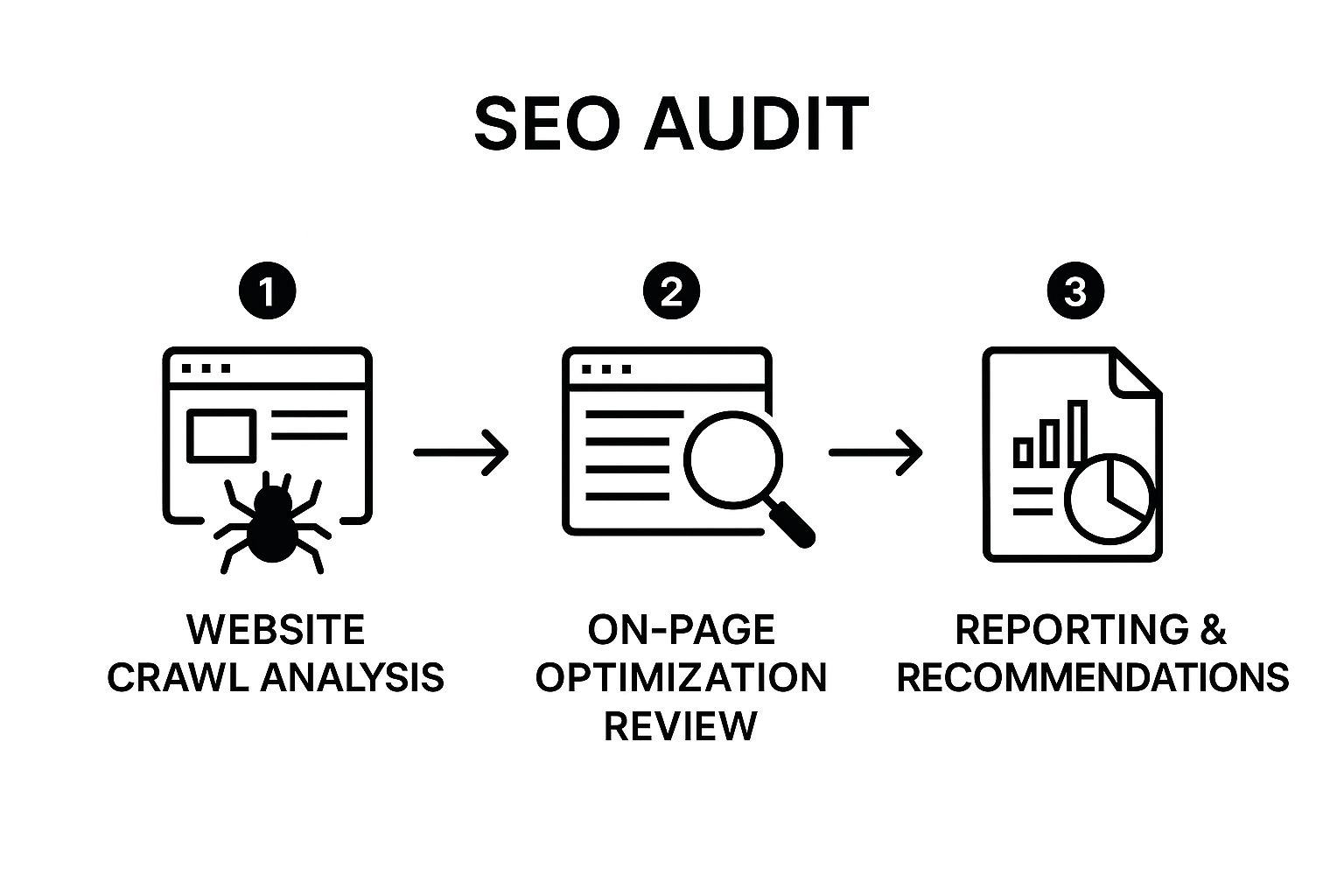
This flow shows how a systematic crawl and review logically lead to a strategic set of recommendations tailored specifically for your site.
Phase 5: Implementation and Support
Finally, the best SEO auditing services don’t just hand you a document and disappear. They stick around to help you put the findings into practice. This might mean a follow-up call to walk you through the report, answer questions from your team, or liaise directly with your web developers to get the changes rolled out. This ongoing partnership is what ensures the audit translates into genuine, lasting results for your business.
How to Choose the Right SEO Audit Partner in the UK

Choosing a partner for SEO auditing services can feel a bit like navigating a minefield. The UK market is crowded with agencies all promising the world, and it’s tough to tell a genuine expert from a slick salesperson. Get it right, and you’re on the path to sustained growth. Get it wrong, and you could be looking at a lot of wasted time and money.
To put it in perspective, the UK SEO industry is a serious business. As of 2024, the market for SEO software alone hit around USD 5.4 billion and is expected to grow by 13.5% each year until 2030. With so much at stake, picking a proven partner has never been more critical. You can get a sense of the UK’s thriving SEO market to see just how big the industry is.
What to Look For in a Provider
When you’re vetting potential agencies, it all comes down to transparency and a proven track record. A credible partner should be an open book about their processes, the tools they use, and what you can realistically expect.
Keep an eye out for these positive signs:
- Detailed Case Studies: They should be able to walk you through real-world examples of how their audits helped businesses like yours hit specific goals.
- Transparent Process: A good partner will clearly map out their entire audit methodology, from the initial data pull to the final report, just like we’ve outlined.
- Expertise with Industry Tools: They need to be comfortable and proficient with the tools of the trade, like Ahrefs, Semrush, and Google’s own suite.
- Focus on Your Business Goals: The first conversation should be about your commercial objectives, not just vanity metrics like traffic.
Critical Red Flags to Avoid
Knowing what to steer clear of is just as important. Some promises sound too good to be true because, frankly, they are. Be wary of any agency showing these warning signs.
A massive red flag is anyone guaranteeing a “#1 ranking” on Google. No ethical SEO provider can promise specific rankings. The final decision always rests with Google’s complex and constantly changing algorithms.
Other things to watch out for include:
- Vague or Data-Light Reports: If their sample reports are fluffy and lack specific, actionable advice, walk away.
- A “Secret Sauce” Mentality: SEO best practices are well-known. Anyone claiming to have a secret formula is probably using outdated or risky tactics that could get you penalised.
- Lack of Technical Depth: A proper audit is built on a deep understanding of the technical side of SEO. For a better idea of what that involves, you can learn about our specialised technical SEO service.
Common Questions About SEO Auditing Services
Diving into SEO auditing services often brings up a few practical questions. To clear up any lingering uncertainties, we’ve pulled together the most common queries we hear from businesses looking to invest in their website’s future. Our goal is to give you direct, no-nonsense answers so you can make confident decisions.
Each question tackles a key part of the process, from typical UK costs to what you should get in a final report. It’s a quick way to reinforce the core ideas from our guide and get the clarity you need to move forward.
How Much Do SEO Auditing Services Cost in the UK?
Costs for an SEO audit in the UK can vary a lot, mostly depending on your website’s size and complexity. A small business site might find services starting from a few hundred pounds, while a deep-dive audit for a large e-commerce platform could easily run into several thousand.
The price tag is usually influenced by the audit’s depth, the tools being used, and the provider’s experience. It’s best to see it not as a cost, but as a strategic investment in a clear roadmap for growth. This is especially true as more businesses realise how crucial these health checks are.
In Europe, including the UK, the SEO audit service market is projected to grow from a global base valued at around $507 million in 2025 to approximately $764 million by 2033. This growth is fuelled by the increasing need for regular, thorough audits to pinpoint technical flaws, content gaps, and backlink issues. You can find more details in these market growth insights.
How Often Should My Website Get an SEO Audit?
For most businesses, a comprehensive SEO audit is a good idea at least once a year. However, if you’re in a highly competitive market, have recently redesigned your website, or are ploughing money into new content, a six-month check-up is a smart move.
Think of it like a regular service for your car. These periodic ‘health checks’ help you adapt to search engine algorithm updates and keep your edge over the competition.
What Is the Difference Between a Tool and a Service?
Automated tools like Ahrefs or Semrush are brilliant for gathering data and flagging common problems. They can quickly show you the ‘what’ like a broken link or a missing title tag.
A professional SEO auditing service provides the essential human element: analysis, interpretation, and strategic planning. An expert understands the ‘why’ behind the data, prioritises actions based on your business goals, and builds a custom roadmap that a tool simply cannot replicate.
What Should I Expect in My Final Audit Report?
A quality SEO audit delivers more than just data; it provides an actionable plan. Your final report should start with an executive summary, followed by a prioritised list of recommendations sorted by impact and effort. Each issue should have a clear, jargon-free explanation.
Most reputable services also include a follow-up call to walk you through the findings and help you figure out where to start with implementation.
Can I Do an SEO Audit Myself?
Of course. A basic DIY audit using online tools is a great way to handle low-hanging fruit and get your head around SEO fundamentals.
However, a professional service brings deep expertise, access to enterprise-level tools, and an objective viewpoint that’s crucial for uncovering complex technical issues. They can perform an in-depth competitor analysis and build a truly effective long-term strategy, ensuring no stone is left unturned.
Ready to uncover the hidden opportunities on your website and build a clear path to growth? The team at GFC Tech provides expert SEO auditing services designed for small businesses in Surrey and beyond. Get in touch with us today for a no-obligation chat about your business goals.
Adam is a Founder of GFC Tech, a company dealing in SEO and website design and development services. Adam has been an SEO expert for the past 8 years and has been working with different companies in this field. He is an SEO consultant and a marketing strategist and works closely with his clients to ensure that his marketing plans and strategies provide them with the marketing advantages they need to grow their business. Adam’s main role is an SEO consultant, but he is also involved in all technical aspects. Adam also develops WordPress websites, designs them professionally and performs SEO for them so they can rank on the first page of google.


