

The best blog posts don’t start with a clever opening sentence. They start with a solid plan. The real secret is nailing down your audience and purpose first, figuring out what they’re actually searching for, and then sketching out a simple outline to keep your writing on track. This groundwork is what makes the difference between content that connects and content that just adds to the noise.
Plan Your Content Before You Write a Word

Diving straight into writing with no plan is like setting off on a road trip without a map. Sure, you’ll end up somewhere, but it probably won’t be where you intended. The blog posts that really perform the ones that pull in readers and climb the Google rankings are always built on a foundation of thoughtful planning.
This isn’t about boxing in your creativity; it’s about giving it direction. By spending a little time upfront, you make sure every word you write has a job to do, speaking directly to your reader’s problems and showing them a clear way forward.
Define Your Purpose and Audience
Before you can even think about writing a blog post that sticks, you need to answer two simple questions: Who am I actually writing for? and What do I want them to do or feel after reading this?
Your audience is never “everyone.” Is it a small business owner in Surrey who needs practical SEO tips? Or maybe a marketing manager hunting for new content strategy ideas? Getting specific on this persona helps you lock in the right tone, language, and examples.
Every post needs a clear goal, too. Are you trying to:
- Educate your reader on a tricky subject?
- Solve a specific headache they’re dealing with?
- Persuade them to see things from a new angle?
- Inspire them with a success story or case study?
Knowing your objective keeps you focused. A post that aims to solve a problem needs to be direct and full of actionable steps, while an inspirational piece might lean more on storytelling.
Conduct Keyword and Competitor Research
Once you’ve got your “who” and “why,” it’s time to find the “what.” What exact phrases are your ideal customers typing into Google? This is where keyword research comes in, and it’s not about stuffing your article with clunky terms. It’s about learning to speak your audience’s language.
Using a keyword tool can reveal what people are really looking for. Instead of guessing they want “blog tips,” you might discover they’re actually searching for “how to write blog posts for beginners.” That small shift is a game-changer.
Next up, take a look at the top-ranking articles for that keyword. Don’t just mimic them look for the gaps. Ask yourself:
- What questions have they left unanswered?
- Can I explain this concept more clearly?
- Could I offer more recent information or better, real-world examples?
This is how you find a unique angle that makes your content the obvious choice.
Key Takeaway: Planning isn’t an optional extra; it’s the most important part of creating content. A well-researched plan is what separates a blog post that gets ignored from one that becomes a go-to resource.
Create a Simple Content Brief
With your research done, the last bit of planning is to pull it all into a simple content brief or outline. This doesn’t need to be some huge, formal document. Just think of it as a roadmap to keep you from getting lost once you start writing.
A good brief should include:
- Working Title: A headline that grabs attention and includes your main keyword.
- Target Audience: A quick note on who you’re writing for (e.g., “Surrey business owner”).
- Primary Goal: What the reader should be able to do or know when they’re finished.
- Main Headings (H2s/H3s): A logical flow for your main arguments.
- Key Talking Points: A few bullet points under each heading to remind you of the core info.
This structure is a lifesaver for beating writer’s block and keeping your thoughts organised. By planning your content before you start, you turn a big, intimidating task into a series of small, manageable steps and set yourself up for a seriously effective article.
Turn Your Ideas into a Compelling First Draft
You’ve done the planning, the research is sorted, and now you’re staring at the blinking cursor on a blank page. It’s the part of the process where many writers get stuck, convinced every word has to be perfect right from the start. Let’s get one thing straight: forget that idea. The first draft is all about momentum, not perfection.
Your only job right now is to get your thoughts out of your head and onto the screen. This is your chance to translate all that expertise and the structure from your content brief into a real, conversational article. Don’t get hung up on beautiful prose or flawless grammar just yet that’s what the editing stage is for.
Craft an Opening That Hooks the Reader
You have about three sentences to convince someone your post is worth their time. A weak opening means they’ll hit the back button before they even reach your best advice. Your introduction needs to answer two questions for the reader, and it needs to do it fast: Is this for me? and What will I get out of this?
A great intro immediately connects with a reader’s pain point or piques their curiosity. Instead of kicking things off with a dry definition, try a relatable scenario or a surprising statistic.
So, instead of this:
“This article will discuss how to write blog posts.”
Try something with a bit more punch:
“Ever spent hours crafting the ‘perfect’ blog post, only to hit publish and hear nothing but crickets? You’re not alone, but the silence isn’t your fault it’s a sign your opening isn’t doing its job.”
This approach shows you get their frustration and promises a solution, making them keen to read on.
Build the Body with Stories and Evidence
Now that you’ve got them hooked, it’s time to deliver on your promise. The body of your post is where you’ll flesh out the main points from your outline. But just listing facts won’t keep anyone scrolling. You need to back up your arguments with a healthy mix of evidence, examples, and personal stories.
Here’s how to build a body section that’s both robust and persuasive:
- Use Real-World Examples: Abstract advice is forgettable. Ground your points in reality. If you’re explaining a content strategy, show what it looks like for a local Surrey-based business.
- Incorporate Data and Statistics: Numbers add credibility. A statement like “73% of businesses find that blogging brings them a positive marketing ROI” is far more powerful than “Blogging is good for business.”
- Tell Personal Stories: People connect with people, not faceless brands. Sharing a genuine struggle or a hard-won success builds trust and makes your content far more memorable. It proves you’ve been in their shoes.
As you get your ideas down, keep one goal in mind: how to create engaging content that converts readers into loyal followers. This mindset ensures every paragraph serves a purpose beyond simply filling the page.
Maintain an Authentic Voice
Your writing voice is your personality on the page. It’s the one thing that distinguishes your content from thousands of other articles on the exact same topic. If you try to sound overly academic or corporate when that’s not really you, readers will spot it a mile off.
Think of it like this: you’re having a one-on-one chat with your ideal reader. So, write like you speak. Use contractions (like “it’s” and “you’re”), ask questions to keep them engaged, and don’t be afraid to let your passion for the subject shine through.
Pro Tip: Read your draft aloud. If it sounds clunky, awkward, or just not like you, rewrite it until it flows like a real conversation. It’s one of the quickest ways to find your true voice and smooth out any rough patches.
Your authentic voice is what builds that genuine connection and makes readers feel like they know and trust you something that’s absolutely crucial for small businesses that thrive on strong client relationships.
Transform Your Draft into a Polished Article
Getting that first draft down is a massive win, but it’s really just the starting line. The magic happens in the editing phase this is where a collection of good ideas transforms into a genuinely helpful article that people actually want to read.
This isn’t about chasing some mythical idea of perfection. It’s about adding clarity, impact, and a professional sheen to your writing. The easiest way to tackle it is in layers: first, the big picture, then the fine details, and finally, a last sweep for errors. Breaking it down like this makes the whole process feel far less intimidating.
Review for Structure and Clarity
Before you even think about fixing commas, step back and read your draft from top to bottom. Don’t get bogged down in grammar just yet. Instead, focus on the journey you’re taking the reader on. Is it a smooth ride or a bumpy one?
Ask yourself a few honest questions:
- Does the intro hook the reader? It needs to clearly state the problem and promise a solution right away.
- Is the flow logical? Each section should build naturally on the one before it, guiding the reader through your points without any jarring jumps.
- Are there any confusing or rambling sections? If a paragraph feels clunky or out of place, it probably is. Sometimes the bravest and best edit is hitting the delete key.
Think of this as a “developmental edit.” Getting the foundation right now saves you from wasting hours polishing sentences in a section that needed to be cut anyway.
Sharpen Your Sentences and Word Choice
Once the overall structure feels solid, it’s time to zoom in and work on the line-by-line details. This is where you make your writing punchy and concise. The goal is to say exactly what you mean in the simplest, most direct way possible.
Keep an eye out for opportunities to:
- Cut the fluff: Get rid of filler words and phrases like “in order to,” “that being said,” or “for all intents and purposes.” They add words but not value.
- Use stronger verbs: Swap passive voice for active voice wherever you can. Instead of “The blog post was written by our team,” go with “Our team wrote the blog post.” It’s got more energy.
- Choose precise words: Could a simple word work better than a complicated one? Clear communication always trumps jargon.
This stage is vital for creating content that feels both authoritative and approachable. It’s worth noting that audiences are increasingly favouring more detailed content. In the UK, the average blog article now sits between 1,400 and 1,427 words that’s a huge jump, about 70% longer than a decade ago. With that much text, every single sentence has to earn its keep to hold a reader’s attention.
Key Takeaway: Editing isn’t just about fixing mistakes. It’s about refining your message to make sure it’s as clear, compelling, and valuable as it can be for your reader.
Proofread for Final Polish
The final pass is all about proofreading. This is your last chance to catch those small but distracting errors typos, grammar slip-ups, and spelling mistakes that can subtly undermine your credibility.
A great trick here is to read your article out loud. It forces you to slow down and helps you catch awkward phrasing and typos your eyes might have skimmed over. Before you hit publish, it’s so important to get this final polish right. Learning some essential proofreading tips can make all the difference. An error-free post shows your readers you respect their time and are serious about giving them quality information.
Optimise Your Post for Search and Readability
A brilliant article that no one can find is a wasted effort. This is where you pivot from just writing to helping both people and search engines discover your work. It isn’t about gaming the system; it’s about making your content clear, helpful, and easy to navigate for everyone.
Think of it this way: you have two audiences. First, the search engine crawlers that scan your content for clues about its topic and quality. Second, and more importantly, your human readers, who have short attention spans and need information served up in a digestible way. Luckily, what’s good for one is almost always good for the other.
Weave Keywords in Naturally
You should already have your primary keyword from the planning phase. The goal now is to use it naturally, not to stuff it into every other sentence like you’re trying to hit a quota. A good rule of thumb is simply to place it where it makes the most sense.
Key spots to include your primary keyword are:
- The title tag (meta title): This is the headline that shows up in search results and is a massive signal to Google.
- The first 100 words: Placing your keyword early helps confirm the post’s topic right out of the gate.
- At least one subheading (H2 or H3): This helps structure your content and shows how different sections relate to the main idea.
- Image alt text: This descriptive text helps search engines “see” your images and improves accessibility for screen readers.
To make sure your posts rank well and pull in the right crowd, it’s crucial to find profitable keywords that actually align with what you’re writing about. Get that right, and you’ve built a solid foundation for your article’s search visibility.
Prioritise Readability for Humans
Search engines like Google pay close attention to how users interact with your site. If someone clicks on your post and immediately hits the “back” button because they’re met with a wall of text, Google takes that as a sign that your content isn’t helpful. That’s why readability is a critical part of modern SEO.
Key Takeaway: Readability isn’t just a design choice; it’s a direct signal of quality. Making your content easy to skim and digest keeps users on your page longer, sending positive signals to search engines that your content is valuable.
To make your post more readable:
- Keep paragraphs short: Aim for a maximum of 1-3 sentences per paragraph. This creates white space and makes the text far less intimidating.
- Use clear headings: Subheadings break your content into logical, scannable sections.
- Use lists: Bullet points and numbered lists are perfect for breaking down complex information into simple, digestible chunks.
Write Meta Titles and Descriptions That Earn the Click
Your meta title and description are your sales pitch in the search results. They are the very first impression a potential reader has, and their job is to convince that person to click on your link instead of the nine others on the page.
A compelling meta title should be:
- Under 60 characters to avoid getting cut off.
- Include your primary keyword, ideally near the beginning.
- Use action words or highlight a clear benefit for the reader.
Your meta description is a brief summary of about 155-160 characters. While it doesn’t directly impact rankings, a well-written one can dramatically increase your click-through rate. Use it to expand on the title’s promise and give a compelling reason to read the full article.
This infographic shows a simple but effective structure for writing compelling content, starting with a hook to grab attention.
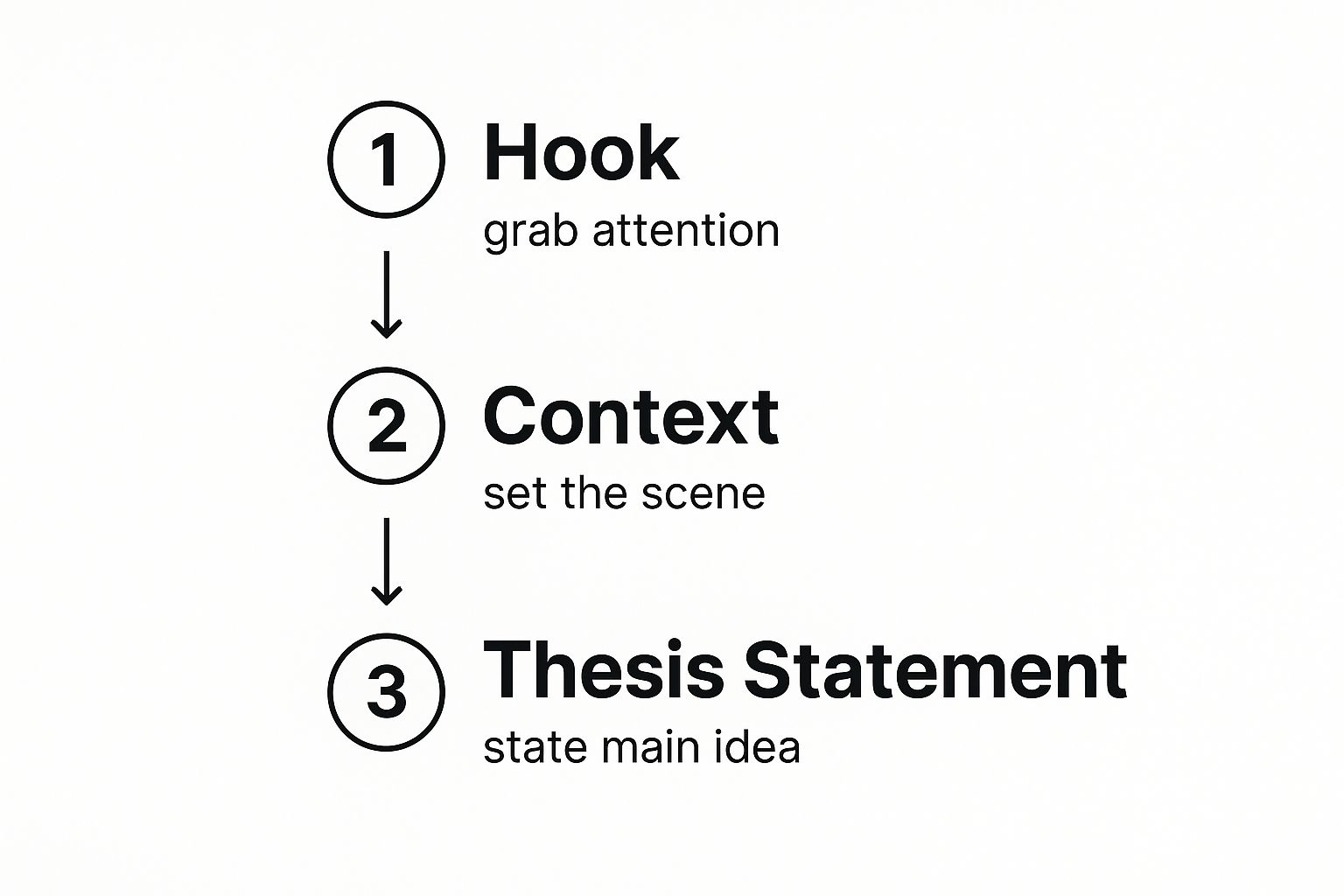
This process shows that the core of great content, whether for a blog post or its meta description, is to quickly establish relevance and promise value.
On-Page SEO Checklist for Blog Posts
To pull everything together, here’s a quick checklist to run through before you hit publish. This ensures you’ve covered all the essential on-page elements that help both readers and search engines.
| SEO Element | Best Practice | Why It Matters |
|---|---|---|
| Meta Title | Under 60 characters, keyword at the start. | Your main headline in search results; crucial for clicks. |
| Meta Description | 155-160 characters, compelling and clear. | The sales pitch that convinces users to click your link. |
| Headings (H1, H2, H3) | Use one H1; use H2s/H3s to structure content. | Breaks up text for readability and helps Google understand the hierarchy. |
| Keyword Placement | Naturally in the title, first 100 words, subheadings. | Confirms the topic for search engines without overstuffing. |
| Internal Links | Link to 2-3 other relevant posts on your site. | Passes authority between pages and keeps users on your site longer. |
| Image Alt Text | Descriptive text explaining the image content. | Improves accessibility and helps images rank in search. |
| URL Slug | Short, descriptive, and includes the main keyword. | A clean URL is user-friendly and provides another SEO signal. |
| Readability | Short paragraphs, bullet points, and simple language. | Improves user experience, reducing bounce rate and boosting engagement. |
Running through this checklist for every post might seem tedious at first, but it quickly becomes second nature and makes a massive difference to your long-term traffic and engagement.
Promote Your Content to Reach a Wider Audience

That feeling when you hit ‘publish’ is great, but it’s not the finish line. Far from it, actually. An outstanding article is worthless if nobody ever sees it, which is why smart promotion is just as crucial as the writing itself.
This isn’t about spamming links everywhere you can think of. It’s about a thoughtful strategy to get your content in front of the right people, at the right time, turning all that hard work into real traffic, leads, and authority.
Go Beyond Basic Social Sharing
Dropping a link on your social media profiles is the obvious first move, but let’s be honest, it’s rarely enough to build any real momentum. To truly expand your reach, you need to think about where your audience is actively looking for information and solutions.
Your email newsletter, for instance, is one of your most powerful assets. Unlike social media algorithms that can bury your content, an email lands directly in your subscriber’s inbox. Send out a dedicated email announcing your new post, highlighting exactly why it’s valuable and who it’s going to help.
Next up, find the relevant online communities where your people hang out. These could be:
- Niche Forums: Are you a Surrey-based IT consultant? Find forums where local business owners are discussing their tech challenges.
- Reddit Subreddits: Look for communities related to your topic (like r/smallbusinessuk). The key here is to participate genuinely before you even think about sharing your own content.
- LinkedIn or Facebook Groups: Join groups where your target audience is active and contribute to conversations. Add value first.
When you do share, don’t just post the link and run. Frame it as a helpful answer to a problem being discussion, adding context and showing its value. The goal is to be helpful, not just self-promotional. This helpful-first approach is fundamental to effective digital outreach, which is why we place it at the core of our content marketing best practices.
Repurpose Your Content for Different Platforms
Not everyone consumes content the same way. The person who loves digging into a detailed article is often different from the one who prefers a quick video summary on their phone. Repurposing your blog post lets you reach both.
Think about how you can repackage your core message:
- Twitter Thread: Turn your main headings into a punchy, easy-to-digest thread.
- Infographic: Visualise the key data points or steps from your article.
- Short Video: Create a one-minute video for Instagram Reels or YouTube Shorts that summarises the key takeaways.
Key Takeaway: Repurposing isn’t about creating more work; it’s about making your existing work go further. One core piece of content can fuel your marketing across multiple channels for weeks.
This approach multiplies the return on your initial writing effort and introduces your brand to entirely new segments of your audience who might have missed it otherwise.
Build Genuine Relationships
One of the most sustainable ways to promote your work is by building relationships with other creators and experts in your field. This isn’t about sending cold emails to hundreds of people asking for shares; it’s about building a genuine network.
Start by engaging with their content. Share their articles, leave thoughtful comments, and join in on discussions they start. When you build this kind of rapport over time, a future request for a share or a collaboration feels natural and reciprocal, not like a demand. The United Kingdom has a particularly robust blogging community, offering plenty of opportunities for local collaboration. For anyone learning how to write blog posts in this context, tapping into this network is a powerful growth strategy.
By focusing on these proactive strategies, you move from passively hoping for readers to actively creating pathways for them to find your best work.
Frequently Asked Questions About Writing Blog Posts
Even with a solid process, a few nagging questions can pop up when you’re getting into the rhythm of writing blog posts. It’s completely normal. Here are some straight-talking answers to the queries we hear most often.
1. How long should a blog post be for good SEO?
There’s no single magic number, but aiming for 1,500-2,500 words is a solid target for comprehensive, in-depth topics that you want to rank for. This length gives you enough space to cover a topic thoroughly, which search engines tend to reward. However, the most crucial factor is satisfying the reader’s intent. If a user is looking for a quick answer, a direct 800-word post is better than a rambling epic. Always match your length to the searcher’s needs.
2. How often should I publish new blog posts?
Consistency will always trump frequency. Churning out mediocre content just to hit a quota is a fast track to burnout and poor results. For a new blog, one or two high-quality, well-researched posts per week is a fantastic and sustainable goal. For established blogs, even one incredibly detailed, cornerstone article per week can maintain momentum. It’s always better to publish one article you’re genuinely proud of than three you rushed out the door.
3. What are the best ways to find new blog post ideas?
Your best ideas will almost always come directly from your audience and their problems. Stop guessing and start listening.
- Use Keyword Research Tools: Platforms like Semrush or Ahrefs are goldmines for seeing what your audience is searching for.
- Browse Online Communities: Dive into forums like Reddit and Quora to find raw, unfiltered questions people are asking in your niche.
- Ask Your Sales Team: Your customer-facing teams know the most common questions and pain points better than anyone.
- Analyse Your Competitors: See what your rivals are writing about. Look for content gaps you can fill or topics you can cover in far more detail.
4. How do I make my writing more engaging and conversational?
The simplest trick is to write like you talk. Ditch corporate jargon and use a natural tone. Break up intimidating walls of text with short paragraphs, clear subheadings, bullet points, and images. Asking direct questions (like this one!) and using relatable, real-world examples helps make abstract ideas feel more concrete and interesting. For more guidance, check out these content tips to boost your rankings and keep readers hooked.
5. Do I really need to promote my posts after publishing?
Yes, a thousand times, yes. Promotion is the crucial step that separates blogs that thrive from those that just exist. Hitting “publish” is only half the job. You need to get your new article in front of people. Share it on your social media channels, send it to your email list, and drop a link in relevant online communities where your audience hangs out. That initial push is essential for building momentum, sending positive user signals to search engines, and reaching people who don’t know you exist yet.
At GFC Tech, we specialise in creating and executing content strategies that get real results for small businesses across Surrey. If you’re ready to turn your blog into a powerful lead-generation tool, contact us today.
Adam is a Founder of GFC Tech, a company dealing in SEO and website design and development services. Adam has been an SEO expert for the past 8 years and has been working with different companies in this field. He is an SEO consultant and a marketing strategist and works closely with his clients to ensure that his marketing plans and strategies provide them with the marketing advantages they need to grow their business. Adam’s main role is an SEO consultant, but he is also involved in all technical aspects. Adam also develops WordPress websites, designs them professionally and performs SEO for them so they can rank on the first page of google.


