

- 1. Personalization and Segmentation
- 2. Mobile-First Email Design
- 3. A/B Testing and Optimization
- 4. Compelling Subject Lines and Preview Text
- 5. Email List Building and Permission-Based Marketing
- 6. Email Automation and Drip Campaigns
- 7. Deliverability and Sender Reputation Management
- 8. Clear Call-to-Action (CTA) Design
- 9. Content Value and Relevance
- 10. Timing and Frequency Optimization
- Top 10 Email Marketing Best Practices Comparison
- Putting These Practices into Action
- Frequently Asked Questions about Email Marketing
In a crowded digital marketplace, simply sending emails isn’t enough. The real challenge lies in cutting through the noise to connect with your customers in a meaningful way. It’s about building relationships, delivering genuine value, and ultimately, driving measurable growth for your business. For many small businesses in Surrey and across the South East, mastering this skill can be the difference between stagnating and thriving. This is where a focus on proven email marketing best practices becomes essential.
This guide moves beyond generic advice. We’ll provide a deep dive into 10 actionable strategies designed to transform your campaigns from standard broadcasts into powerful conversion engines. You will learn how to implement everything from advanced personalisation and mobile-first design to the critical nuances of deliverability and automation. Each point is crafted to be a practical tool, helping you enhance engagement and maximise your return on investment.
Whether you’re a local tradesperson, a startup founder, or managing a small marketing team, these principles are fundamental to building an email programme your audience actually wants to receive. They provide a clear roadmap for optimising every aspect of your email strategy. For those seeking an even more comprehensive overview to complement these practices, exploring this ultimate guide to email marketing offers a wealth of additional insights. Now, let’s get started on refining your approach.
1. Personalization and Segmentation
Gone are the days of sending a single, generic email to your entire contact list. One of the most critical email marketing best practices today is the strategic use of personalization and segmentation. This approach involves dividing your email list into smaller, more focused groups (segments) based on shared characteristics and then tailoring your message to resonate with each specific group. Instead of a one-size-fits-all broadcast, you deliver relevant, valuable content that feels like a one-to-one conversation.
This method moves beyond simply using a subscriber’s first name. True personalization leverages data about your audience, such as their location, past purchases, or how they’ve interacted with your website. For a local Surrey-based tradesperson, this could mean sending a post-winter roof maintenance offer only to customers in specific postcodes who had a new roof installed over five years ago. This targeted approach dramatically increases the chances that your message will be opened, read, and acted upon.
Why It Works and How to Implement It
The power of segmentation lies in its relevance. When a customer receives an email that directly addresses their needs or interests, it builds trust and strengthens your relationship. For example, a local wellness centre could segment its audience into groups interested in yoga, pilates, or massage, sending class updates and special offers only to the relevant members.
To get started, follow these actionable steps:
- Start with the basics: Begin by segmenting your list based on simple demographic data you likely already have, such as location (e.g., Guildford vs. Woking), or how they signed up (e.g., website contact form vs. in-store).
- Use progressive profiling: Don’t ask for too much information upfront. Gradually collect more data over time with short, simple forms or surveys within your emails to build a richer customer profile.
- Implement dynamic content: Use your email marketing software to create dynamic content blocks. This allows you to show or hide specific sections of an email based on which segment the recipient is in, so you only need to build one campaign.
The data clearly shows the benefits of adopting this strategy. The following summary box highlights the significant uplift in key metrics when campaigns are properly segmented.
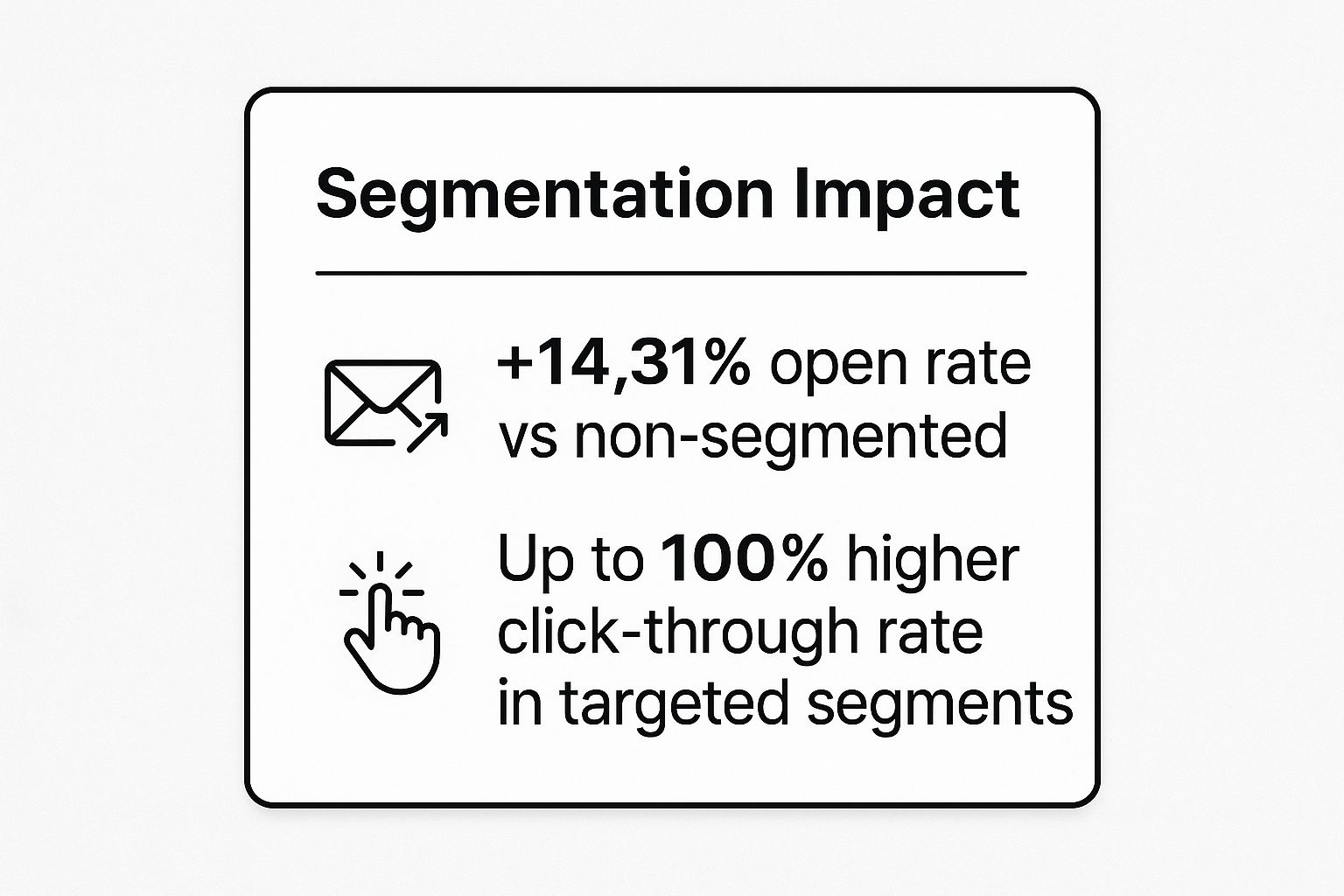
As the data illustrates, segmented campaigns not only receive substantially higher open rates but can also double your click-through rate, directly translating to more engagement and potential sales. By organising your contacts into meaningful groups, you ensure your marketing efforts are both efficient and highly effective.
2. Mobile-First Email Design
With a significant majority of emails now being opened on smartphones, adopting a mobile-first design philosophy is no longer optional; it’s essential. This approach prioritises creating emails that look and function flawlessly on smaller screens first, before ensuring they adapt correctly for larger desktop displays. Instead of designing for a desktop and shrinking it down, you build for the mobile experience from the ground up, guaranteeing readability and usability for the largest segment of your audience.

For a small business in Surrey, this means your promotional offers, newsletters, and appointment reminders must be easy to read and interact with on the go. Imagine a customer checking their emails while waiting for a coffee in Guildford; a difficult-to-read, poorly formatted message will be deleted instantly. A clean, mobile-optimised email, however, encourages engagement and drives action. This practice is closely related to the principles of responsive web design, ensuring a consistent user experience across all digital touchpoints.
Why It Works and How to Implement It
The power of mobile-first design lies in its user-centricity. By catering to the device your customers use most, you reduce friction and make it easier for them to engage with your call to action (CTA). For instance, a local restaurant sending a last-minute dinner deal can use a large, tappable button that allows a customer to book a table directly from their phone with a single click. This immediacy is key to boosting conversion rates.
To get started, follow these actionable steps:
- Embrace a single-column layout: This is the foundation of mobile-first design. It prevents horizontal scrolling and ensures your content flows logically down the screen, making it easy to scan.
- Keep subject lines concise: Aim for under 50 characters. Mobile email clients often truncate longer subject lines, so keeping them short and impactful is crucial for grabbing attention in a crowded inbox.
- Use large fonts and buttons: Ensure your body text is at least 14-16px and that buttons are at least 44x44px. This makes content legible and easy to tap with a finger, preventing accidental clicks.
- Optimise your images: Compress images to reduce their file size for faster loading times on mobile networks without sacrificing too much quality.
- Place key info “above the fold”: Your most important message and primary CTA should be visible without the need for scrolling. This ensures your core objective is immediately clear to the recipient.
3. A/B Testing and Optimization
Guesswork has no place in an effective marketing strategy. One of the most powerful email marketing best practices is A/B testing, a systematic method of comparing two versions of an email to see which performs better. Also known as split testing, this data-driven approach allows you to test variables like subject lines, send times, or calls-to-action to continuously refine and improve your campaign performance based on how your actual audience responds.
This process involves sending one version (Version A, the control) to one part of your audience, and a second version (Version B, the variation) to another. By measuring the results, such as open rates or clicks, you gain concrete evidence about what truly resonates with your customers. For example, a local restaurant in Dorking could test whether a “20% Off Your Next Meal” subject line performs better than “A Special Treat From Our Kitchen”. The winning version can then be sent to the rest of the list, maximising engagement.
Why It Works and How to Implement It
A/B testing removes assumptions and replaces them with hard data, enabling you to make incremental improvements that lead to significant gains over time. The impact can be substantial; Charity: Water famously increased donations by 60% simply by testing different subject lines to find the most compelling one. This highlights how small tweaks can yield major results.
To get started with A/B testing, follow these actionable steps:
- Isolate your variable: For a clear and reliable result, test only one element at a time. If you change both the subject line and the main image, you won’t know which change was responsible for the difference in performance.
- Focus on high-impact elements first: Begin by testing the components that have the biggest influence on results. These typically include the subject line (which impacts open rates) and the call-to-action (CTA) button or link (which impacts click-through rates).
- Ensure statistical significance: Don’t declare a winner too early. Most email marketing platforms like Mailchimp or Campaign Monitor will tell you when a test has reached statistical significance, meaning the result is reliable and not just due to random chance. You generally need a decent sample size, often at least 1,000 recipients per variant, for trustworthy results.
- Document everything: Keep a simple log of your tests, the variants, the results, and what you learned. This creates a valuable knowledge base for your business, helping you make smarter decisions in future campaigns and avoid repeating mistakes.
By adopting a consistent testing mindset, you turn every email you send into an opportunity to learn more about your audience. This iterative process of testing, learning, and optimising is fundamental to achieving long-term success with your email marketing.
4. Compelling Subject Lines and Preview Text
Your subject line and the accompanying preview text are the gatekeepers to your email content. No matter how valuable your offer or well-written your message is, it won’t matter if nobody opens it. Mastering compelling subject lines and preview text is one of the most crucial email marketing best practices because these two elements are often the only information a recipient uses to decide whether to open or delete your email.
Think of it as the headline and sub-headline of your email. The subject line must grab attention in a crowded inbox, while the preview text (the short snippet of text visible next to the subject line) provides additional context and a reason to click. A local garden centre in Guildford, for example, could use the subject “Your Garden’s Ready for Spring,” with a preview text of “Get 20% off all bedding plants this weekend only.” This combination creates relevance, urgency, and a clear value proposition before the email is even opened.
Why It Works and How to Implement It
An effective subject line works by creating a powerful first impression, sparking curiosity, or communicating an immediate benefit. It cuts through the noise of promotional offers and personal messages, convincing the user that your email is worth their time. When the preview text complements this, it reinforces the message and boosts open rates significantly.
To craft subject lines that get clicks, follow these actionable steps:
- Create urgency and curiosity: Use phrases like “Last chance,” “24 hours left,” or ask a question that makes the reader want to know the answer. For instance, a local theatre in Woking could use: “Will you be there for our final performance?”
- Keep it short and specific: Aim for 50 characters or less to ensure the full subject line is visible on mobile devices. Use numbers and specific details to make it more concrete (e.g., “3 simple ways to improve your home’s kerb appeal”).
- Test and analyse: Don’t guess what works best. Use your email platform’s A/B testing feature to try out two different subject lines on a small portion of your list and send the winner to the rest. For more specific examples and strategies, explore these tips on crafting professional email subject lines that ensure your messages stand out in a crowded inbox.
- Use emojis strategically: A well-placed emoji can add visual appeal and convey emotion, helping your email stand out. A coffee shop might use a ☕ emoji, but ensure it’s relevant and not overused.
By treating the subject line and preview text as a critical part of your campaign strategy, you directly influence the first and most important metric: your open rate. This initial engagement is the gateway to achieving your wider campaign goals, from driving traffic to generating sales.
5. Email List Building and Permission-Based Marketing
The foundation of any successful email marketing strategy isn’t the emails you send; it’s the quality of the list you send them to. This is where email list building and permission-based marketing come in. This best practice focuses on ethically and strategically growing your subscriber base by attracting genuinely interested people who explicitly consent to receive your communications. This approach is not just about compliance with regulations like GDPR; it’s about building a loyal audience that wants to hear from you.
Instead of buying lists or adding contacts without consent, which leads to low engagement and high unsubscribe rates, you focus on providing value upfront. For a local Surrey-based accountancy firm, this could mean offering a free downloadable guide on “5 Tax-Saving Tips for Small Businesses” in exchange for an email address. This ensures that every subscriber has a genuine interest in your services, making your subsequent marketing efforts far more effective.
Why It Works and How to Implement It
Permission-based marketing works because it’s built on trust and mutual interest. When someone voluntarily signs up, they are already pre-qualified and more likely to open, click, and convert. This is the core principle behind effective lead generation through digital marketing. For instance, a local fitness studio could offer a free trial class pass via a popup on their website, attracting potential members who are actively seeking fitness solutions in the area.
To build a high-quality list, follow these actionable steps:
- Create compelling lead magnets: Offer valuable resources that solve a problem for your target audience. This could be a checklist, a how-to guide, a template, or an exclusive discount. The key is to make it relevant and irresistible.
- Optimise signup forms: Place clear, simple signup forms in high-traffic areas of your website, such as the homepage, blog posts, and footer. Use social proof like “Join 500+ other local businesses” to build trust and encourage signups.
- Use targeted popups: Implement well-timed exit-intent popups to capture the attention of visitors before they leave your site. Offering a last-minute discount or a helpful resource can be a powerful way to convert them into subscribers.
- Clean your list regularly: Periodically remove inactive or unengaged subscribers. This practice, known as list hygiene, improves your sender reputation, boosts deliverability, and ensures your metrics accurately reflect the engagement of your interested audience.
By focusing on attracting subscribers who want to be there, you’re not just growing a list; you’re building a community around your brand, leading to higher open rates, better engagement, and ultimately, more business.
6. Email Automation and Drip Campaigns
Moving beyond single campaigns, one of the most powerful email marketing best practices is embracing email automation and drip campaigns. This involves setting up systematic, pre-written email sequences that are automatically sent to subscribers based on specific triggers or a set timeline. Instead of manually sending every email, you can nurture leads, onboard new customers, and re-engage dormant contacts with timely, relevant messages that guide them through their journey with your business.
This approach allows you to maintain consistent communication without constant effort. For a local business, this is a game-changer. Imagine a potential client downloads a guide from your website; an automated sequence can follow up with more helpful tips, a case study, and finally, an offer for a consultation. This hands-off nurturing process builds trust and keeps your brand top-of-mind, converting prospects into customers while you focus on running your business.
Why It Works and How to Implement It
Automation works because it delivers the right message at the right time, triggered by a customer’s own behaviour. This relevance makes the communication feel personal and helpful, not intrusive. For example, a local gym in Woking could have an automated welcome series for new members that introduces facilities, class schedules, and personal training options over their first week. This ensures every new member has a consistent, positive onboarding experience.
To get started with automation, follow these actionable steps:
- Map the customer journey: Before writing a single email, sketch out the key touchpoints a customer has with your business, from initial enquiry to post-purchase follow-up. Identify where an automated email could add value.
- Start with a simple workflow: Don’t try to build a complex, multi-branching sequence from day one. Begin with a straightforward welcome series for new subscribers or an abandoned cart reminder for your online shop.
- Personalise beyond the name: Use the data you have to make your automated emails more relevant. You can trigger different sequences based on the service or product a customer showed interest in, ensuring the content directly addresses their needs.
Well-executed automation not only saves significant time but also drives engagement and revenue by ensuring no lead is left behind.
By setting up these “always-on” marketing flows, you create a scalable system for building customer relationships. Regularly review the performance of your automated campaigns and tweak the content or timing to continuously improve results, ensuring your email marketing efforts are working for you 24/7.
7. Deliverability and Sender Reputation Management
Even the most brilliantly crafted email is useless if it never reaches the subscriber’s inbox. This is where deliverability and sender reputation management become fundamental. This practice covers the technical and strategic actions you take to ensure your emails land in the inbox, not the spam folder. It’s about building trust with Internet Service Providers (ISPs) like Gmail and Outlook by proving you are a legitimate, responsible sender.
Your sender reputation is like a credit score for your email address. Sending relevant, engaging content to a clean list improves your score, while high bounce rates or spam complaints damage it. For a Surrey-based estate agent, maintaining a high reputation ensures their new property alerts are seen by keen buyers, rather than being filtered out as junk. Mastering this aspect of email marketing best practices is non-negotiable for long-term success.
Why It Works and How to Implement It
A strong sender reputation directly influences your inbox placement rate. ISPs use this score to decide whether to deliver your emails, and a good reputation means your messages are prioritised. This builds a reliable communication channel, ensuring your audience consistently receives your valuable updates, offers, and news, which in turn protects your marketing investment.
To effectively manage your deliverability, implement these actionable steps:
- Authenticate your domain: Set up SPF, DKIM, and DMARC records for your sending domain. These are like a digital passport, verifying to ISPs that your emails are genuinely from you and have not been forged.
- Maintain list hygiene: Regularly clean your email list by removing inactive subscribers and invalid addresses. This reduces bounce rates and signals to ISPs that you manage your audience responsibly.
- Warm up your IP: If you’re a new sender or using a new dedicated IP address, start by sending small volumes of emails and gradually increase them. This gradual process, used by platforms like SendGrid, builds a positive sending history.
- Monitor engagement: Pay close attention to open rates, click-through rates, and unsubscribe rates. Low engagement can harm your reputation, so focus on sending content your audience wants to interact with.
8. Clear Call-to-Action (CTA) Design
Every email you send should have a purpose, and the Call-to-Action (CTA) is the bridge between that purpose and your reader’s action. A clear Call-to-Action (CTA) design is one of the most vital email marketing best practices because it explicitly tells your audience what you want them to do next. It’s the strategic placement, compelling copy, and visual design of action-oriented buttons or links that guide recipients towards a conversion, whether that’s booking a service, visiting your website, or downloading a guide.
Without a strong CTA, even the most well-written email will fail to produce results. Think of it as the final, crucial instruction in your message. For a local Surrey tradesperson, this could be a brightly coloured button that says “Get Your Free Quote” or “Book Your Boiler Service Now”. It removes any ambiguity and makes it incredibly simple for your potential customer to take the next step. Companies like Netflix and Spotify are masters of this, using unmissable “Watch Now” or “Listen Now” buttons to drive immediate engagement.
Why It Works and How to Implement It
A powerful CTA works because it leverages basic psychological principles: it creates a clear path and reduces cognitive load, making it easy for the user to make a decision. When a button stands out visually and uses direct, action-oriented language, it naturally draws the eye and encourages a click. A local restaurant in Guildford, for instance, could use a “Book Your Table” CTA in their weekly specials email, which is far more effective than a simple text link.
To design CTAs that convert, follow these actionable steps:
- Use action-oriented verbs: Start your CTA with a command verb that tells the user exactly what will happen. Use words like ‘Shop’, ‘Register’, ‘Download’, or ‘Book’ instead of passive phrases like ‘Click Here’.
- Design for visibility: Make your CTA a button with a contrasting colour that stands out from the email’s background. Ensure it’s large enough to be easily tapped on a mobile device, with a recommended minimum size of 44×44 pixels.
- Create a sense of urgency: Encourage immediate action by incorporating phrases like ‘Shop the Sale Now’, ‘Offer Ends Friday’, or ‘Limited Spaces Available’. This can significantly boost click-through rates.
- Focus on a single, primary CTA: While you can have secondary links, your email should guide users towards one main action. This avoids decision paralysis and keeps your message focused and powerful.
9. Content Value and Relevance
At its core, every email you send is an interruption. The most crucial of all email marketing best practices is ensuring that this interruption is welcome by providing genuine content value and relevance. This strategy shifts the focus from purely promotional messages to delivering content that educates, entertains, or solves a problem for your subscribers. It’s about building a relationship based on trust and expertise, not just transactions.
For a small business, this means becoming a go-to resource. For instance, a Surrey-based accountant could send a monthly email with timely tax tips for sole traders or a guide to claiming business expenses. This positions them as a helpful expert, making them the first choice when a subscriber needs professional accounting services. Instead of just selling, you are consistently proving your worth.
Why It Works and How to Implement It
Valuable content keeps your audience engaged and reduces unsubscribe rates because they gain something from every interaction. This approach transforms your email list from a simple sales channel into a loyal community. When subscribers know your emails contain useful information, like Home Depot’s seasonal DIY project guides, they are far more likely to open them consistently.
To deliver exceptional value, consider these actionable steps:
- Follow the 80/20 rule: Aim for 80% of your content to be purely valuable (tips, guides, news, insights) and only 20% to be promotional. This balance prevents subscriber fatigue.
- Use storytelling: Share case studies or behind-the-scenes content. A local tradesperson could share a story about a challenging project and how they solved it, making their service more relatable and authentic.
- Create a content series: Build anticipation by developing a multi-part series, such as a “Weekly Website Tip” or a “Monthly Marketing Myth-Busting” segment. This encourages subscribers to look forward to your next email.
- Curate relevant news: Act as a filter for your audience. A local B2B service provider could curate the most important local business news, saving their subscribers time and effort.
By prioritising the needs of your audience, you build brand equity and create a more receptive environment for your promotional messages when you do send them. This strategy is a cornerstone of effective content marketing for business growth, turning your email list into a significant business asset.
10. Timing and Frequency Optimization
Sending the perfect email means nothing if it arrives at the wrong time or too often. One of the most impactful email marketing best practices is timing and frequency optimisation. This strategy involves strategically determining when and how often to send emails to maximise engagement while avoiding subscriber fatigue. It’s about meeting your audience where they are, in their own time, rather than just broadcasting on your schedule.
This approach requires you to analyse your audience’s behaviour, test different send times, and adapt based on performance data. For a B2B service provider in Guildford, this might mean sending emails between Tuesday and Thursday mornings when professionals are actively checking their inboxes. In contrast, a local restaurant in Woking might find that sending weekend special offers on a Friday evening yields the best results as people plan their leisure time. It’s about aligning your communication rhythm with your customer’s daily life.
Why It Works and How to Implement It
The power of optimal timing and frequency lies in its respect for the subscriber’s inbox. When your email arrives at a convenient moment, it feels less like an interruption and more like a helpful reminder or a welcome offer. This builds goodwill and significantly increases the likelihood of opens and clicks. For instance, a local fitness studio could time motivational workout reminders for early mornings, catching members when they are most likely to plan their day.
To get started, follow these actionable steps:
- Test systematically: Don’t guess. Run A/B tests on different days and times. Send one campaign to a segment at 9 AM and the same campaign to another segment at 2 PM, then compare the results to find your sweet spot.
- Consider audience lifestyle: Think about your ideal customer’s routine. A tradesperson targeting homeowners might get better engagement in the evenings, while an accountant targeting other businesses will succeed during office hours.
- Monitor engagement patterns: Use your email platform’s analytics to identify when your subscribers are most active. Most tools, like Mailchimp or Campaign Monitor, provide reports that highlight the best-performing send times based on your historical data.
- Let subscribers choose: Add a link to a preference centre in your email footer. Allowing users to choose if they want weekly or monthly updates respects their autonomy and drastically reduces unsubscribe rates.
Top 10 Email Marketing Best Practices Comparison
| Item | Implementation Complexity | Resource Requirements | Expected Outcomes | Ideal Use Cases | Key Advantages |
|---|---|---|---|---|---|
| Personalization and Segmentation | High – requires data management and tools | Advanced email marketing tools, data collection | Higher open & click rates, reduced unsubscribes | Targeted campaigns, customer retention | Increased engagement and brand loyalty |
| Mobile-First Email Design | Medium – needs responsive design skills | Design expertise, device testing | Improved mobile engagement and accessibility | Mobile-heavy audiences, omni-channel marketing | Better UX on mobile, higher engagement rates |
| A/B Testing and Optimization | Medium to high – requires testing setup | Tools for split testing, analytics | Data-driven improvements, higher ROI | Campaign performance enhancement | Reduced guesswork, continuous optimization |
| Compelling Subject Lines and Preview Text | Low to medium – creative and testing effort | Content creation, testing tools | Higher open rates, better initial engagement | All email campaigns | Cost-effective, impactful on open rates |
| Email List Building and Permission-Based Marketing | Medium – requires strategy & compliance | Lead magnets, signup optimizations | Higher engagement, legal compliance | Long-term subscriber growth | Better deliverability, qualified leads |
| Email Automation and Drip Campaigns | High – complex setup with triggers | Marketing automation platforms | Scalable, timely communication, improved conversion | Lead nurturing, customer journey management | 24/7 engagement, resource efficiency |
| Deliverability and Sender Reputation Management | High – technical expertise needed | Technical setup and monitoring | Higher inbox placement, reduced spam risk | All email programs with deliverability focus | Better sender reputation, increased ROI |
| Clear Call-to-Action (CTA) Design | Low to medium – design and copywriting | Design resources, testing | Increased click-through and conversion rates | Promotional and conversion-driven emails | Direct conversion impact, measurable performance |
| Content Value and Relevance | Medium – ongoing content creation | Content marketing resources | Higher engagement, trust, and long-term loyalty | Educational and relationship-building emails | Builds authority, reduces unsubscribes |
| Timing and Frequency Optimization | Medium – requires data analysis & testing | Analytics tools, audience insights | Improved engagement and reduced fatigue | Campaign scheduling and list management | Efficient resource use, better user satisfaction |
Putting These Practices into Action
We have journeyed through ten foundational pillars of modern email marketing, from the granular details of subject line psychology to the strategic architecture of automated campaigns. It can feel like a lot to absorb, especially when you are busy running your business. However, the key is not to attempt to master everything overnight but to embrace a philosophy of continuous, incremental improvement. The most successful email marketing programmes are not built in a day; they are carefully cultivated over time, one refined practice at a time.
The core message connecting all these strategies is a shift in perspective. Instead of viewing email as a simple broadcast channel, think of it as a tool for building genuine relationships. Every practice we’ve discussed, whether it’s meticulous list segmentation, creating truly valuable content, or respecting inbox permissions, is rooted in this principle. When you prioritise your audience’s experience, the metrics you care about, from open rates to conversions, will naturally follow. Adopting these email marketing best practices is less about ticking boxes and more about committing to a customer-centric approach that builds trust and loyalty.
Your Actionable Roadmap to Email Excellence
To avoid feeling overwhelmed, we recommend a focused, step-by-step approach. Rather than trying to overhaul your entire strategy at once, select one or two areas from this guide that feel most achievable or offer the biggest potential return for your specific business.
Consider this your starting plan:
- For the next month: Focus solely on A/B testing your subject lines (Practice #4). Run a simple test for every campaign you send. This single habit can quickly reveal what captures your audience’s attention and deliver immediate improvements in open rates.
- For the next quarter: Commit to improving your mobile-first design (Practice #2). Review your email templates on different devices. Are they easy to read and interact with on a small screen? Making simple adjustments, like increasing font size and ensuring your CTAs are “thumb-friendly,” can dramatically improve engagement for your on-the-go customers.
- Within the next six months: Plan and launch your first simple automation sequence (Practice #6). A basic three-part welcome series for new subscribers is an excellent starting point. It works tirelessly in the background to nurture new leads, introduce your brand, and set the stage for a long-term relationship.
By breaking down these comprehensive email marketing best practices into manageable, time-bound goals, you transform a daunting list into a clear, actionable plan for growth.
Frequently Asked Questions about Email Marketing
To help you on your journey, here are answers to some common questions we hear from businesses in Surrey and beyond.
1. How often should I email my list?
There is no single correct answer, as it depends entirely on your audience and industry. The key is consistency and value. Start by testing a frequency, perhaps once a week or fortnightly, and closely monitor your engagement metrics (opens, clicks) and unsubscribe rates. If engagement is high and unsubscribes are low, you might test a higher frequency. If you see fatigue setting in, scale it back. Always prioritise quality over quantity.
2. What is a good open rate for my industry?
Open rates vary significantly across industries. For example, a local tradesperson might see different benchmarks than a retail shop. Generally, an open rate between 20-30% is considered healthy for most small businesses. However, instead of chasing a specific number, focus on improving your own baseline. Consistent A/B testing and better segmentation are the most reliable ways to increase your unique open rate over time.
3. Can I still build a list if I don’t have much website traffic?
Absolutely. Leverage every customer touchpoint. You can collect permissions in-person at your shop or office, via a QR code on your business cards or van, or through a sign-up form on your Google Business Profile. Social media competitions or offering a valuable lead magnet (like a checklist or guide) are also excellent ways to attract subscribers even with lower website traffic.
4. Is email marketing still effective with the rise of social media?
Yes, more than ever. Email marketing offers a direct, personal line of communication to an audience that has explicitly given you permission to contact them. Unlike social media, you own your email list and are not subject to the whims of algorithms that can limit your reach. It consistently delivers one of the highest returns on investment of any digital marketing channel.
5. How do I make sure my emails don’t end up in the spam folder?
Maintaining a good sender reputation is crucial (Practice #7). Key actions include using a reputable email service provider, always getting explicit permission before adding someone to your list (no purchased lists!), keeping your list clean by regularly removing inactive subscribers, and avoiding “spammy” tactics like excessive capital letters or misleading subject lines.
Navigating the nuances of email marketing can be a significant undertaking for a time-poor business owner. If you’re a local business in Surrey or the South East looking for a trusted partner to implement these best practices and turn your email list into a powerful lead generation engine, GFC Tech is here to help. We specialise in creating and managing results-driven digital marketing strategies that build lasting customer relationships.
Learn more about our digital marketing services at GFC Tech
Adam is a Founder of GFC Tech, a company dealing in SEO and website design and development services. Adam has been an SEO expert for the past 8 years and has been working with different companies in this field. He is an SEO consultant and a marketing strategist and works closely with his clients to ensure that his marketing plans and strategies provide them with the marketing advantages they need to grow their business. Adam’s main role is an SEO consultant, but he is also involved in all technical aspects. Adam also develops WordPress websites, designs them professionally and performs SEO for them so they can rank on the first page of google.


