

Technical SEO is all about optimising the bits of your website that most people never see. It’s the backend work, the digital plumbing and wiring, that helps search engines like Google find, understand, and rank your pages more effectively.
Building Your Website on a Solid Foundation
Imagine your website is a brand-new house. You can fill it with beautiful furniture (that’s your content) and decorate it perfectly (that’s your on-page design), but what happens if the foundations are cracked? Or if the wiring is dodgy and the doors are impossible to find? No one will want to visit. Crucially, search engine crawlers won’t be able to properly explore it and assess its value.
Technical SEO is the work of an expert builder making sure your website’s structure is flawless. It’s less about the words on the page and much more about the invisible architecture holding everything up. Before we dive into the nuts and bolts, it helps to see how this fits into the bigger picture of Search Engine Optimization (SEO).
Essentially, technical SEO ensures there are no roadblocks stopping search engines from accessing and understanding your content. It’s the groundwork that makes all your other SEO efforts count.
Without this solid base, even the most brilliant blog post or slickest product page can remain completely invisible online. The main goals are to improve three key areas:
- Crawlability: How easily can search engine bots explore your site?
- Indexing: How well are your pages stored and organised in Google’s library?
- User Experience: How fast, secure, and easy to use is your site for actual visitors?
Why a Strong Technical Foundation Matters
So, why should you care about what’s happening behind the scenes? It’s simple: a technically sound website has a direct impact on your bottom line. Search engines like Google now prioritise user experience above almost everything else.
A fast, secure, and easily navigable site keeps your visitors happy and engaged. This lowers your bounce rate when people leave after viewing just one page and signals to Google that your site offers real value. More importantly, strong technical SEO ensures that search engines can actually find and understand your content in the first place.
Without that clarity, your best pages might as well be invisible. Neglecting the technical side is a sure-fire way to end up with lost traffic and frustrated users.
The Cost of a Poor Foundation
Imagine launching a beautiful new product page, only to find out a simple coding error has blocked Google from ever seeing it. No matter how brilliant your content is, it won’t appear in search results. This isn’t a rare scenario; it’s a common consequence of poor technical health that leads to zero return on your content investment.
Slow loading times are another classic example. Studies have shown that a delay of just a few seconds can cause a huge chunk of your visitors to give up and leave. Each lost visitor is a potential lost sale.
A solid technical setup isn’t just about pleasing search engines; it’s about creating a smooth and reliable experience for your human visitors, which is essential for achieving your digital marketing goals.
For businesses serious about building a robust online presence, investing in a professional technical SEO service is often the first and most critical step towards sustainable growth.
Understanding the Core Pillars of Technical SEO
To really get to grips with technical SEO, we need to break it down into its core components. Think of these as the essential systems that keep your website running smoothly for both your visitors and the search engines trying to understand it. When these elements are properly tuned, your site gets faster, becomes more trustworthy, and is far easier for Google to make sense of.
Each pillar has a specific job, from making sure search engine bots can find all your pages to giving visitors a secure browsing experience. Let’s unpack the most important ones.
Crawlability and Indexing: The Digital Map
Before Google can even think about ranking your website, it has to find it first. This all starts with crawlability how easily a search engine’s bots can navigate through your site’s pages and follow the links between them. If your site is a maze of broken links or has confusing navigation, these bots can easily get lost, and pages get missed.
Once a page is successfully crawled, it moves on to indexing. This is like adding a new book to a massive library. Google analyses the page’s content and stores it in its database. A well-organised, logically structured site makes this whole process seamless.
An XML sitemap is like a detailed map you hand directly to the search engine. It lists every important page, making sure the delivery driver (Googlebot) can find every single address without missing any stops.
As this infographic shows, your site’s architecture provides the blueprint for this map, guiding both users and crawlers efficiently.
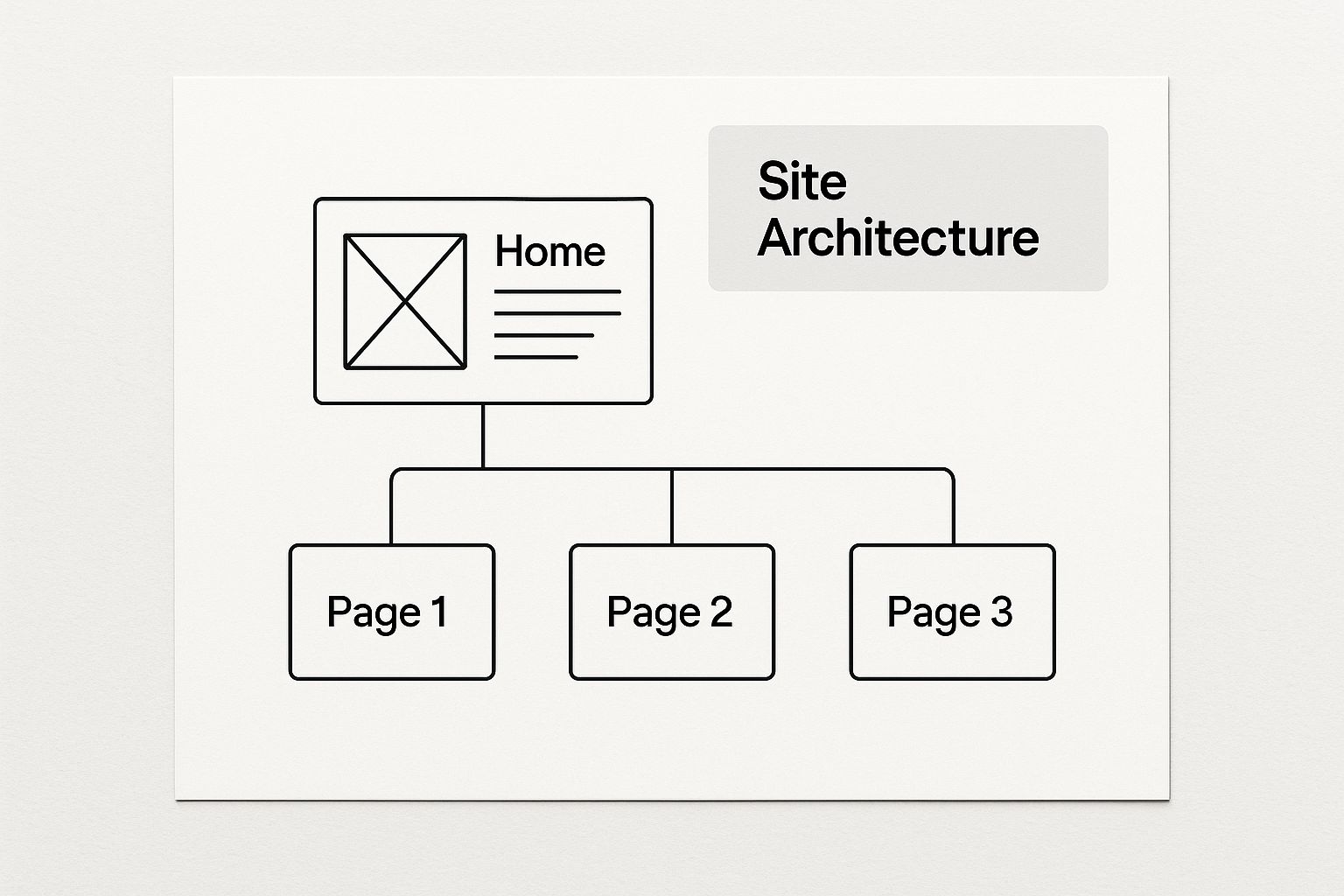
It’s clear from this that a logical structure is the absolute backbone of any technically sound website.
Site Speed and Security: The User Experience Essentials
People today expect websites to load in the blink of an eye. Site speed is a confirmed ranking factor for a simple reason: a slow website creates a frustrating user experience, causing visitors to give up and leave. Simple fixes like optimising images and cleaning up code can make a dramatic difference to your loading times.
Just as important is security. A site using HTTPS encrypts the data shared between a visitor’s browser and your website, keeping their information safe. Search engines actively favour secure sites, and modern browsers will often warn users away from any that are insecure.
These factors are vital, yet it’s surprising how many sites get them wrong. For instance, technical SEO in the UK is a significant challenge; over 88% of UK domains face issues with HTTP to HTTPS redirects, which hurts both security and search rankings.
To see the real-world impact of getting these elements right or wrong take a look at this comparison.
Technical SEO Health Good vs Poor
| Technical Element | Good Implementation (Optimised Site) | Poor Implementation (Unoptimised Site) |
|---|---|---|
| Site Speed | Pages load in under 2.5 seconds, keeping users engaged. | Pages take over 4 seconds to load, causing high bounce rates. |
| Security | Uses HTTPS sitewide, displaying a padlock icon in the browser. | Lacks HTTPS, showing “Not Secure” warnings to visitors. |
| Mobile-Friendliness | The layout adapts perfectly to any screen size. | Content is difficult to read and navigate on a smartphone. |
| Site Architecture | A clear, logical structure that is easy to navigate. | Disorganised pages with a confusing or non-existent menu. |
As you can see, the difference between a well-optimised site and a neglected one is night and day, impacting everything from user trust to your bottom line.
Getting these technical elements right is fundamental to online success. Our guide on why technical SEO is important offers more depth on how all these pieces fit together.
Using Schema Markup to Speak Google’s Language
Ready to get a bit more advanced with your technical SEO? Let’s talk about structured data, often called schema markup. Think of it as a secret language that lets you whisper hints directly to search engines.
Without it, Google has to guess what your content is all about. With schema, you’re explicitly telling it, “This is a recipe with a 5-star rating,” “This is a product that costs £25,” or “This is an event happening next Tuesday.” It takes all the guesswork out of the equation.

Making Your Content Stand Out
This clarity helps search engines create rich snippets those eye-catching extras like star ratings, prices, and cooking times that you see right in the search results. A listing with these details is far more tempting to click on than a standard blue link.
In fact, UK featured snippets, which are often powered by schema, can achieve an incredible 42.9% click-through rate. It’s not uncommon for UK sites using schema to see their click-through rates jump by around 40% compared to those without it.
By implementing schema markup, you’re giving search engines the context they need to showcase your content properly, which is especially powerful when you combine it with various local schema SEO tactics.
Your First Technical SEO Audit Checklist
Right, it’s time to roll up your sleeves and put some of this theory into practice. This isn’t about becoming an expert overnight; it’s about running a few simple checks to get a feel for your website’s technical health. Best of all, you can do this with free, easy-to-use tools.

This process will help you spot some quick wins and start building a solid plan for improvement. Let’s get you started.
Core Audit Steps
- Check Site Speed: Head over to Google’s PageSpeed Insights. Just pop in your website URL, and it’ll spit out a performance score with suggestions for both mobile and desktop. You’re aiming for a “Good” score (90-100) on Core Web Vitals.
- Verify Mobile-Friendliness: Use Google’s Mobile-Friendly Test to see if your site plays nicely on smartphones. With most people browsing on their phones these days, this is non-negotiable.
- Confirm HTTPS Security: Take a quick look at your website’s address in your browser. Do you see that little padlock icon? That means your site is secure with an SSL certificate. If it’s not there, fixing this should be your top priority.
- Review Index Status: Go to Google and type in “site:yourdomain.co.uk” (swapping in your actual domain, of course). This will give you a rough idea of how many pages Google has in its index. If the number seems shockingly low, you might have a crawlability issue on your hands.
For a more detailed walkthrough, our comprehensive technical SEO audit checklist provides an expanded list of steps to follow.
Common Questions About Technical SEO
Even with a clear understanding of the basics, diving into the nuts and bolts of technical SEO can bring up a few tricky questions. Here, we tackle some of the most common queries, giving you straightforward answers to help you keep your website’s foundation in top shape.
How Often Should I Perform a Technical SEO Audit?
For most websites, a comprehensive technical audit every three to six months is a good rule of thumb. That said, you should keep a closer eye on critical metrics like site speed, checking them more regularly.
A full, deep-dive audit is non-negotiable before and after a major site redesign or migration to a new platform. This is your insurance policy against sudden traffic drops and helps make sure the transition goes off without a hitch.
Can I Do Technical SEO Myself or Do I Need an Expert?
You can absolutely handle many of the basics yourself, especially with today’s user-friendly platforms. Tasks like fixing broken links, compressing images to improve load times, or updating your sitemap are perfectly manageable for most business owners.
However, when you run into more complex issues think cryptic server errors, advanced schema markup, or deep-rooted crawlability problems calling in a technical SEO specialist is a smart move. Trying to fix these without the right expertise can sometimes make things worse.
What Is the Difference Between Technical and On-Page SEO?
Let’s go back to our house analogy for a moment. Technical SEO is the very foundation of your house, along with the plumbing and electrical wiring. It makes the whole structure functional, safe, and easy for people (and search engines) to get around in.
On-page SEO, on the other hand, is the interior design. It’s the paint on the walls, the furniture in the rooms, and the art you hang up in other words, the keywords, content, and images that make each page valuable and appealing. You need both to have a house anyone wants to visit.
Will Technical SEO Guarantee a Number One Ranking?
No single part of SEO can guarantee a number one spot on its own. Think of technical SEO as the essential groundwork. It’s what allows your fantastic content, smart keyword strategy, and hard-earned backlinks to actually be seen and properly valued by search engines. It’s a vital piece of a much larger puzzle.
How Important Is Site Speed for My Rankings?
In a word: incredibly. Site speed is a confirmed Google ranking factor, and for good reason. A slow website frustrates visitors, leading them to click away in seconds (this is what we call a high bounce rate).
Google sees this poor user experience as a major negative signal. So, by speeding up your site, you’re not just pleasing your visitors you’re directly signalling to Google that your site is a quality destination, which helps boost your rankings.
At GFC Tech, we provide expert technical SEO services to ensure your website’s foundation is built for success. Contact us today to see how we can help your Surrey business thrive online.
Adam is a Founder of GFC Tech, a company dealing in SEO and website design and development services. Adam has been an SEO expert for the past 8 years and has been working with different companies in this field. He is an SEO consultant and a marketing strategist and works closely with his clients to ensure that his marketing plans and strategies provide them with the marketing advantages they need to grow their business. Adam’s main role is an SEO consultant, but he is also involved in all technical aspects. Adam also develops WordPress websites, designs them professionally and performs SEO for them so they can rank on the first page of google.


